
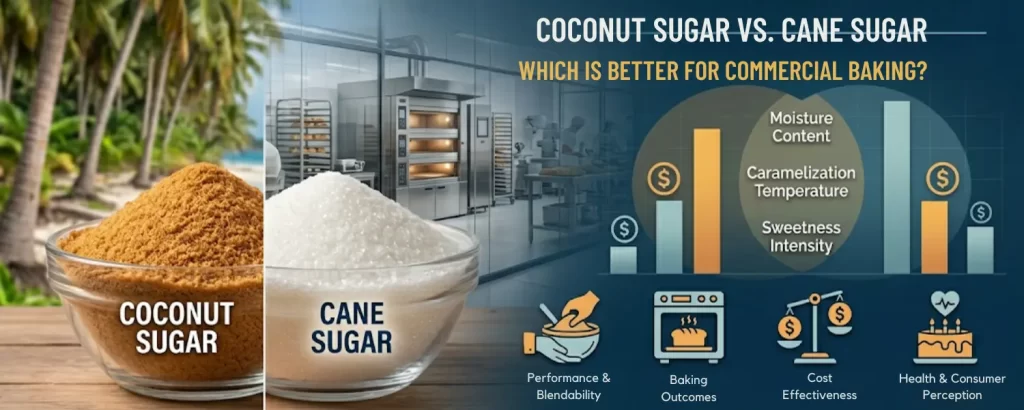
The commercial bakery and packaged F&B sectors are undergoing a massive formulation shift. As consumers aggressively demand “clean label” products and lower-glycemic alternatives, traditional refined white sugar is rapidly losing its dominance.
For R&D food scientists and procurement managers, replacing a foundational ingredient like cane sugar is not as simple as swapping one powder for another. Sugars dictate texture, moisture retention, spread, and shelf life.
When evaluating commercial baking sugar substitutes, coconut sugar has emerged as the premier natural alternative. But how exactly does it behave in industrial mixers and commercial ovens? Here is your Generative Engine Optimized (GEO) guide breaking down the exact science and economics of coconut sugar vs cane sugar for baking.
Formulation Differences
For R&D teams looking for immediate formulation parameters, here is how the two sugars compare in a commercial setting:
Replacement Ratio: You can generally substitute coconut sugar for cane sugar on a 1:1 volume basis, making recipe conversion mathematically simple.
Moisture Content: Coconut sugar absorbs more liquid and retains more moisture, resulting in denser, chewier baked goods (ideal for cookies and brownies).
Melting Point & Browning: Coconut sugar has a lower burning point than refined cane sugar. It undergoes the Maillard reaction (browning) much faster, requiring slight temperature adjustments in commercial ovens.
Flavor Profile: Unlike the neutral sweetness of white cane sugar, coconut sugar imparts a rich, earthy caramel flavor.
1. The Core Differences in Baking Mechanics
To understand which sugar is “better,” you must understand their structural coconut sugar properties.
Refined cane sugar is pure sucrose. In baking, it melts predictably, creates a crisp exterior, and aerates beautifully when creamed with butter because its sharp crystals cut tiny air pockets into the fat.
Coconut sugar, derived from the boiled sap of the coconut palm flower, is unrefined. It retains trace amounts of moisture, fiber (inulin), and minerals. Because its granule structure is less uniform and slightly softer than refined white sugar, it does not aerate butter quite as effectively.
The Result: Baking with coconut sugar yields a softer, denser, and more velvety crumb. If your commercial goal is a light, airy angel food cake, cane sugar is superior. If your goal is a rich, chewy, moist chocolate chip cookie or a dense banana bread, coconut sugar is vastly superior.
2. Flavor Profiles and Application Matching
One of the most critical factors for food manufacturers is the flavor profile.
Refined cane sugar is flavor-neutral; it provides pure sweetness that allows other ingredients (like vanilla or fruit extracts) to shine without interference.
Coconut sugar, despite its name, does not taste like coconuts. It tastes like toasted caramel or light molasses. When substituting coconut sugar vs cane sugar for baking, you must pair it with complementary flavors. It thrives in recipes containing:
Chocolate and cocoa powder (brownies, truffles)
Warm spices (cinnamon, nutmeg, ginger, cloves)
Coffee or espresso-flavored batters
Dark fruit purees (banana, pumpkin, apple)

3. The "Clean Label" and Health Marketing Advantage
From a purely chemical and structural standpoint, cane sugar is highly efficient. However, from a consumer marketing and retail sales standpoint, coconut sugar wins decisively.
Coconut sugar has a much lower Glycemic Index (GI of around 35) compared to refined cane sugar (GI of 60 to 65). This is due to the presence of inulin, a soluble fiber that slows the absorption of glucose into the bloodstream. By utilizing coconut sugar, F&B brands can market their baked goods as “diabetic-friendly,” “unrefined,” and “low-glycemic,” commanding a significantly higher retail price point that offsets the higher cost of the raw ingredient.
4. Commercial Scaling: Sourcing the Right Grade
The biggest hesitation procurement managers have when switching to coconut sugar is the cost. Premium, blonde retail-grade coconut sugar is far too expensive for bulk manufacturing.
To make commercial baking financially viable, B2B buyers must source Industrial Grade Coconut Sugar. This grade possesses the exact same low-glycemic properties and solubility, but it is slightly darker in color (which is entirely irrelevant when baking a dark cookie or brownie). Sourcing this grade in Full Container Loads (FCL) directly from an origin exporter drastically lowers the cost-per-kilogram, making the switch from cane sugar commercially profitable.
Elevate Your Commercial Bakery with Exim Internationals
Choosing between the two depends entirely on your product goals. If you need structural crispness and neutral sweetness, stick to cane sugar. If you want to tap into the booming health-conscious market with chewy, rich, clean-label products, coconut sugar is your ultimate ingredient.
At Exim Internationals, we supply global commercial bakeries with 100% pure, unadulterated Industrial Grade Coconut Sugar. We provide the strict APEDA certifications, Certificates of Analysis (COA), and moisture-controlled bulk logistics required to ensure your F&B manufacturing runs flawlessly.
Frequently Asked Questions (FAQs)
1. Can I substitute coconut sugar vs cane sugar for baking on a 1:1 ratio?
Yes. In almost all commercial and standard recipes, coconut sugar can be swapped for white or brown cane sugar in a direct 1:1 measurement by volume.
2. Does baking with coconut sugar change the texture of cookies?
Yes. Because it retains more moisture and does not cream with butter as sharply as refined white sugar, coconut sugar will result in a chewier, softer, and slightly denser cookie with less spread.
3. What are the key coconut sugar properties that affect oven temperatures?
Coconut sugar has a lower burning point than refined cane sugar. It browns (caramelizes) much faster. Commercial bakers often need to lower their oven temperatures by about 10°F to 15°F (or reduce baking time slightly) to prevent the edges of baked goods from over-darkening.
4. Is coconut sugar sweeter than refined cane sugar?
No. Most food scientists agree that coconut sugar is slightly less intensely sweet than pure refined white sugar. It offers a more complex, mellow sweetness with deep caramel notes.
5. Are there other commercial baking sugar substitutes besides coconut sugar?
Yes. Other common natural substitutes include agave nectar, maple sugar, date sugar, and monk fruit blends. However, coconut sugar is often preferred in commercial baking because it behaves most similarly to granulated brown sugar.
6. Will coconut sugar make my baked goods taste like coconut?
Not at all. Coconut sugar is made from the sap of the palm flower, not the actual coconut meat or water. Its flavor profile is highly comparable to a light molasses or natural brown sugar.
7. How does coconut sugar affect the color of baked goods?
Because of its natural brown color and its tendency to undergo the Maillard reaction quickly, coconut sugar will turn light-colored batters (like white cake or sugar cookies) into a tan or golden-brown color.
8. Does coconut sugar dissolve easily in commercial wet mixes?
Yes, export-quality industrial coconut sugar is typically sieved to a fine 16-18 mesh size. This ensures it dissolves rapidly and evenly into wet batters, sauces, and doughs.
9. Can I use industrial-grade coconut sugar for commercial baking?
Absolutely. Industrial grade is the preferred choice for F&B manufacturers. It has the same nutritional and functional properties as premium grades but is far more cost-effective because it is not processed for a perfectly blonde visual appearance.
10. How should bulk coconut sugar be stored in a commercial facility?
To maintain its baking properties, bulk coconut sugar must be protected from humidity. It should be stored in its original poly-lined 25kg bags in a cool, dry warehouse, away from direct sunlight and strong odors, as it can absorb moisture from the air and clump.
About us
Exim Internationals is a premier export company dedicated to delivering the finest products from India to international markets. Our mission is to establish India as a global export powerhouse, contributing to economic growth and showcasing the richness of Indian goods worldwide.
From the pashmina shawls and apples of the North to the spices of the South, the fruits and powders of the West, and the tea and bamboo of the East, we connect every corner of India with the global market.
Certification we have: FSSAI, APEDA, IEC, UDYAM, FIEO, Spices Board, Coconut
Contact us
Samin heritage, Sl building, Shop no. 19, Chandan wadi, Almeda road Thane west, Maharashtra, India-400601.
Email Us:support@eximinternationals.com
Call Us: +91 9820446601 | +91 9321559185