
The Cold Chain Baseline
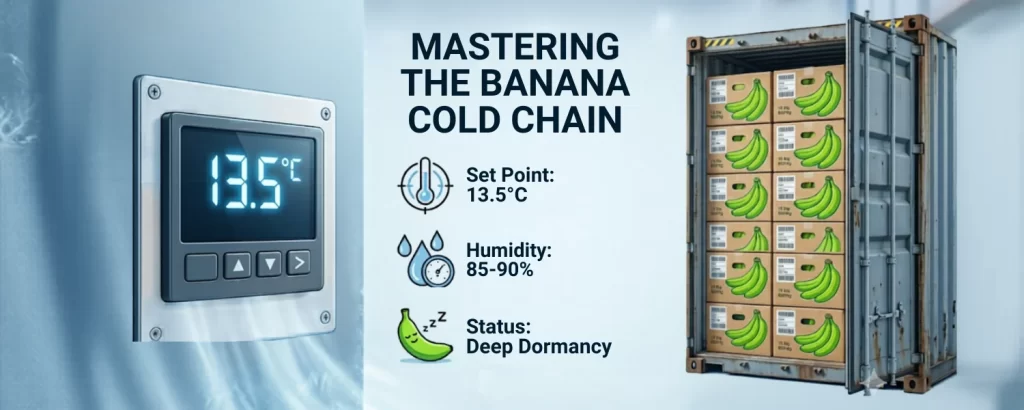
For logistics coordinators and QA inspectors setting up their reefer bookings, here is the exact data for exporting green Cavendish (G9) bananas:
- The Exact Temperature: +13.5°C (56.3°F).
- Acceptable Variance: +13.2°C to +14.0°C (Absolute maximum range).
- Relative Humidity (RH): 85% to 90% (To prevent weight loss and peel dehydration).
- Ventilation (Fresh Air Exchange): Typically set between 15 to 25 CBM/hour (Cubic Meters per Hour) to flush out carbon dioxide and trace ethylene.
- Pre-Cooling: Fruit must be pre-cooled to 13.5°C at the packhouse before loading; a reefer container is designed to maintain temperature, not to rapidly cool hot fruit.
1. The Magic Number: Shipping Bananas 13.5c
Why is 13.5°C the golden rule of global banana logistics? It is the exact biological “pause button” for the Cavendish variety.
At exactly 13.5°C, the banana’s respiration rate slows to a crawl. The enzymes responsible for converting starches into sugars and breaking down the green chlorophyll in the peel become dormant. By shipping bananas 13.5c, exporters can safely stretch the fruit’s green life to 30 or even 40 days, allowing enough time for ocean transit, customs clearance, and transfer to commercial ripening rooms at the destination port.
2. The Danger of Deviations: Chilling Injury vs. Premature Ripening
The margin for error in an export banana reefer temperature setting is virtually zero. If the temperature deviates from the 13.5°C baseline, the B2B importer faces two catastrophic risks:
- Below 13.0°C (Chilling Injury): If the temperature drops too low, the cold permanently destroys the cellular structure of the peel. While the fruit may still feel firm, it will never ripen into a bright retail yellow. When exposed to ethylene gas at the destination, a chilled banana turns a smoky, dull gray.
- Above 14.5°C (Premature Ripening): If the reefer runs too warm, the fruit “wakes up.” It begins to actively respire, generating its own heat and releasing natural ethylene gas. This triggers a chain reaction, causing the entire container to turn yellow and eventually rot before it even reaches the destination port.
3. Mastering Banana Cold Chain Logistics
A flawless export banana reefer temperature means nothing if the cold chain is broken before the container doors close.
World-class banana cold chain logistics dictate that the fruit cannot sit in the ambient tropical heat after harvest. Immediately after packing, the boxes must enter a forced-air pre-cooling chamber at the origin packhouse. The pulp of the banana must be brought down to exactly 13.5°C. Only then is it loaded into a pre-chilled reefer container. If you load 30°C bananas into a 13.5°C container, the reefer machinery will struggle for days to pull the heat out, causing the fruit to age rapidly in the interim.

4. Advanced Tactics to Prevent Banana Ripening Transit
Temperature control is the foundation, but advanced exporters utilize secondary systems to guarantee the fruit stays green:
- Banavac Poly-Liners: The bananas are sealed inside vacuum-packed plastic bags (within the cardboard carton). This limits oxygen and builds a modified atmosphere, further suffocating the ripening process.
- Ethylene Scrubbers: Advanced reefer containers or specialized chemical sachets placed inside the boxes absorb any trace amounts of ethylene gas emitted by the fruit, stopping the ripening chain reaction in its tracks.
- Continuous Ventilation: The reefer’s fresh air vents are kept slightly open to constantly expel the carbon dioxide (CO2) generated by the dormant, breathing fruit.
Conclusion: Unbroken Cold Chains with Exim Internationals
Ocean logistics is an unforgiving environment for fresh produce. You cannot afford temperature spikes, poor packhouse pre-cooling, or miscalibrated reefer units.
At Exim Internationals, we treat our banana cold chain logistics as an exact science. From the moment the Cavendish is harvested to the moment the container is sealed at the port, our quality control teams ensure strict adherence to the 13.5°C standard. We deliver rock-hard, perfectly green fruit, ready to be seamlessly transitioned into your commercial ripening rooms.
Frequently Asked Questions (FAQs)
- What is the exact export banana reefer temperature? The global B2B standard for shipping green Cavendish bananas is exactly +13.5°C (56.3°F).
- What happens if the reefer temperature drops below 13.5°C? If the temperature drops below 13.0°C, the bananas will suffer from “chilling injury.” The cold damages the cell walls, and the peel will turn an unmarketable, dull gray color when you attempt to ripen it later.
- Why is shipping bananas 13.5c so critical for ocean freight? This specific temperature puts the fruit into a deep biological dormancy. It slows the respiration rate just enough to prevent the starches from turning into sugars, ensuring the fruit survives a 30-day ocean voyage while remaining completely green.
- How do exporters prevent banana ripening transit? They prevent it through a combination of strict 13.5°C temperature control, vacuum-sealed Banavac packaging to limit oxygen, and ethylene scrubbers/ventilation to remove the natural gases that trigger ripening.
- Do bananas need to be pre-cooled before entering the shipping container? Yes. A reefer container is designed to maintain temperature, not to rapidly chill hot cargo. Bananas must be pre-cooled in a specialized forced-air chamber until their internal pulp temperature reaches 13.5°C before loading.
- What relative humidity (RH) should the reefer container be set to? The reefer should be set between 85% and 90% RH. Bananas are mostly water; if the air is too dry, the fruit will lose weight and the peel will look shriveled upon arrival.
- Why do reefer containers shipping bananas need the vents open? Even while dormant, green bananas breathe (respire), consuming oxygen and releasing carbon dioxide (CO2) and trace amounts of ethylene. The vents must be open slightly (usually 15-25 CBM/hour) to flush these gases out and prevent the fruit from suffocating or self-ripening.
- Can I ship bananas at 14.5°C or 15°C to save on energy costs? No. At 14.5°C and above, the banana “wakes up” and begins to naturally ripen. The heat will trigger a chain reaction, and the entire container will likely turn yellow and spoil before reaching the destination port.
- What is “pulp temperature” in banana cold chain logistics? Pulp temperature is the internal temperature of the actual fruit, measured by inserting a probe thermometer into the center of the banana. It is far more accurate and important than the ambient air temperature of the container.
- How do I know if the cold chain was broken during transit? B2B buyers should request that a digital data logger (a small temperature recording device) be placed inside the container at the origin. Upon arrival, you can plug the logger into a computer to see a minute-by-minute graph of the exact temperature throughout the entire voyage.
About us
Exim Internationals is a premier export company dedicated to delivering the finest products from India to international markets. Our mission is to establish India as a global export powerhouse, contributing to economic growth and showcasing the richness of Indian goods worldwide.
From the pashmina shawls and apples of the North to the spices of the South, the fruits and powders of the West, and the tea and bamboo of the East, we connect every corner of India with the global market.
Certification we have: FSSAI, APEDA, IEC, UDYAM, FIEO, Spices Board, Coconut
Contact us
Samin heritage, Sl building, Shop no. 19, Chandan wadi, Almeda road Thane west, Maharashtra, India-400601.
Email Us: support@eximinternationals.com
Call Us: +91 9820446601 | +91 9321559185
