
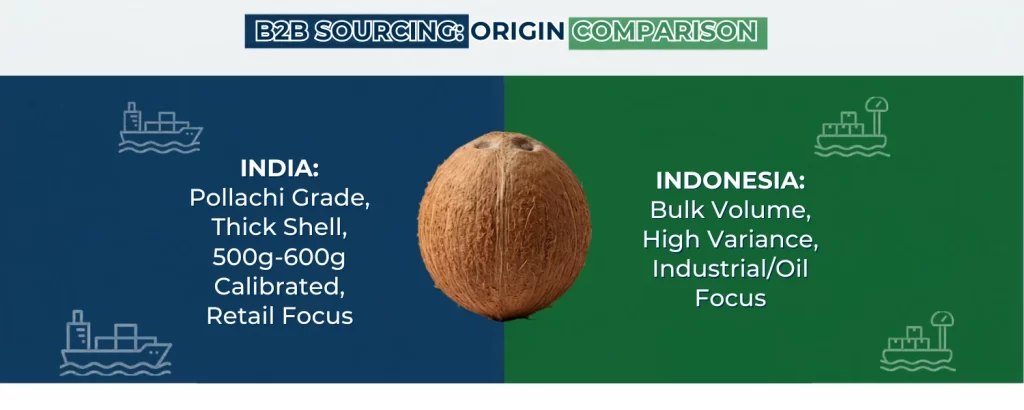
India vs. Indonesia Export Data
For supply chain directors evaluating origin points, here is the direct, side-by-side logistical comparison:
| Specification | Indian Coconuts (Pollachi Region) | Indonesian Coconuts (Sumatra/Java) |
| Shell Thickness | Very Thick (High break resistance) | Thinner (More vulnerable to transit shock) |
| Water Retention | Excellent (Loud slosh test) | Good (Prone to faster evaporation) |
| Average Export Weight | Highly Standardized (500g – 600g) | Highly Variable (Often 400g – 800g mixed) |
| Primary Advantage | Long shelf life, perfect for fresh retail | Massive bulk volume, ideal for oil processing |
| Best Trade Routes | Middle East, Europe, UK | East Asia, Australia, West Coast USA |
1. Anatomy of the Nut: Pollachi Coconut Export Quality
The physical structure of the coconut shell dictates its survival during a 30-day ocean voyage.
When discussing Indian exports, the global benchmark is pollachi coconut export quality. Grown in the nutrient-rich soils of Tamil Nadu, Pollachi coconuts are renowned for developing exceptionally thick, robust shells. This thickness is a massive logistical asset. When bags are floor-loaded into a 40ft container and subjected to rough ocean swells, the Pollachi shell resists micro-cracking.
Indonesian coconuts, while often slightly larger in overall circumference, generally possess a thinner outer shell. This makes them highly susceptible to transit damage. A micro-crack during loading will cause the internal water to evaporate during the voyage, resulting in a rejected, “dry” nut upon arrival.
2. Grading and Standardization in B2B Coconut Sourcing
A container is only profitable if its contents are uniform. Supermarkets demand consistent sizing for their produce displays.
India’s export infrastructure is heavily regulated by bodies like APEDA. Indian packhouses excel at strict calibration. When you order a 25-nut bag from India, you receive a uniform 13.5kg to 14.5kg bag, with every single nut precisely weighing between 500g and 600g.
Conversely, b2b coconut sourcing in Indonesia often involves decentralized farming cooperatives. While they produce immense volumes, the packhouse calibration is historically less rigid. Buyers often receive “mixed-grade” bags containing a blend of 400g and 700g nuts. While acceptable for a desiccated coconut processing plant, this lack of uniformity is a major liability for fresh retail distributors.
3. The Evaporation Factor and Shelf Life
The shelf life of a semi-husked coconut is directly tied to the “tuft” of fiber left over its three germinating eyes.
Indian exporters are meticulously trained to preserve this tuft during the de-husking process. Because the Pollachi nut has a thicker shell and a perfectly sealed tuft, it retains its internal water significantly longer, making it the superior choice for long-haul routes to the Middle East and Europe. If you are looking to import wholesale coconuts from asia for fresh supermarket sales where the “slosh test” is mandatory, India is the clear winner.

4. Cost Economics: Retail Display vs. Industrial Extraction
Your end-use determines your origin.
- If you are a commercial oil or desiccated coconut processor: Indonesia is often highly competitive. Because cosmetic uniformity and water retention do not matter when the nut is immediately crushed, buyers can leverage Indonesia’s massive raw volumes at aggressive FOB prices.
If you are a fresh produce importer/distributor: India is the premier choice. The slightly higher premium paid for Pollachi grading is immediately recovered by the near-zero rejection rate, longer retail shelf life, and flawless visual appeal on the supermarket floor.
Conclusion: Secure Premium Asian Yields with Exim Internationals
Finding the lowest price per ton is easy; finding cargo that survives the ocean is the true challenge of international procurement.
At Exim Internationals, we leverage India’s superior agricultural infrastructure to provide the world’s most resilient fresh coconuts. Our APEDA-certified packhouses guarantee strict pollachi coconut export quality, ensuring perfect 500g-600g calibration, intact fiber tufts, and zero-defect floor loading. When you need reliable, retail-ready cargo, we are your ultimate partner for global supply.
Frequently Asked Questions (FAQs)
- Which is the best country to import coconuts from in Asia?
It depends on your end-use. For fresh retail and supermarket distribution requiring uniform size and long shelf life, India is the best. For bulk industrial processing (like oil extraction) where cosmetic appearance doesn’t matter, Indonesia is highly competitive.
- What makes Pollachi coconut export quality so famous?
Coconuts from the Pollachi region of Tamil Nadu, India, are globally recognized for their exceptionally thick shells, sweet internal water, high meat-to-water ratio, and robust resistance to cracking during ocean freight.
- Why do Indian coconuts survive ocean transit better than Indonesian coconuts?
Indian coconuts generally have thicker, denser shells. This prevents micro-cracking under the immense pressure of floor-loaded shipping containers, ensuring the internal water does not evaporate during a 30-day voyage.
- Is there a difference in sizing when I import wholesale coconuts from asia?
Yes. Indian export packhouses are known for strict mechanical grading, ensuring uniform 500g-600g nuts in every bag. Indonesian exports often have higher variance, mixing smaller and larger nuts in the same shipment unless strictly negotiated.
- How does the transit time differ between India and Indonesia?
India holds a massive geographical advantage for shipping to the Middle East, Europe, and the UK, offering significantly shorter transit times. Indonesia is geographically closer to East Asia, Australia, and the West Coast of the Americas.
- Do both countries leave the “tuft” on their semi-husked coconuts?
While both attempt to, Indian export protocols are generally stricter about ensuring the fibrous tuft over the “eyes” remains completely intact, which acts as a crucial seal against bacterial rot and water loss.
- Which origin is better for producing coconut oil?
Indonesia and the Philippines are the largest producers of copra (dried coconut kernel used for oil). Because cosmetic uniformity is irrelevant for crushing, buyers can often source massive, uncalibrated volumes from Indonesia at very low prices.
- What certifications should I look for in b2b coconut sourcing from India?
You should always demand APEDA certification (Agricultural and Processed Food Products Export Development Authority), alongside a Phytosanitary Certificate to ensure the cargo is pest-free and meets international customs standards.
- Are Indonesian coconuts sweeter than Indian coconuts?
Flavor profiles vary by specific region and soil, but Pollachi coconuts are widely considered to have sweeter, more flavorful water, making them highly desirable in premium retail markets.
- How do B2B buyers prevent receiving “dry” coconuts from Asia?
Regardless of the country, mandate a pre-shipment inspection (via an agency like SGS) that includes a random “shake test” of the bags to ensure the water is still sloshing, and verify that the shells are free from cracks and mold before the container is sealed.
About us
Exim Internationals is a premier export company dedicated to delivering the finest products from India to international markets. Our mission is to establish India as a global export powerhouse, contributing to economic growth and showcasing the richness of Indian goods worldwide.
From the pashmina shawls and apples of the North to the spices of the South, the fruits and powders of the West, and the tea and bamboo of the East, we connect every corner of India with the global market.
Certification we have: FSSAI, APEDA, IEC, UDYAM, FIEO, Spices Board, Coconut
Contact us
Samin heritage, Sl building, Shop no. 19, Chandan wadi, Almeda road Thane west, Maharashtra, India-400601.
Email Us: support@eximinternationals.com
Call Us: +91 9820446601 | +91 9321559185
