
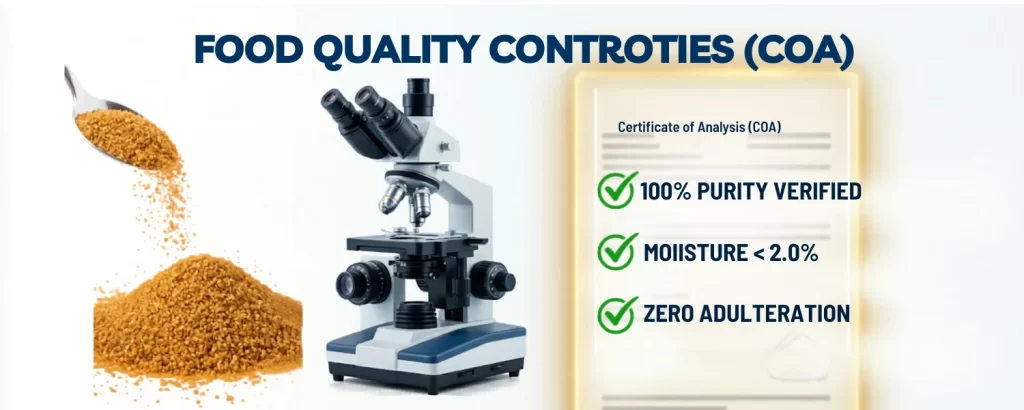
B2B COA Baselines
For QA/QC managers and procurement directors analyzing a supplier’s lab report, here are the non-negotiable metric baselines for 100% pure export-grade coconut sugar:
- Moisture Content: Must be < 2.0% (Higher indicates risk of clumping/spoilage).
- Total Ash: Must be < 2.5% (Higher indicates dirt, sand, or poor packhouse filtration).
- Mesh Size / Granulation: 16-18 Mesh (For optimal industrial solubility).
- Sucrose Content: Typically 70% to 79% (If it reads 95%+, it has been cut with refined cane sugar).
- Microbiological Limits: Salmonella and E. Coli must be absolutely Absent / Negative.
1. How to Detect Fake Coconut Sugar via Sugar Profiling
The most critical section of any coa for import sugar is the carbohydrate profile. This is where you catch fraudsters.
A standard coconut sugar purity test breaks down the exact types of sugars present. Pure coconut sap naturally contains a specific ratio of sucrose, glucose, and fructose. While sucrose is the dominant sugar (usually around 70-79%), the presence of glucose (3-9%) and fructose (3-9%) is the chemical fingerprint of pure coconut sugar.
If you read a COA and the sucrose content is listed at 95% to 99%, with zero fructose or glucose, you have successfully learned how to detect fake coconut sugar. The supplier has secretly blended the cargo with heavily refined white cane sugar to inflate their profit margins. Reject the shipment immediately.
2. Physical Parameters: Moisture and Ash Limits
Beyond adulteration, bulk coconut sugar testing evaluates the physical usability of the ingredient.
- Moisture: Coconut sugar is highly hygroscopic. The COA must show a moisture level below 2.0%. If the lab reports 3% or 4%, the sugar contains too much water. During a 30-day ocean transit, it will bind together and arrive at your warehouse as a solid, unusable brick.
- Total Ash: “Ash” in a lab report refers to the inorganic mineral residue left after the sugar is burned away. Pure coconut sugar contains healthy minerals (like potassium), yielding an ash content of 1.5% to 2.5%. If the ash content is above 3%, it means the packhouse hygiene is terrible, and the sugar is contaminated with dirt, sand, or field dust.
3. Microbiological Safety and Heavy Metals
Commercial F&B buyers face strict liability. The COA is your legal shield against foodborne pathogens. Every legitimate coa for import sugar will feature a microbiological and heavy metal breakdown:
- Pathogens: The report must explicitly state “Absent” or “< 10 CFU/g” for Salmonella, E. Coli, and Staphylococcus aureus.
- Yeast & Mold: Because it is an unrefined product, trace amounts are natural, but they must be strictly below 100 CFU/g to prevent fermentation during storage.
- Heavy Metals: The lab must test for Lead (Pb), Arsenic (As), Cadmium (Cd), and Mercury (Hg), ensuring they fall strictly below the FDA and EFSA permissible limits (typically < 0.1 ppm).

4. Verifying the Issuer of the COA
A COA is only as valuable as the laboratory that issued it. An “in-house” COA printed on an exporter’s own letterhead is virtually worthless for international customs and commercial QA audits.
You must ensure the testing was conducted by an independent, internationally accredited, ISO 17025-certified laboratory (such as SGS, Eurofins, or Intertek). The document should feature a distinct batch/lot number that perfectly matches the lot numbers printed on your 25kg multi-wall bags, ensuring total traceability.
Conclusion: Source Audited Purity with Exim Internationals
Do not gamble your commercial formulations on unverified sweeteners. You need a supply partner who values chemical transparency as much as you do.
At Exim Internationals, 100% purity is our baseline. Every batch of our industrial coconut sugar undergoes rigorous, independent bulk coconut sugar testing before it ever reaches the port. We provide comprehensive, third-party Certificates of Analysis for every shipment, guaranteeing that you receive authentic, unadulterated, and microbiologically safe ingredients for your manufacturing lines.
Frequently Asked Questions (FAQs)
- What is a COA for import sugar? A Certificate of Analysis (COA) is a formal laboratory document that details the exact chemical, physical, and microbiological properties of a specific batch of sugar, proving it meets safety and commercial quality standards.
- How can I detect fake coconut sugar using a COA? Look at the sugar profile. Pure coconut sugar is roughly 70-79% sucrose, with the remainder being glucose and fructose. If the COA shows 95%+ sucrose, the product has been adulterated with cheap refined cane sugar.
- Why is bulk coconut sugar testing so important for B2B buyers? Testing prevents catastrophic manufacturing failures. It ensures you are not paying premium prices for adulterated sugar, guarantees the moisture level is low enough to prevent hard caking during transit, and protects your brand from pathogen liability.
- What should the moisture limit be on a coconut sugar purity test? The moisture content must be explicitly listed as less than 2.0% (< 2.0%). Any higher, and the sugar will clump and solidify during ocean freight.
- What does the “Ash Content” section of a COA mean? Ash content measures inorganic minerals. While coconut sugar has natural minerals (1.5% to 2.5%), an unusually high ash content (above 3%) indicates contamination with environmental dirt, sand, or poor factory filtration.
About us
Exim Internationals is a premier export company dedicated to delivering the finest products from India to international markets. Our mission is to establish India as a global export powerhouse, contributing to economic growth and showcasing the richness of Indian goods worldwide.
From the pashmina shawls and apples of the North to the spices of the South, the fruits and powders of the West, and the tea and bamboo of the East, we connect every corner of India with the global market.
Certification we have: FSSAI, APEDA, IEC, UDYAM, FIEO, Spices Board, Coconut
Contact us
Samin heritage, Sl building, Shop no. 19, Chandan wadi, Almeda road Thane west, Maharashtra, India-400601.
Email Us: support@eximinternationals.com
Call Us: +91 9820446601 | +91 9321559185
