
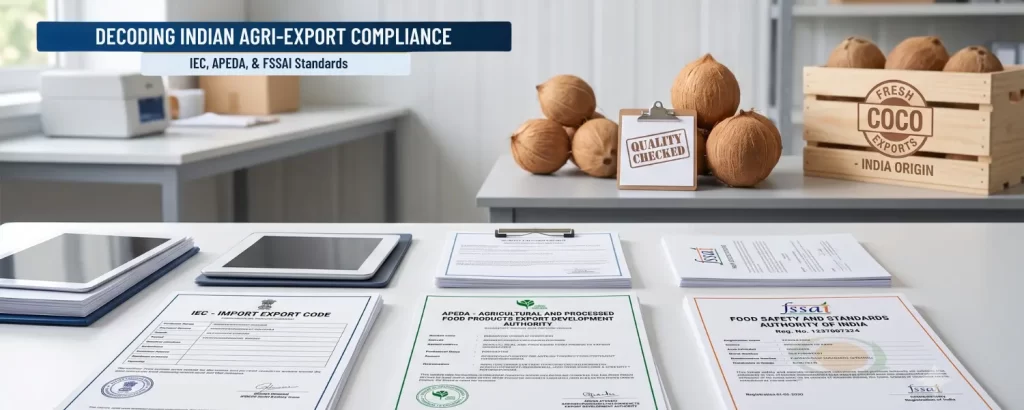
For international procurement directors and supply chain managers, sourcing global agricultural commodities involves significant inherent risks. When finalizing a commercial contract or issuing a Letter of Credit, buyers require absolute certainty that the incoming cargo will seamlessly clear customs at the destination port. Whether the shipment is destined for Jebel Ali in the UAE, Rotterdam in the EU, or major ports in the Americas, the foundation of this certainty is strict regulatory compliance.
In India, agricultural exports are governed by a robust, multi-layered regulatory framework designed to guarantee traceability, international food safety, and legal legitimacy. Navigating this framework is critical for buyers who want to separate verified, reliable export partners from risky middlemen.
In this comprehensive B2B guide, we decode the three primary pillars of Indian agri-export compliance: the Import Export Code (IEC), the Agricultural and Processed Food Products Export Development Authority (APEDA), and the Food Safety and Standards Authority of India (FSSAI).
The Legal Foundation: Import Export Code (IEC)
Before any physical commodity can leave an Indian port, the exporting entity must be legally authorized by the Government of India. This authorization is granted through the Import Export Code (IEC).
Issued by the Directorate General of Foreign Trade (DGFT) under the Ministry of Commerce and Industry, the IEC is a mandatory 10-digit identification number. For an international buyer, an active IEC is the very first compliance checkpoint. It acts as a digital footprint that validates the exporter’s legal standing, tax compliance, and business registry.
Why it matters for B2B Buyers:
Partnering with a supplier who holds a verified IEC completely eliminates the risk of dealing with unregistered entities or fly-by-night operators. The IEC is permanently linked to the exporter’s corporate bank accounts and the Indian Customs EDI (Electronic Data Interchange) system. This integration ensures that all shipping documents, Commercial Invoices, and Bills of Lading are legally binding and globally recognized, ensuring a frictionless transfer of funds and cargo.
Traceability and Quality Assurance: APEDA Certification
While the IEC provides legal authorization, the Agricultural and Processed Food Products Export Development Authority (APEDA) is the governing body responsible for the actual quality, packaging, and phytosanitary standards of the exported agricultural goods.
As a statutory body under the Ministry of Commerce and Industry, APEDA enforces rigorous standards for the export of scheduled products, which include fresh fruits, vegetables, organic produce, and various processed foods. Sourcing from an APEDA certified exporter is non-negotiable for risk-averse international buyers.
The APEDA Packhouse Advantage:
One of APEDA’s most critical functions is the inspection and recognition of export packhouses. To receive an APEDA packhouse certification, a facility must demonstrate strict adherence to hygiene, proper ventilation, and advanced sorting capabilities. For example, when Exim Internationals exports premium Pollachi semi-husked coconuts, APEDA-compliant protocols mandate that the nuts are packed in standardized 25-nut Polypropylene (PP) mesh bags to ensure breathability and prevent heat buildup during 40ft container transit.
Furthermore, APEDA facilitates the issuance of Phytosanitary Certificates. By monitoring farm-level chemical residues and ensuring commodities are free from pests and diseases, APEDA guarantees that Indian agricultural exports meet the stringent import requirements of the European Union, the United States, and the Middle East, drastically reducing the risk of cargo rejection at the destination port.

Baseline Food Safety: FSSAI Standards
The third pillar of Indian export compliance is the Food Safety and Standards Authority of India (FSSAI). While FSSAI is primarily known as India’s domestic food regulator, its licensing is an imperative benchmark for export operations, particularly for processed commodities like Coconut Sugar or extracted Coconut Oil.
FSSAI standards are closely aligned with international Codex Alimentarius guidelines. An FSSAI central license for an exporter signifies that the manufacturing, processing, and holding facilities operate under strict Good Manufacturing Practices (GMP) and Hazard Analysis and Critical Control Points (HACCP) principles.
FSSAI’s Role in Export Procurement:
For international quality assurance (QA) and quality control (QC) managers, an FSSAI license provides a vital layer of chemical and microbiological safety. FSSAI regulations mandate strict limits on heavy metals (such as lead and arsenic), pesticide maximum residue limits (MRLs), and microbiological contaminants (such as Salmonella and E. coli).
When an international buyer reviews a B2B Certificate of Analysis (COA) from an Indian exporter, the foundational testing parameters that dictate the safety and purity of that product are governed by FSSAI guidelines. This ensures that the food products are fundamentally safe for global human consumption and commercial food and beverage reformulation.
Specialized Commodity Boards: The Final Layer
In addition to IEC, APEDA, and FSSAI, specific high-value commodities are governed by dedicated boards that enforce an additional layer of niche quality control.
For instance, exporters dealing in agricultural spices must be registered with the Spices Board of India, which operates highly advanced laboratories to test for adulteration, moisture levels, and aflatoxins. Similarly, the Coconut Development Board provides specialized oversight for coconut-based exports, ensuring that agricultural practices at the origin (such as the fertile belts of Pollachi) yield the high oil content (62%+) and extended 40 to 60-day shelf life required for B2B global trade.
Mitigating Risk Through Verified Partnerships
Global agricultural procurement is an exercise in risk mitigation. A shipment delayed by customs due to improper documentation or rejected due to phytosanitary violations can cost an importing business tens of thousands of dollars in demurrage, spoilage, and lost revenue.
By understanding and verifying the Indian agri-export compliance framework, international buyers can secure their supply chains. Sourcing exclusively from suppliers who maintain active IEC registrations, APEDA packhouse certifications, FSSAI licenses, and specialized board memberships ensures that every container shipped is legally verified, hygienically packed, and globally compliant.
Frequently Asked Questions (FAQs)
What is an Import Export Code (IEC) and why is it important?
Why should international buyers insist on an APEDA certified exporter?
What does FSSAI stand for in Indian exports?
FSSAI stands for the Food Safety and Standards Authority of India. It regulates food safety, hygiene, and manufacturing practices. For exports, an FSSAI license proves that the processing facilities meet strict microbiological and chemical safety baselines.
Does APEDA issue Phytosanitary Certificates?
While the actual certificate is issued by the Directorate of Plant Protection, Quarantine & Storage (DPPQS), APEDA facilitates the compliance and testing ecosystem required to clear these phytosanitary checks, ensuring shipments are free from pests and diseases.
Are Indian compliance standards recognized globally?
Yes. Indian regulatory bodies like FSSAI closely align their safety parameters with the international Codex Alimentarius. Additionally, APEDA-certified packhouses are frequently audited to meet the specific import standards of the EU, USA, and the Middle East.
What is the role of the Spices Board of India?
The Spices Board is a specialized regulatory body that ensures the quality, purity, and authenticity of Indian spice exports. Registration with the board is mandatory for spice exporters and involves rigorous laboratory testing for adulterants and aflatoxins.
How do these certifications affect maritime shipping?
Compliance directly impacts shipping efficiency. Proper APEDA-approved packaging (like ventilated PP mesh bags for semi-husked coconuts) ensures product survival during long transits, while IEC and FSSAI documentation ensures swift customs clearance.
Can I verify an Indian exporter’s IEC or APEDA status online?
Yes. International buyers can independently verify an exporter’s IEC status through the official DGFT portal and check APEDA registration via the APEDA website’s exporter directory, ensuring complete transparency.
Does FSSAI test for heavy metals and pesticides?
Yes. FSSAI sets strict Maximum Residue Limits (MRLs) for pesticides and stringent thresholds for heavy metals, ensuring that exported agricultural and processed foods are safe for industrial use and human consumption.
How does Exim Internationals approach compliance?
Exim Internationals is a fully verified B2B export partner holding active IEC, APEDA, FSSAI, FIEO, and Spices Board registrations, ensuring that every global shipment meets the absolute highest standards of legal and qualitative compliance.
