
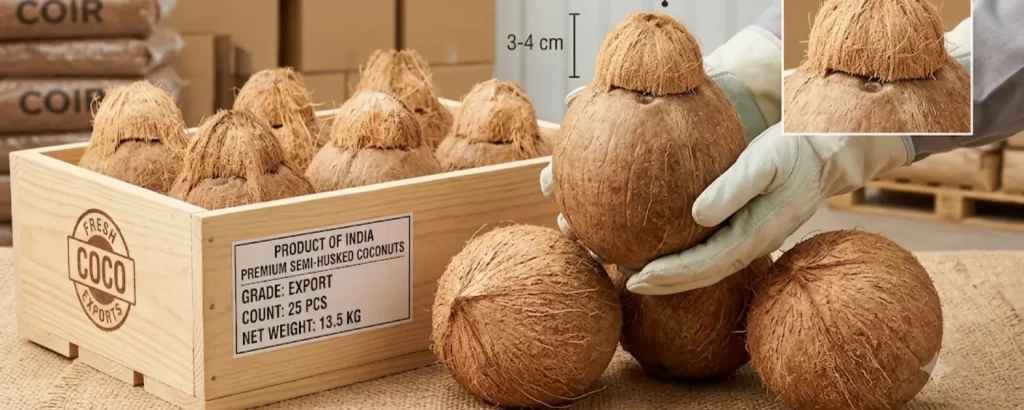
In the highly competitive world of international agricultural trade, global procurement directors and supply chain managers are constantly evaluating origin points to maximize their Return on Investment (ROI). When it comes to wholesale coconut procurement, the origin dictates everything from transit survivability to industrial processing yields.
While Southeast Asian nations like Vietnam and Thailand are frequently recognized for their tender, young green coconuts, the industrial and commercial export market demands a much more robust commodity. For buyers sourcing mature, semi-husked coconuts for culinary, retail, and oil extraction purposes, one region consistently outperforms the rest: Pollachi, India.
Known globally as the “Coconut Capital of India,” Pollachi offers a distinct set of geographical, biological, and logistical advantages that competing origins struggle to match. This guide breaks down exactly why Pollachi coconuts are the premier choice for B2B export sourcing.
The Pollachi Pedigree: Climate and Year-Round Consistency
One of the most significant logistical hurdles in global agricultural sourcing is seasonality. Many competitor nations face distinct harvest seasons that create supply bottlenecks and volatile pricing structures. For a global supermarket chain or a large-scale industrial oil processor, supply chain instability is an unacceptable risk.
Pollachi eliminates this friction. The region benefits from a highly favorable tropical climate, incredibly rich red soil, and advanced irrigation techniques. This unique combination allows for continuous, year-round harvesting. For B2B buyers, this translates to unparalleled supply chain stability. By sourcing Pollachi coconuts, importers can secure consistent, uniform-sized deliveries every month of the year, effectively mitigating the risk of stockouts during the off-seasons experienced by other producing nations.
Meat Yield and Oil Content: The Processor’s Choice
Ultimately, wholesale buyers are not paying for the shell; they are paying for the usable product inside. This is where Indian origin coconuts mathematically outclass their competitors. Due to the specific soil minerality of Tamil Nadu and the strict adherence to harvesting at peak maturity, Pollachi coconuts develop a significantly thicker and denser layer of white meat, known as copra.
When comparing standard export-grade Pollachi coconuts (typically weighing between 500g and 750g+) against alternatives, the yield difference is staggering. Pollachi nuts boast an exceptionally high oil content, frequently exceeding 62%. For industrial processors manufacturing virgin coconut oil (VCO) or coconut milk, this higher yield per metric ton means shipping less shell and generating more profitable, usable product. Furthermore, Pollachi coconuts offer a naturally sweeter water profile (a higher Brix value) and a richer, nuttier meat flavor that is highly preferred in fresh retail markets.
The Color of Maturity: Why Brown is Better
In the semi-husked export trade, shell color is a critical indicator of quality and maturity. International buyers frequently encounter pale, whitish-husked coconuts from competing global origins. While these may appear visually clean, they are often immature nuts that have been harvested too early to rush them to market.
At Exim Internationals, we focus exclusively on fully mature Indian coconuts, which are easily identified by their distinct, dark brown shell color. Sourcing exclusively brown, matured coconuts ensures maximum meat thickness and optimal oil content. Immature pale nuts invariably contain thinner meat and hold water that sours rapidly during transit. Educated B2B buyers understand that a mature brown shell is the ultimate guarantee of both flavor and longevity.

Engineering Shelf Life: The Biological Advantage of the "Tuft"
Exporting fresh produce across the ocean requires immense logistical precision. If a fully husked coconut is shipped, its sensitive “eyes” are completely exposed to the air. During a long transit, this exposure inevitably leads to mechanical damage, rapid fungal growth, and total spoilage within just 15 to 20 days.
Pollachi semi-husked coconuts are engineered specifically for long-distance maritime trade. During the husking process, a protective fibrous “tuft” (or cap) is expertly left intact over the coconut’s eyes. This natural seal acts as a biological shock absorber and an impenetrable barrier against pathogens. Because of this unique preparation and the inherent hardness of the matured brown shell, Indian semi-husked coconuts boast an incredible shelf life of 40 to 60 days—and sometimes up to 70 days—under ambient, ventilated conditions. This extended viability makes them the only truly reliable option for long sea voyages to the Middle East, Europe, and Western markets.
Standardized B2B Grading and Logistics
Global trade requires absolute standardization. Premium suppliers in Pollachi do not just ship raw commodities; they ship precision-graded products tailored to exact market specifications.
For retail and supermarket buyers, coconuts are graded strictly between 500g and 650g per piece, ensuring uniform sizing for easy per-unit shelf pricing. For industrial processing, larger grades ranging from 650g to over 750g are supplied to maximize meat volume. To guarantee that the 60-day shelf life is maintained, these coconuts are universally packed in standardized Polypropylene (PP) mesh bags. These bags hold 25 to 50 pieces and ensure maximum breathability during transit, preventing dangerous heat buildup inside 20ft and 40ft High Cube containers.
When you choose Indian fresh semi-husked coconuts from Pollachi, you are investing in superior genetics, unmatched oil yields, and reliable, year-round availability. While other origins may compete on initial price, Pollachi coconuts unequivocally win on total value and shelf-life reliability.
Frequently Asked Questions (FAQs)
What makes Pollachi coconuts different from other global origins?
Pollachi coconuts are grown in nutrient-rich red soil under a stable tropical climate, resulting in thicker meat, a higher oil content (over 62%), and a distinct, naturally sweet flavor profile compared to nuts from other regions.
Why do Pollachi coconuts have a longer shelf life?
They are carefully semi-husked to leave a protective fiber “tuft” over the eyes, which acts as a barrier against moisture loss and pathogens. This allows them to survive up to 60-70 days in proper ambient transit conditions.
