
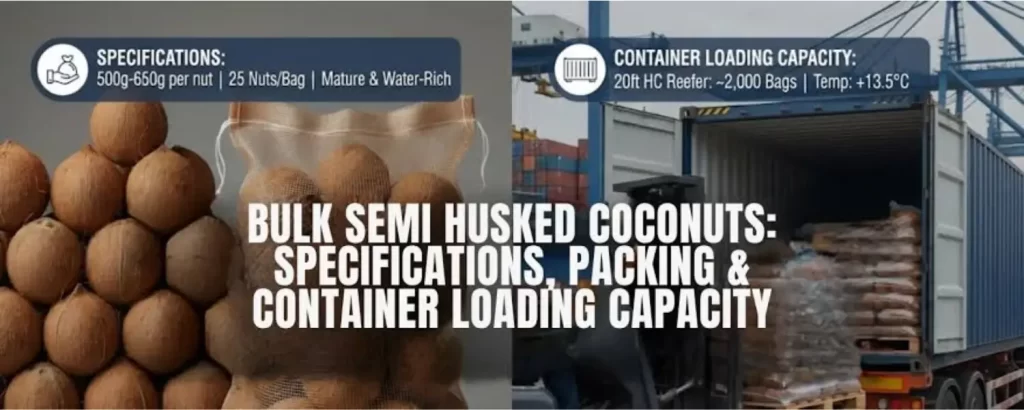
In the competitive world of global agricultural commodities, your margin isn’t just decided by the farm-gate price of the crop—it is decided inside the steel walls of a shipping container. For heavy, low-cost commodities like semi-husked coconuts, mastering 40ft container economics is the difference between a highly profitable export business and a logistical failure.
When you are shipping coconuts from tropical origin countries to high-demand markets in North America, Europe, or the Middle East, you are essentially paying for space and weight. If you ship “air” (wasted volume) or hit weight limits too early, your freight cost per nut skyrockets.
In this guide, we will break down the exact economics, math, and logistics of maximizing a 40ft High Cube container for bulk coconut shipping, ensuring you get the absolute best return on investment (ROI) on your ocean freight.
The Golden Ratio: Weight vs. Volume in Container Shipping
Every shipping container has two hard limits:
Volumetric Capacity (Cubic Meters/CBM): How much physical space is inside.
Payload Capacity (Metric Tonnes/MT): The maximum weight the container can safely carry.
Semi-husked coconuts are incredibly dense. Unlike lightweight consumer goods (like clothing or electronics) that “cube out” (fill the space before hitting the weight limit), coconuts usually “weigh out.” This means you will hit the container’s maximum legal weight limit before you completely run out of physical space.
To optimize unit cost optimization, your goal is to pack the maximum number of nuts to reach the payload weight limit perfectly, without exceeding it.
40ft High Cube (HC) Container Specifications for Coconuts
For long-haul semi-husked coconut export, the industry standard is the 40ft High Cube (HC) Container. An HC container is a foot taller than a standard 40ft container, giving a bit more breathing room for agricultural ventilation. Depending on transit length, exporters use either Dry High Cubes (ventilated) or Reefer High Cubes (temperature-controlled).
Here is the math you need to know:
Max Payload Limit: Generally capped around 27 to 28.5 Metric Tonnes (MT) depending on the shipping line and destination port regulations.
Ideal Coconut Export Weight: The global B2B standard demands coconuts weighing precisely 500g to 600g each.
Packing Standard: 25 uniform nuts packed into one ventilated Polypropylene (PP) mesh bag.
Standard Bag Weight: 25 nuts × ~550g (average) = 13.5 kg to 14.5 kg per bag.
The Loading Math
If your maximum allowable payload is 28,000 kg (28 MT), and each bag weighs 14 kg:
28,000 kg ÷ 14 kg/bag = 2,000 bags.
To stay safely under weight limits while maximizing space, a standard 40ft High Cube is typically loaded with 1,800 to 2,000 bags.
Total Payload Yield:
Total Nuts: 45,000 to 50,000 coconuts per 40ft HC.
Total Weight: ~25 to 28 Metric Tonnes.

3 Strategies for Unit Cost Optimization
How do top exporters ensure they aren’t bleeding margin on freight? They execute the following logistics strategies:
1. Floor Loading vs. Palletizing
Wooden pallets take up crucial vertical space, add dead weight (about 15-20 kg per pallet), and cost money. In FCL shipping cost optimization, exporters almost exclusively use floor loading. By hand-stacking the PP mesh bags directly on the container floor in an interlocking pattern, you gain back the weight and space that pallets would have stolen, allowing you to fit an extra 100 to 200 bags per container.
2. Strict Grading at the Packhouse
As demonstrated above, uniformity is profitability. You must mandate that your supplier uses strict weighing scales during the packing process. Every bag must hit that 13.5 kg – 14.5 kg sweet spot. Overweight bags kill your total nut yield; underweight bags mean you are shipping small, unsellable coconuts.
3. Understanding the 20ft vs. 40ft Dynamic
Why not use a 20ft container? A 20ft container maxes out its weight limit at roughly the same weight as a 40ft (around 28 MT). However, because it has half the volume, you cannot fit 28 MT of coconuts inside it before running out of space. A 20ft container typically maxes out at 900 to 1,000 bags (22,500 to 25,000 nuts). Because ocean carriers charge heavily for weight, the cost of shipping a 20ft container is rarely exactly half the cost of a 40ft. Therefore, the 40ft HC always offers a vastly superior cost-per-nut ratio.
The True Cost of "Air"
If freight rates from India to New York are $4,500 for a 40ft HC:
Optimized Load (50,000 nuts): Ocean freight cost is $0.09 per nut.
Poorly Graded/Packed Load (43,000 nuts): Ocean freight cost is $0.104 per nut.
That is a $700 margin leak on a single container just in freight inefficiency. When you scale that to 10 or 20 containers a month, poor 40ft container economics will quietly bankrupt an agricultural import business. The key to bulk coconut shipping isn’t just finding a good farm—it’s finding a packhouse that understands how to perfectly play the game of weight versus volume.
Frequently Asked Questions (FAQs)
How many semi-husked coconuts fit in a 40ft High Cube container?
A perfectly optimized 40ft High Cube container can hold between 1,800 and 2,000 bags. With 25 coconuts per bag, this equals a total payload of 45,000 to 50,000 nuts.
Why do coconut exporters use 40ft containers instead of 20ft containers?
A 40ft HC offers a significantly better economy of scale. While a 20ft container holds around 900-1,000 bags, a 40ft holds double that amount, reducing the per-unit freight cost dramatically.
Why is it important for every coconut to weigh 500g-600g?
Predictable sizing ensures predictable bag weights (13.5 – 14.5 kg). Predictable bag weights allow logistics teams to perfectly calculate the container load, ensuring they hit the maximum legal weight limit without exceeding it, thereby maximizing the total number of coconuts shipped.
Should coconut bags be shipped on pallets?
No. For bulk coconut export, floor-loading is preferred. Pallets take up valuable space and add dead weight to the container, which reduces the total amount of coconuts you can legally load.
What is "weighing out" in ocean freight?
“Weighing out” means the cargo has reached the container’s maximum legal weight limit before the physical space inside the container is entirely full. Coconuts are heavy, so they typically weigh out before they cube out (run out of space).
