
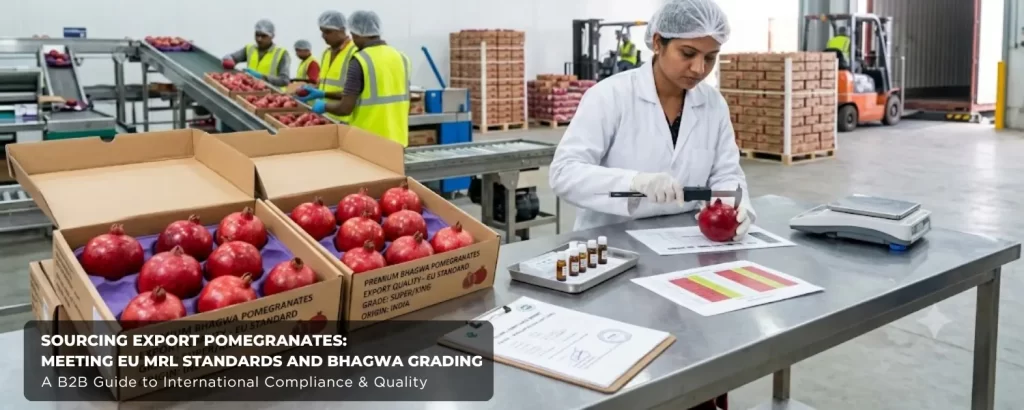
The European and Middle Eastern markets have an insatiable appetite for premium pomegranates, driven by the booming health-food and cold-pressed juice sectors. For B2B procurement directors and fresh produce importers, capitalizing on this demand requires securing a reliable supply of high-yield, visually flawless fruit.
Globally, the Indian Bhagwa pomegranate has emerged as the gold standard for fresh retail export. However, the international pomegranate trade is fraught with regulatory landmines. The European Union operates under some of the strictest food safety laws in the world, and a single shipment exceeding pesticide residue limits will result in immediate rejection, incineration, and severe financial loss.
In this guide, we break down the technical parameters of sourcing export pomegranates, focusing on the physical grading of the Bhagwa variety and the critical lab analytics required to pass EU Maximum Residue Limit (MRL) standards.
The Bhagwa Advantage: Why Importers Demand It
India is the world’s largest producer of pomegranates, and the Bhagwa variety (cultivated primarily in the arid regions of Maharashtra) constitutes the vast majority of its export volume.
Why do European and Middle Eastern procurement teams specifically request Bhagwa?
Deep Red Arils: Unlike varieties that yield pale pink seeds, Bhagwa produces dark, ruby-red arils that are highly attractive in transparent retail clamshells.
Soft Seeds: The seeds inside the arils are exceptionally soft, making them ideal for fresh consumption and preventing damage to commercial juice-press machinery.
Thick Rind (High Shelf Life): The Bhagwa boasts a thick, glossy, saffron-to-red skin. This natural armor provides remarkable resistance to transit scuffing and moisture loss, granting the fruit a 30 to 45-day shelf life when properly managed in cold storage.
Export Grading Standards for B2B Procurement
When you issue a Request for Quotation (RFQ) for wholesale pomegranates, you cannot rely on generic terms like “large” or “premium.” B2B transactions rely on strict, quantifiable grading parameters.
Export-grade Bhagwa pomegranates are graded primarily by weight and diameter, which dictates how they are packed into the standard 3.5 kg to 4.5 kg corrugated display cartons.
Standard Grading Categories
Super Size: > 350 grams (Counts: 9 to 10 per 3.5 kg box)
King Size: 300g to 350g (Counts: 10 to 12 per box)
Queen Size: 250g to 300g (Counts: 12 to 15 per box)
Prince Size: 200g to 250g (Counts: 15 to 18 per box)
Cosmetic Tolerances
Beyond weight, QA/QC inspectors evaluate the rind. To meet premium export standards, the skin must be free from bacterial blight spots, sunburn, and severe thrips (insect) damage. Minor superficial scuffing is typically tolerated at an AQL (Acceptable Quality Level) of less than 3% per batch.

Navigating EU MRL (Maximum Residue Limit) Compliance
The single highest risk when sourcing export pomegranates is failing the destination port’s phytosanitary and chemical inspections. The European Food Safety Authority (EFSA) enforces draconian Maximum Residue Limits (MRLs) for agricultural pesticides.
Because pomegranates are susceptible to fungal infections during the monsoon season, farmers often use chemical fungicides and insecticides. If these chemicals are applied too close to the harvest window, the residue on the skin will exceed the EU’s legally permitted parts-per-million (ppm) thresholds.
The GlobalGAP and Lab Testing Requirement
To successfully import into the EU or UK, your B2B supplier must source exclusively from GlobalGAP-certified orchards. These farms follow strict pre-harvest intervals (PHI), ensuring chemicals degrade before the fruit is picked.
Before a container is sealed, a top-tier exporter will pull random samples and send them to an accredited, third-party laboratory (like Eurofins or SGS) for multi-residue LC-MS/MS testing. The resulting Certificate of Analysis (CoA) must explicitly prove that common agrochemicals fall below the EU limits.
Packing, Pre-Cooling, and Reefer Logistics
Passing chemical compliance is only half the battle; the other half is logistics. Pomegranates are non-climacteric (they do not ripen after being picked), but they are highly susceptible to moisture loss and fungal rot during ocean transit.
Sorting and Cleaning: Upon arriving at the packhouse, the fruits are washed, air-dried, and polished to remove field dust.
Pre-Cooling: Before being packed into the shipping container, the core temperature of the fruit must be rapidly brought down to 5°C to 7°C in a forced-air pre-cooling chamber.
Reefer Container Settings: The pomegranates are loaded into refrigerated (reefer) containers set strictly to 5°C (41°F) with a ventilation setting of 15 to 20 CBM/hour to prevent carbon dioxide buildup and mold proliferation.
Partnering for Reliable Supply
Sourcing export pomegranates is a highly technical procurement exercise. B2B buyers must navigate exact physical grading requirements while shielding their companies from the severe financial liabilities of MRL compliance failures.
To guarantee year-round profitability, importers must move away from spot-market traders and partner exclusively with origin-verified exporters who control the supply chain from the GlobalGAP orchard to the APEDA-certified packing facility. By demanding rigorous lab analytics and strict cold-chain adherence, you can confidently supply your retail networks with the finest Bhagwa pomegranates on the market.
Frequently Asked Questions (FAQs)
What makes the Indian Bhagwa pomegranate ideal for export?
The Bhagwa variety is favored for its thick, protective rind (which offers a 30 to 45-day shelf life), its deep ruby-red arils, and its extremely soft seeds, making it perfect for both fresh retail and commercial juice extraction.
What is an MRL, and why is it critical for EU imports?
MRL stands for Maximum Residue Limit. It is the maximum legally allowable concentration of pesticide residue on agricultural produce. If a shipment exceeds the EU’s strict MRL thresholds, customs will reject and destroy the cargo.
What are the standard B2B grading sizes for export pomegranates?
Export pomegranates are graded by weight. Standard categories include Super Size (>350g), King Size (300g-350g), Queen Size (250g-300g), and Prince Size (200g-250g).
What temperature should a reefer container be set to for pomegranates?
Reefer containers carrying fresh pomegranates should be maintained at a strict 5°C (41°F) throughout the maritime voyage to prevent moisture loss and fungal rot.
How do exporters prove their pomegranates meet chemical safety standards?
Verified exporters send random batch samples to accredited third-party laboratories (like SGS or Eurofins) for multi-residue LC-MS/MS testing. The resulting Certificate of Analysis (CoA) proves the fruit complies with the destination country’s MRL laws.
