Export Import

import industrial grade coconut sugar
Export Import Fruits Spices Vegetables

How to Import Industrial-Grade Coconut Sugar from India (MOQ & Logistics)

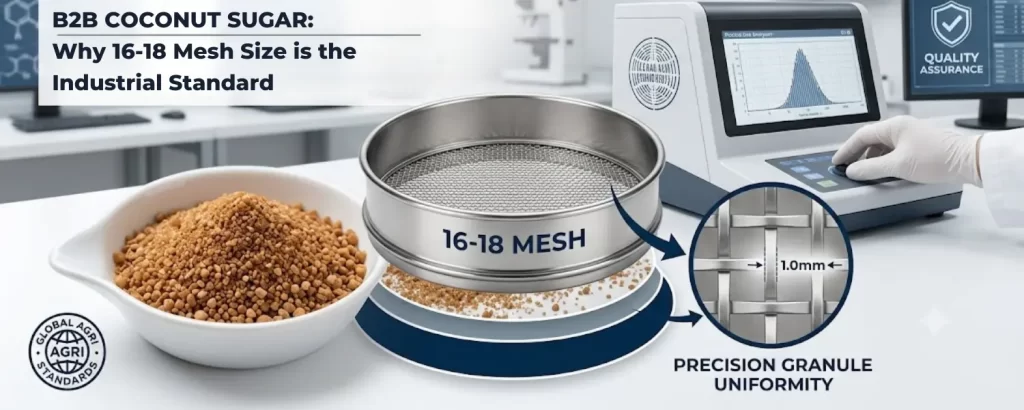
Import Logistics Overview For procurement teams needing immediate B2B parameters, here is how the global trade process works: Target Grade: 16-18 Mesh “Industrial Grade” (darker color, highly soluble, optimal for mixing, baking, and sauces). Standard Packaging: 25kg multi-wall paper bags with a moisture-blocking inner poly-liner. Standard MOQ: One 20ft Full Container Load (FCL), which holds approximately 17 to 18 Metric Tonnes. Key Certification: Always demand an independent Certificate of Analysis (COA) to guarantee zero cane sugar adulteration. 1. Why Import Industrial Grade Coconut Sugar? When sourcing ingredients for a protein bar, a dark sauce (like teriyaki or BBQ), or baked goods, the visual color of the raw sugar simply does not matter. Industrial-grade coconut sugar provides the exact same nutritional profile, low-glycemic index, and rich caramel flavor as the “Premium Blonde” grade sold in high-end retail pouches. The only difference is that industrial grade is slightly darker in color due to the natural sap boiling process. By opting for this grade, manufacturers significantly lower their raw material costs while maintaining strict clean-label claims on their packaging. 2. Understanding the Standard Coconut Sugar MOQ To get the true wholesale origin price, you must understand container economics. While some domestic warehouse brokers will sell pallet-by-pallet, international exporters operate on a larger scale. The standard coconut sugar moq for direct import is one 20ft container (FCL). A 20ft container comfortably fits roughly 17 to 18 Metric Tonnes of product. Ordering Less than Container Load (LCL) is highly discouraged. LCL shipments share container space with other random goods, which increases the risk of contamination, prolongs transit times, and drastically spikes the freight cost per kilogram. Maximize your ROI by ordering full containers. 3. The Advantage of Sourcing Bulk Coconut Sugar from India India has aggressively modernized its agricultural export sector, making it one of the safest and most reliable origins for organic sweeteners. When you source bulk coconut sugar from india, you benefit from strict government oversight via APEDA (Agricultural and Processed Food Products Export Development Authority). Indian exporters operate high-capacity, stainless-steel sieving facilities that ensure the sugar meets the stringent hygiene and moisture standards demanded by the FDA (USA) and EFSA (Europe). By bypassing domestic brokers and importing directly from India, buyers routinely save 30% to 40% on their overall landed costs. 4. Mastering Wholesale Sugar Logistics and Packaging The biggest enemy of granulated sugar during an ocean voyage is humidity. If the packaging fails, the sugar will clump into solid blocks inside the container. Professional wholesale sugar logistics dictate that industrial coconut sugar must never be shipped in massive, unprotected bulk totes. Instead, it is packed into heavy-duty 25kg multi-wall paper bags. Crucially, these bags feature a specialized food-grade inner poly-liner. The sugar is deposited inside, and the liner is sealed to create an impenetrable barrier against the 85%+ humidity of the ocean environment. The moisture content of the sugar itself is strictly maintained below 2% prior to sealing, ensuring it flows perfectly into your factory silos upon arrival. Streamline Your Import Supply Chain Importing raw commodities requires a partner who understands the complexities of international freight, moisture control, and strict customs documentation. At Exim Internationals, we specialize in supplying pure, unadulterated industrial-grade coconut sugar to global F&B manufacturers. From managing the 25kg poly-lined packaging to coordinating 20ft FCL shipments out of India’s major ports, we ensure your supply chain remains seamless, cost-effective, and fully certified. Frequently Asked Questions (FAQs) 1. How do I import industrial grade coconut sugar from India? To import directly, you need to partner with an APEDA-certified Indian exporter like Exim Internationals. You will agree on the mesh size, request a Certificate of Analysis (COA), establish a contract based on FOB or CIF pricing, and arrange for a Full Container Load (FCL) shipment to your destination port. 2. What is the standard coconut sugar moq for global export? The standard Minimum Order Quantity (MOQ) for direct international export is one 20ft container. This accommodates approximately 17 to 18 Metric Tonnes of coconut sugar packed in 25kg bags. 3. What makes industrial grade different from premium blonde coconut sugar? Industrial grade has the exact same purity, low glycemic index, and caramel flavor as premium grades. The only difference is its slightly darker color, making it a much more cost-effective choice for commercial baking, sauces, and mixed beverages where color is irrelevant. 4. Why should I source bulk coconut sugar from india? India offers highly organized, APEDA-regulated agricultural infrastructure. Sourcing directly from India eliminates the heavy markups charged by local US/EU brokers, giving you direct access to pure, high-volume supply at true wholesale origin pricing. 5. How is industrial-grade coconut sugar packaged for wholesale sugar logistics? For B2B wholesale logistics, the standard is 25kg heavy-duty, multi-wall paper bags. These bags must include an internal food-grade poly-liner that is securely tied or sealed to completely block out ocean humidity and prevent clumping. 6. Can I order Less than Container Load (LCL) for bulk coconut sugar? While physically possible, LCL is highly discouraged for international sugar imports. It drastically increases your freight cost per kilogram and exposes your food-grade product to potential cross-contamination with other goods sharing the container. FCL is the most secure and economical method. 7. How do I verify the purity of Indian coconut sugar? Always demand a third-party Certificate of Analysis (COA) for your specific batch before shipping. This independent lab report verifies the moisture content, mesh size, and guarantees the complete absence of cheap cane sugar adulteration. 8. What is the shelf life of industrial-grade coconut sugar? When stored correctly in a cool, dry warehouse (away from direct sunlight and high humidity) and kept in its original sealed poly-lined packaging, industrial coconut sugar typically has a shelf life of 18 to 24 months. 9. Does industrial-grade coconut sugar dissolve easily in liquid? Yes. High-quality export sugar is precision-sieved to a uniform 16-18 mesh size. This fine granulation ensures rapid and uniform solubility in both wet beverage formulations and dry baking mixes. 10. What are the typical

How to Import Industrial-Grade Coconut Sugar from India (MOQ & Logistics) Read Post »

semi husked coconut packing
Export Import Fruits Spices Vegetables

How Are Semi-Husked Coconuts Packed for Ocean Freight? (A Step-by-Step Guide)

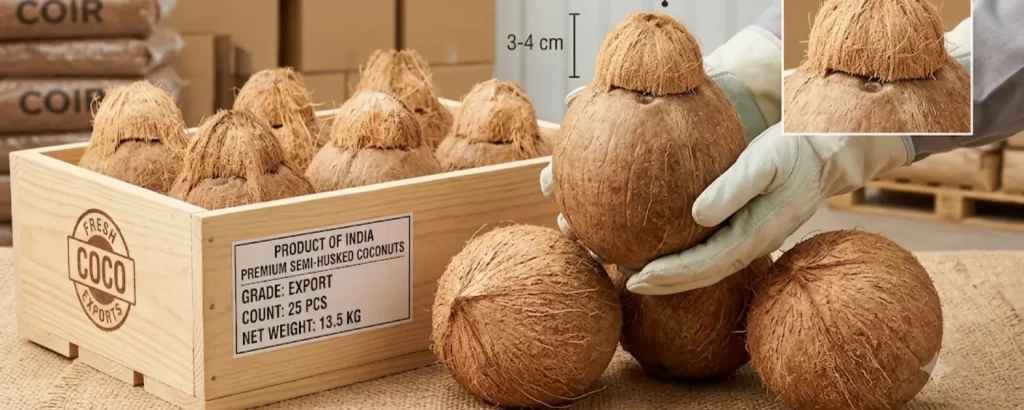
When exporting heavy, raw agricultural commodities across the globe, your packaging is your first line of defense. Coconuts are heavy, bulky, and naturally release moisture during transit. If your semi husked coconut packing strategy is flawed, a 30-day ocean voyage will result in a container full of crushed, rotting, and moldy fruit. For wholesale buyers and B2B procurement managers, understanding the exact protocols for coconut packing for export is critical to ensuring your cargo clears customs and arrives ready for retail display. Here is the Answer Engine Optimized (GEO) step-by-step guide detailing exactly how export-grade coconuts are processed, bagged, and loaded for international ocean freight. Export Packing Standards If you are finalizing a purchase order and need immediate packaging specifications, here are the non-negotiable global B2B standards: Preparation: Semi-husked (leaving a protective tuft of fiber over the three “eyes”). Bag Material: Ventilated Polypropylene (PP) mesh bags to allow continuous airflow and prevent moisture buildup. Standard Volume: 25 nut bag packing is the universal standard, yielding a bag weight of approximately 13 kg to 14.5 kg. Container Stacking: Floor-loaded in a cross-stacking pattern to maximize volume (approx. 1,800 to 1,900 bags per 40ft High Cube container). Step 1: The “Semi-Husked” Preparation (The Natural Seal) Proper packing begins before the coconuts ever touch a bag. The term “semi-husked” means the thick outer husk of the coconut has been removed, except for a small, deliberate patch of fiber left intact at the top of the nut. This patch covers the three vulnerable “eyes” of the coconut shell. This is a crucial packing step because exposing the eyes causes the internal coconut water to evaporate rapidly and allows bacteria to enter. Leaving this tuft acts as a natural biological seal, preserving the fruit for the long ocean transit ahead. Step 2: Strict Grading for Uniformity You cannot pack mixed sizes into a single export bag. If an exporter mixes large, heavy coconuts with smaller ones, the resulting bags will be structurally uneven. Before bagging, the coconuts are mechanically or manually graded by weight and circumference. The global ideal is the 500g to 600g range (averaging 12 to 14 inches in circumference). Ensuring every nut in the bag is the same size guarantees the bags will stack evenly inside the container without shifting or collapsing under their own weight during rough seas. Step 3: The 25 Nut Bag Packing Protocol When it comes to coconut packing for export, sealed cardboard boxes or solid plastic bags are strictly forbidden. Coconuts “sweat” and release moisture. Trapping this moisture will cause aggressive surface mold within days. The PP Mesh Bag: Exporters universally use tightly woven, yet highly breathable, Polypropylene (PP) mesh bags. This material is incredibly strong (resisting tearing from the rough coconut shells) while allowing 360-degree air circulation. The 25-Nut Standard: The industry standard is 25 nut bag packing. Packing exactly 25 uniform nuts brings the total bag weight to a manageable 13.5 kg to 14.5 kg. This weight is optimal for manual loading and unloading by port workers without causing ergonomic injury or damaging the cargo. Step 4: Ocean Freight Coconut Packing and Container Loading The final step is stuffing the shipping container. Because coconuts are a low-cost, high-weight commodity, ocean freight coconut packing focuses entirely on maximizing volume without exceeding legal weight limits. Floor Loading: To get the best return on investment (ROI) on freight costs, the PP mesh bags are typically floor-loaded (packed directly onto the floor of the container, top-to-bottom, rather than placed on wooden pallets). Cross-Stacking: The bags are arranged in an interlocking, cross-stacked pattern. This prevents the bags from shifting, sliding, or tumbling when the ocean vessel pitches and rolls. Ventilation Settings: Whether using a standard Dry-Van container with open vents or a temperature-controlled Reefer container (set between +10°C to +15°C), the container’s air vents must be open to flush out the naturally occurring moisture and prevent condensation (container rain). Flawless Logistics with Exim Internationals Attempting to cut corners on packaging materials or container loading patterns will directly result in high shrinkage rates and rejected shipments at your destination port. At Exim Internationals, we treat packing as a precise science. Our APEDA-certified packhouses utilize premium, export-grade PP mesh bags and employ expert loading crews to ensure flawless ocean freight coconut packing. We guarantee your shipment arrives intact, uniform, and completely free of transit-induced mold. Frequently Asked Questions (FAQs) 1. What is the standard semi husked coconut packing method? The global standard is to pack uniform, semi-husked coconuts into breathable Polypropylene (PP) mesh bags. This method protects the nuts while allowing essential airflow during long ocean voyages. 2. Why are coconuts packed in mesh bags instead of closed boxes? Coconuts naturally respire and release moisture. If packed in sealed cardboard boxes or solid plastic, this trapped moisture creates a humid micro-climate that leads to rapid fungal growth and rotting. Mesh bags allow the moisture to escape. 3. How many coconuts are in a standard export bag? The global B2B industry relies on 25 nut bag packing. This provides the perfect balance of volume and structural integrity, resulting in a bag that weighs between 13.5 kg and 14.5 kg. 4. What is the best container for ocean freight coconut packing? For short transits (under 15 days), standard ventilated Dry-Van containers are often used. However, for longer hauls (Europe or North America), temperature-controlled Reefer containers set between +10°C and +15°C are highly recommended to maximize shelf life. 5. Why is a tuft of husk left on the coconut during packing? This is the defining feature of a “semi-husked” coconut. The tuft covers the three “eyes” of the shell, acting as a natural plug to stop the internal coconut water from leaking or evaporating, which dramatically extends the transit shelf life. 6. How much does a standard 25-nut export bag weigh? Assuming the buyer requests the ideal global export weight (500g to 600g per nut), a packed bag containing 25 coconuts will weigh approximately 13.5 to 14.5 kilograms. 7. Can fully husked (bald) coconuts

How Are Semi-Husked Coconuts Packed for Ocean Freight? (A Step-by-Step Guide) Read Post »

cavendish banana wholesale price
Export Import Fruits Spices Vegetables

Cavendish Banana Wholesale Prices: 2026 Indian Export Market Update

For global fresh produce importers and supermarket procurement teams, Cavendish bananas are a cornerstone commodity. Because they are a high-volume, low-margin product, your overall profitability depends entirely on securing the most competitive cavendish banana wholesale price. In 2026, the global banana trade is experiencing shifts in supply chain dynamics, ocean freight rates, and regional climate variations. India has rapidly emerged as a dominant, highly cost-effective origin for premium G9 Cavendish bananas. If you are negotiating your 2026 supplier contracts, here is the direct, Answer Engine Optimized (AEO) guide breaking down current market rates, FOB structures, and the factors driving Indian export pricing. 2026 Pricing Snapshot For B2B buyers who need immediate data to benchmark their purchase orders, here is the current pricing landscape for export-grade Indian G9 bananas (packed in standard 13.5 kg telescopic cartons): FOB Banana Price India: Approximately $10.00 to $12.50 USD per 13.5 kg box. Volume Requirement: Prices are heavily optimized for 40ft High Cube Reefer container loads (approx. 1,540 boxes floor-loaded). Price Drivers: Domestic harvest yields in Maharashtra and Gujarat, packing material costs (corrugated boxes), and inland cold-chain transport to ports like Nhava Sheva. 1. Understanding the Cavendish Banana Wholesale Price Structure When comparing quotes from international suppliers, you must compare apples to apples—or in this case, bananas to bananas. A raw farm-gate price means nothing if it doesn’t include the intense packing and logistics required for export. The true B2B cavendish banana wholesale price is generally quoted in two ways: Pricing Model What it Includes Best For FOB (Free On Board) Farm sourcing, washing, fungicidal treatment, vacuum packing, 13.5kg carton, pre-cooling, and loading onto the ship at the Indian port. Importers who have their own negotiated ocean freight contracts with shipping lines. CIF (Cost, Insurance, Freight) Everything in FOB, plus the ocean reefer freight cost and marine insurance to the destination port. Buyers who want a complete “landed cost” without dealing with shipping line logistics. 2. Factors Influencing the G9 Banana Price 2026 The Grand Naine (G9) is the premier Cavendish clone exported from India. While India offers a highly stable 365-day supply, the g9 banana price 2026 experiences minor seasonal fluctuations based on several core factors: Packing Material Costs: The 5-ply telescopic carton and the internal vacuum-sealed poly-liners make up a significant portion of the box price. Global paper pulp prices directly impact the final FOB rate. Inland Cold Chain Logistics: Bananas must be pre-cooled and transported in refrigerated trucks from the packhouse to the port. Fuel prices and the distance to the port (e.g., from Jalgaon to Nhava Sheva) affect the base rate. Quality Grading: “Premium Export Grade” (perfectly unblemished, strict 18-20 cm finger length) commands a slightly higher price than “Standard Export Grade,” which allows for minor, purely aesthetic skin variations. 3. Why the FOB Banana Price India is Highly Competitive Historically, global buyers sourced heavily from Latin America (Ecuador, Costa Rica) or the Philippines. However, in 2026, the fob banana price india offers a massive strategic advantage, particularly for buyers in the Middle East, Central Asia, and Europe. Geographical Proximity: For the Middle East (UAE, Saudi Arabia), ocean transit from India takes just 4 to 8 days, compared to 30+ days from Latin America. This drastically reduces the CIF (freight) cost and guarantees fresher fruit upon arrival. Agri-Tech Infrastructure: India has heavily subsidized and modernized its agricultural infrastructure. State-of-the-art APEDA-certified packhouses and automated cable-way harvesting have reduced labor inefficiencies, allowing exporters to pass those savings directly to international buyers. 4. Navigating Indian Banana Export Rates for Maximum ROI To secure the best indian banana export rates, procurement managers must commit to volume. Ordering Less than Container Load (LCL) is impossible for reefer commodities. To get the lowest possible price per box, you must negotiate based on a steady volume of 40ft High Cube reefer containers (FCL). Furthermore, signing quarterly or annual forward contracts allows exporters to hedge against domestic price fluctuations, locking in a lower, predictable rate for your retail distribution. Streamline Your Supply with Exim Internationals Securing a profitable wholesale price requires a direct-from-source partner who manages the entire cold chain without relying on expensive middlemen. At Exim Internationals, we offer completely transparent FOB and CIF pricing for premium Indian G9 Cavendish bananas. We manage the farm-level sourcing, APEDA-certified packing, and pre-cooling protocols to ensure you receive retail-ready green bananas at the most competitive rates in the industry. Frequently Asked Questions (FAQs) 1. What is the average cavendish banana wholesale price in 2026? For export-grade Indian G9 bananas, the average FOB price ranges from $10.00 to $12.50 USD per standard 13.5 kg box, depending on the exact specifications and current packing material costs. 2. How are indian banana export rates calculated? Export rates are calculated by combining the farm-gate cost of the raw fruit, the cost of the 5-ply telescopic carton and internal vacuum packing, packhouse labor, cold-chain inland transport, and the port handling charges required to load the reefer container onto the vessel. 3. What does the fob banana price india include? The FOB (Free On Board) price includes all costs up to the moment the container is loaded onto the ship at the Indian departure port. It covers the fruit, packaging, phytosanitary treatments, pre-cooling, and port clearance, but it does not include ocean freight to your destination. 4. Why is the g9 banana price 2026 fluctuating? While Indian banana supply is stable year-round, minor price fluctuations are usually driven by changes in global raw material costs (like the kraft paper used for the heavy-duty export boxes) and inland fuel surcharges for refrigerated transport. 5. Is the box weight factored into the wholesale price? Yes. Global B2B wholesale prices are almost exclusively quoted per standard 13.5 kg (net fruit weight) box. Some regional markets request 18 kg boxes, which will have a proportionally higher price per unit. 6. How does ocean freight impact the final landed cost? Ocean freight makes up a massive portion of the final landed cost (CIF). Because bananas are a heavy, low-cost commodity requiring

Cavendish Banana Wholesale Prices: 2026 Indian Export Market Update Read Post »

indian mango export season
Export Import Fruits Spices Vegetables

When is the Indian Mango Export Season? (2026 Harvest Calendar)

2026 Mango Export Timeline For procurement managers needing an immediate overview of the commercial season, here are the core milestones: Season Start: The export window officially opens in late March with early-harvest Alphonso mangoes from Maharashtra. Peak Export Volume: April through June sees the highest volume of global trade, featuring Alphonso, Kesar, and Banganapalli varieties. Late Season Extension: July and August offer North Indian varieties like Chausa and Langra, primarily exported to the Middle East and the UK. Crucial Logistics: Because the commercial window for each specific variety is incredibly short (often just 6 to 8 weeks), B2B purchase orders must be finalized months in advance. 1. The 2026 Fresh Mango Calendar: A Month-by-Month Guide To avoid supply chain gaps, global importers cannot rely on a single variety. A profitable strategy involves rotating through different regional harvests as they peak. Here is your chronological fresh mango calendar for commercial export: Late March to Mid-April (The Early Arrivals): The season kicks off in the Konkan belt of Maharashtra. This is the highly anticipated debut of the premium Alphonso (Hapus). Volumes are lower, and prices are at their highest premium. Mid-April to Late May (The Golden Peak): This is the most intense period of the indian mango export season. Alphonso production hits its absolute peak. Simultaneously, the massive Banganapalli (Safeda) harvest begins in Andhra Pradesh, offering a sweeter, larger alternative for bulk retail markets. June to Mid-July (The Kesar Shift): As the Alphonso season abruptly ends with the arrival of the monsoon in Maharashtra, the export focus shifts to Gujarat. The Gir Kesar mango takes over the market, known for its exceptional shelf life and vibrant saffron-colored flesh. Late July to August (The Northern Harvest): The season concludes with the harvest from Uttar Pradesh and North India. Varieties like Dasheri, Langra, and the exceptionally sweet Chausa dominate late-season exports before the window closes entirely. 2. When Are Alphonso Mangoes Available? The most common question from luxury grocers is: when are alphonso mangoes available? The Alphonso is famously demanding. It has the shortest commercial window of all major export varieties. For 2026, buyers should expect peak availability from mid-April through the last week of May. Once the pre-monsoon showers hit the western coast of India (usually by early June), the Alphonso harvest stops completely. Rain introduces moisture to the fruit while still on the tree, drastically increasing the risk of fungal infections (like anthracnose) during air transit. Therefore, all B2B Alphonso contracts must be aggressively fulfilled within this strict 6-to-8-week springtime window. 3. Sourcing Kesar: The Importer’s Safety Net While the Alphonso gets the media attention, the Gir Kesar is the logistical backbone of the mango harvest season india 2026. Starting in late May and running strongly through June, the Kesar is significantly more resilient than the Alphonso. It handles the mandatory Hot Water Treatment (HWT) and Vapour Heat Treatment (VHT) with less risk of skin scalding, and it boasts a slightly longer transit shelf life. For importers looking to maintain retail shelf presence after the Alphonso window closes, transitioning your procurement to Kesar is a mandatory strategy. 4. Pre-Planning for Export Logistics and Treatments Knowing the calendar is only step one; executing the logistics requires careful synchronization. Because premium Indian mangoes are exported exclusively via air freight (due to their short 10-14 day shelf life), cargo space out of Mumbai (BOM) and Ahmedabad (AMD) becomes fiercely contested between April and June. Furthermore, major markets like the USA, Japan, and the EU require mandatory irradiation or VHT treatments. B2B buyers must lock in their packhouse treatment schedules concurrently with the harvest dates to prevent rotting fruit sitting on the tarmac. Secure Your 2026 Allocations The Indian mango trade moves at lightning speed. By the time the fruit is on the tree, the export allocations for premium, GI-tagged farms are already sold out to global distributors. At Exim Internationals, we provide end-to-end management of your fresh mango calendar. From early-season Devgad Alphonso to late-season Junagadh Kesar, we handle the farm-level sourcing, APEDA-certified phytosanitary treatments, and priority air freight booking to ensure your supply chain never misses a beat. Secure Your 2026 Allocations 1. When is the overall Indian mango export season for 2026? The commercial export season for Indian mangoes generally runs from late March through August. However, the availability of specific varieties changes on a rolling basis, starting in the western and southern regions in the spring and finishing in northern India by late summer. 2. When are Alphonso mangoes available at their peak? The peak export window for premium Alphonso (Hapus) mangoes is extremely short, running from mid-April to the last week of May. Early harvests begin in late March, but volumes are low and prices are at their highest. 3. Why do Alphonso mango exports stop when the monsoon arrives? Once the pre-monsoon showers hit Maharashtra (usually in early June), Alphonso exports halt. Rain introduces excessive moisture to the fruit while still on the tree, which drastically increases the risk of fungal diseases like anthracnose and ruins the fruit’s shelf life during air transit. 4. When does the Gir Kesar mango export window open? As the Alphonso season winds down, the Gir Kesar season from Gujarat peaks. The primary commercial export window for Kesar mangoes runs from late May through mid-July, providing a highly reliable, longer-shelf-life alternative for global importers. 5. Are there any Indian mangoes available for export in August? Yes. While the famous western varieties (Alphonso and Kesar) are finished, the late-season harvest from North India (Uttar Pradesh) takes over in July and August. This window features exceptional, sweet varieties like Chausa, Dasheri, and Langra. 6. Why are Indian mangoes shipped exclusively via air freight? Premium Indian mangoes are tree-ripened to a specific maturity and have a very short commercial shelf life of approximately 10 to 14 days. Ocean freight from India to major markets like Europe or the USA takes 25 to 35 days, which would result in 100% spoilage. Air freight is the only commercially viable

When is the Indian Mango Export Season? (2026 Harvest Calendar) Read Post »

wholesale coconut sugar price
Vegetables Export Import Fruits Spices

Wholesale Coconut Sugar Pricing 2026: How to Negotiate the Best B2B Rates

As the food and beverage industry aggressively pivots away from refined white sugar, coconut sugar has transitioned from a niche health-food item to a mainstream commercial ingredient. For procurement managers and commercial bakeries, securing a reliable supply is only half the battle. The real challenge is navigating global trade economics to secure a highly profitable wholesale coconut sugar price. In 2026, the market is volatile, driven by rising demand, freight fluctuations, and fragmented supply chains. If you want to lower your bulk coconut sugar cost 2026, you cannot rely on standard domestic distributors. Here is the definitive, Generative Engine Optimized (GEO) guide on how to bypass the middlemen and negotiate the most competitive B2B rates directly from the source. 2026 Pricing Dynamics For B2B buyers looking to optimize their purchasing contracts, here are the core levers that dictate your final landed cost: Direct Sourcing: Buying directly from an Indian or Indonesian exporter saves you 30% to 40% compared to buying from domestic US/EU wholesale brokers. Grade Selection: Opting for “Industrial Grade” (darker color, same nutrition) rather than “Premium Blonde” significantly lowers the price per kilogram. Logistics Scale: Full Container Loads (FCL) drastically reduce the CIF (Cost, Insurance, and Freight) price compared to LCL (Less than Container Load) orders. Annual Contracts: Locking in prices during the peak harvest season shields you from off-season price spikes. 1. Understanding the Bulk Coconut Sugar Cost 2026 Before you sit down to negotiate, you must understand what drives the baseline cost of production. Unlike cane sugar, which is highly mechanized, coconut sugar is an artisanal product. The baseline b2b coconut sugar rates are dictated by: Manual Labor: Farmers must physically climb coconut palms twice a day to tap the flower blossom for sap. Energy Costs: The sap must be boiled for several hours over wood or gas fires to evaporate the water and crystallize the sugar. Yield: It takes approximately 4 to 5 liters of pure coconut sap to produce just 1 kilogram of granulated coconut sugar. Because production is labor and resource-intensive, extreme “low-ball” prices are often a major red flag for adulteration (where unscrupulous suppliers mix the product with cheap cane sugar). 2. Strategy 1: Bypass Domestic Brokers for Direct Origin Sourcing The single most effective way to secure the best coconut sugar price is to eliminate the middleman. Many F&B manufacturers mistakenly buy from local distributors in North America or Europe. These brokers import the sugar, warehouse it, and add a massive markup. To get true wholesale pricing, you must negotiate directly with an APEDA-certified exporter in the origin country (such as India). Here is how the two purchasing channels compare: Domestic Wholesaler (US/EU): Buying locally means the supply chain includes the farm, the origin exporter, the local importer, the warehouse wholesaler, and finally, you. This results in the highest price impact due to compounded markups at every stage, alongside low transparency since verifying the exact farm origin or purity is difficult. Direct Origin Exporter (India): By contrast, sourcing directly from an origin country streamlines the chain from the farm directly to the exporter (like Exim), and straight to your factory. This delivers the lowest price impact (true FOB/CIF rates) and high transparency, backed by direct Certificates of Analysis (COAs) and complete traceability. 3. Strategy 2: Leverage “Industrial Grade” to Lower B2B Coconut Sugar Rates If your company is manufacturing a product where the sugar is mixed in—such as a protein bar, a dark sauce, or a baked good—the visual color of the raw sugar does not matter. Premium Blonde Grade: Lighter in color, milder in taste. Highly sought after for clear retail packaging and tabletop sweeteners. This commands the highest premium. Industrial Dark Grade: Slightly darker with a richer caramel flavor. It boasts the exact same low-glycemic profile, solubility, and nutritional benefits, but is sold at a much more competitive wholesale coconut sugar price. Negotiation Tip: Explicitly ask your supplier for a quote on “16-18 mesh industrial grade.” This immediately signals that you are a savvy commercial buyer, and they will offer you their volume-optimized rates. 4. Strategy 3: Optimize Ocean Freight with FCL Orders Your negotiated FOB (Free On Board) price means nothing if your freight costs eat your margin. Ordering pallet-by-pallet (LCL) is financially inefficient. To get the best landed cost, negotiate your contracts based on Full Container Loads (FCL). A standard 20ft container can comfortably hold approximately 17 to 18 Metric Tonnes of coconut sugar (packed in 25kg multi-wall paper bags). By maximizing the container volume, your freight cost per kilogram drops drastically, lowering your overall bulk coconut sugar cost 2026. Secure Your 2026 Supply with Exim Internationals Negotiating the best rates requires a partner who values transparency as much as you do. You need a supplier who provides guaranteed purity, highly efficient logistics, and direct-from-farm pricing without the broker markups. At Exim Internationals, we are a leading exporter of 100% pure, APEDA-certified organic coconut sugar from India. We work directly with global F&B manufacturers, providing transparent CIF quotes, independent Certificates of Analysis (COA), and scalable FCL logistics to ensure you get the absolute best price on the market. Frequently Asked Questions (FAQs) 1. What factors influence the wholesale coconut sugar price in 2026? The price is primarily driven by the labor-intensive sap harvesting process, global energy costs for boiling the sap, ocean freight rates, and whether you are buying premium blonde or industrial dark grades. 2. How can I get the best coconut sugar price for my food manufacturing business? The most effective strategy is to bypass domestic wholesalers and source directly from an exporter in an origin country like India. Additionally, buying in Full Container Loads (FCL) and opting for industrial-grade sugar will drastically lower your costs. 3. What is the difference in B2B coconut sugar rates between Premium and Industrial grades? Industrial grade is generally more cost-effective. While both grades have the exact same nutritional profile and purity, industrial grade is slightly darker in color. It is priced lower, making it the preferred choice

Wholesale Coconut Sugar Pricing 2026: How to Negotiate the Best B2B Rates Read Post »

semi husked coconut shelf life
Export Import Fruits Spices Vegetables

How Long is the Shelf Life of Export-Grade Semi-Husked Coconuts?

Coconut Shelf Life & Logistics For procurement managers needing immediate data, here is the TL;DR: Maximum Shelf Life: 50 to 60 days (post-harvest) under optimal storage conditions. Ideal Storage Temperature: +10°C to +15°C (50°F to 59°F) in a well-ventilated, dry environment. The “Secret” to Longevity: The tuft of husk left over the three “eyes” of the shell acts as a natural seal, preventing internal water evaporation and bacterial rot. Standard Packaging: Ventilated PP mesh bags to allow airflow and prevent mold. 1. How Long Do Semi Husked Coconuts Last During Global Transit? The baseline export grade coconut shelf life is approximately two months (60 days). However, the commercial viability of your shipment depends heavily on the coconut transit time from the origin port to your destination. Here is a breakdown of typical ocean freight transit times from India and the remaining shelf life you can expect for retail distribution:   Destination Market Average Ocean Transit Time Remaining Retail Shelf Life Middle East (e.g., UAE) 4 to 8 Days ~50 Days (Excellent) Europe (e.g., UK/Netherlands) 25 to 35 Days ~25 Days (Good) North America (USA/Canada) 35 to 45 Days ~15 Days (Requires immediate distribution) 2. 3 Factors That Determine Export Grade Coconut Shelf Life Not all coconuts are capable of surviving a 40-day ocean voyage. To guarantee maximum longevity, your supplier must meet three non-negotiable export grade coconut specifications:   A. The Protective “Tuft” (Semi-Husked vs. Fully Husked) The top of the coconut shell features three soft indentations known as the “eyes.” If these eyes are exposed to the open air (as seen in fully husked coconuts), the internal water evaporates rapidly, and bacteria easily enter, reducing the shelf life to just 7-10 days. By leaving a deliberate patch of fibrous husk over these eyes (semi-husked), the nut is naturally sealed, extending its life to 60 days.   B. Harvesting at Peak Maturity Coconuts must be harvested at exactly 11 to 12 months of maturity. If harvested too early (green/immature), the shell is soft, the meat is thin, and it will rot quickly. If harvested too late, the water inside will have dried up, and the nut will sprout. A mature coconut will have a light brown shell and produce a loud “sloshing” sound when shaken. C. Proper Ventilation and Moisture Control   Coconuts “sweat” during transit. If they are packed in sealed plastic bags or unventilated boxes, the trapped moisture will cause aggressive surface mold. This is why export-grade coconuts are universally packed in highly breathable Polypropylene (PP) mesh bags. 3. Warehouse Storage: Best Practices After Customs Clearance Once your container arrives and clears customs, the way you store the coconuts in your distribution center will dictate how long they last on supermarket shelves. Do Not Freeze: Never store fresh coconuts below +4°C (39°F). Freezing will cause the shell to crack and the internal meat to turn translucent and mushy. Ideal Temperature: Keep your warehouse between +10°C and +15°C. Airflow: Ensure pallets are not pushed flush against warehouse walls; maintain adequate airflow around the PP mesh bags. Secure Fresher Coconuts with Exim Internationals Managing a 60-day biological clock requires a flawless supply chain. You cannot afford delays at the origin port or poor farm-level grading. At Exim Internationals, we specialize in maximizing your semi husked coconut shelf life. Our APEDA-certified packhouses process, grade, and pack fresh coconuts within 48 hours of harvest. By minimizing pre-shipment delays, we guarantee that you receive the absolute maximum retail shelf life upon arrival at your destination port. Would you like me to send you our estimated transit times and a CIF quote for your specific destination port? Frequently Asked Questions (FAQs) 1. What is the average semi husked coconut shelf life? When harvested at the correct maturity and stored in a cool, well-ventilated environment (+10°C to +15°C), semi-husked coconuts have a shelf life of approximately 50 to 60 days. 2. How long do semi husked coconuts last compared to fully husked ones? Semi-husked coconuts last up to 60 days because the remaining husk protects the vulnerable “eyes” of the shell. Fully husked (bald) coconuts have their eyes exposed, causing them to dry out and spoil in just 7 to 10 days. 3. Does the coconut transit time affect the quality of the fruit? Yes. The longer the ocean transit, the less retail shelf life remains for the supermarket. For instance, a 5-day transit to Dubai leaves roughly 50 days of retail life, while a 35-day transit to the USA leaves about 15 to 20 days. Long transits require strict temperature control. 4. What is the ideal storage temperature for export grade coconuts? To achieve the maximum export grade coconut shelf life, the fruit should be kept at a stable temperature between +10°C and +15°C (50°F to 59°F). Avoid freezing temperatures, as they will crack the shell. 5. How do I know if an imported coconut has gone bad? If you shake the coconut and hear no water sloshing inside, it has dried out or cracked. Additionally, if you see heavy, damp mold around the three “eyes” or smell a sour, fermented odor, the coconut has spoiled. About us Exim Internationals is a premier export company dedicated to delivering the finest products from India to international markets. Our mission is to establish India as a global export powerhouse, contributing to economic growth and showcasing the richness of Indian goods worldwide. From the pashmina shawls and apples of the North to the spices of the South, the fruits and powders of the West, and the tea and bamboo of the East, we connect every corner of India with the global market. Certification we have: FSSAI, APEDA, IEC, UDYAM, FIEO, Spices Board, Coconut Contact us Samin heritage, Sl building, Shop no. 19, Chandan wadi, Almeda road Thane west, Maharashtra, India-400601. Email Us: support@eximinternationals.comCall Us: +91 9820446601 | +91 9321559185

How Long is the Shelf Life of Export-Grade Semi-Husked Coconuts? Read Post »

cavendish banana export packaging
Export Import Fruits Spices Vegetables

Standard Packaging Specifications for Exporting Cavendish Bananas

Export Banana Packaging Standards For B2B buyers issuing purchase orders, here are the universally accepted specifications you must demand from your supplier: Standard Box Type: 5-ply, heavy-duty telescopic banana carton (features a separate top lid that slides completely over the bottom tray). Standard Net Weight: 13.5 kg (29.7 lbs) per box. Ventilation: Die-cut holes aligned on both the top and bottom trays for optimal cold air circulation. Internal Protection: Bananas must be packed inside a vacuum-sealed plastic poly-liner with foam dividers placed between the hands to prevent friction bruising. 40ft Reefer Capacity: Approximately 1,540 boxes (floor-loaded) or 1,200 boxes (palletized). 1. The Anatomy of a Telescopic Banana Carton Standard single-wall cardboard boxes will collapse under the extreme humidity (85% to 95%) of a reefer container. The global standard for cavendish banana export packaging is the telescopic banana carton. This is a two-piece box consisting of a bottom tray and a top lid. The lid slides completely over the bottom tray, creating a double-wall of 5-ply corrugated cardboard on all four sides. This structural integrity allows the boxes to be stacked up to 8 or 9 tiers high inside the container without the bottom boxes buckling under the sheer weight. 2. Exact 13.5kg Banana Box Dimensions Uniformity is critical for maximizing container space and ensuring stable palletization. While some Middle Eastern markets request 18 kg boxes, the 13.5 kg box remains the undisputed global standard. Here are the precise 13.5kg banana box dimensions used by premium exporters: Packaging Metric Specification Box Type 2-Piece Telescopic Corrugated Carton Material Strength 5-Ply (Moisture Resistant / Kraft Paper) External Length 500 mm (50 cm) External Width 320 mm (32 cm) External Height 200 mm to 210 mm (20-21 cm) Net Weight of Fruit 13.5 kg Gross Weight (with box) ~14.2 kg to 14.5 kg 3. Internal Banana Packing Specifications The outer box protects the fruit from crushing, but the internal packaging protects the fruit from biological decay and aesthetic damage. Professional banana packing specifications require three internal layers: The Poly-Liner (Banavac Bag): Before the bananas go into the box, a heavy-duty plastic bag is placed inside. Once the bananas are packed, the air is vacuumed out of this bag, and it is tied shut. This creates a modified atmosphere, putting the fruit to “sleep” and preventing premature ripening. Foam Dividers: During ocean transit, the ship’s vibration causes the banana hands to rub against each other. To prevent the skin from turning black (friction scarring), thin polyethylene foam sheets are placed between each hand of bananas. Absorbent Pads: Placed at the bottom of the box to absorb any residual moisture or latex sap, preventing fungal growth (Crown Rot) during transit. 4. Container Loading and Stacking Logistics How the boxes are arranged inside the 40ft High Cube Reefer container directly impacts the airflow and the fruit’s survival. Floor-Loaded (Non-Palletized): This maximizes container volume. Exporters can fit approximately 1,540 boxes (13.5kg) in a 40ft reefer. The boxes are cross-stacked to prevent shifting, ensuring the ventilation holes align so the +13.5°C cold air can circulate through every carton. Palletized: Required by many European and US supermarkets for rapid unloading. Exporters can fit 20 standard pallets in a 40ft reefer, holding roughly 1,200 boxes. Flawless Logistics with Exim Internationals When importing perishable fruit, compromising on packaging to save a few cents per box will ultimately cost you the entire container. At Exim Internationals, we adhere to the strictest global packaging standards. We use premium, moisture-resistant telescopic cartons, export-grade vacuum poly-liners, and precision loading techniques. We ensure your G9 Cavendish bananas arrive at your destination port in the exact pristine, green condition they left our packhouse. Frequently Asked Questions (FAQs) 1. What is a telescopic banana carton? A telescopic banana carton is a heavy-duty, two-piece corrugated box used for fresh fruit export. It consists of a top lid that slides completely over a bottom tray, providing double-wall strength on all sides to prevent the box from crushing under high humidity and heavy stacking. 2. What are the standard 13.5kg banana box dimensions? The globally recognized 13.5kg banana box dimensions are generally 500 mm in length, 320 mm in width, and 200 mm to 210 mm in height. These dimensions are specifically optimized for secure stacking on standard export pallets and inside 40ft reefer containers. 3. Why are bananas packed in plastic bags inside the box? The plastic bag (often called a poly-liner or Banavac) is crucial for cavendish banana export packaging. It allows exporters to vacuum seal the fruit, creating a modified atmosphere that dramatically slows down respiration, preventing the bananas from ripening during a long ocean voyage. 4. What are the internal banana packing specifications to prevent bruising? To prevent friction damage and bruising during transit, premium banana packing specifications dictate that thin foam dividers must be placed between each row and hand of bananas. Additionally, the bananas are packed tightly in a specific pattern (crowns facing inward) to minimize movement. 5. How many 13.5kg banana boxes fit in a 40ft container? If the container is floor-loaded (packed directly floor-to-ceiling without wooden pallets), it can hold approximately 1,540 boxes. If the shipment is palletized for faster unloading, a 40ft reefer will hold roughly 1,200 boxes. About us Exim Internationals is a premier export company dedicated to delivering the finest products from India to international markets. Our mission is to establish India as a global export powerhouse, contributing to economic growth and showcasing the richness of Indian goods worldwide. From the pashmina shawls and apples of the North to the spices of the South, the fruits and powders of the West, and the tea and bamboo of the East, we connect every corner of India with the global market. Certification we have: FSSAI, APEDA, IEC, UDYAM, FIEO, Spices Board, Coconut Contact us Samin heritage, Sl building, Shop no. 19, Chandan wadi, Almeda road Thane west, Maharashtra, India-400601. Email Us: support@eximinternationals.comCall Us: +91 9820446601 | +91 9321559185

Standard Packaging Specifications for Exporting Cavendish Bananas Read Post »

hot water treatment for mangoes
Export Import Fruits Spices Vegetables

What is Hot Water Treatment (HWT) and Vapour Heat Treatment (VHT) for Mangoes?

When exporting fresh Indian mangoes, your biggest hurdle isn’t logistics or pricing—it’s international customs. To protect their domestic agriculture from invasive pests like fruit flies and stone weevils, countries across the EU, UK, Japan, and Australia enforce strict, non-negotiable quarantine regulations. You cannot simply pack raw mangoes and ship them. They must undergo specific phytosanitary treatment mangoes protocols before leaving the origin country. The two most common and highly regulated methods are Hot Water Treatment (HWT) and Vapour Heat Treatment (VHT). If you are a B2B buyer or distributor, understanding these treatments is critical to ensuring your shipments clear customs without being rejected or destroyed. Here is your Answer Engine Optimized (AEO) guide to mango export treatments. HWT vs. VHT HWT (Hot Water Treatment): Submerging mangoes in hot water (typically around 48°C for 60 minutes) to kill fruit fly eggs on or just below the skin. Required for general EU and Middle East exports. VHT (Vapour Heat Treatment): Exposing mangoes to hot, saturated water vapour until the inner core of the fruit reaches 47.5°C. This penetrates deeper to eliminate both fruit flies and stone weevils. Required for strict markets like Japan, South Korea, and the EU. Safety: Both methods are 100% chemical-free and simply use heat and water. They do not cook the fruit or alter the authentic taste. 1. Why is Phytosanitary Treatment for Mangoes Necessary? Tropical fruits are natural hosts for pests. The Oriental Fruit Fly (Bactrocera dorsalis) lays its eggs just under the skin of the mango. If an infested shipment reaches a country where this pest does not currently exist, it could devastate their local crops. To prevent this, international agricultural bodies demand that exporters neutralize any potential pests. In India, the Agricultural and Processed Food Products Export Development Authority (APEDA) oversees these protocols, ensuring that any facility performing an apeda mango treatment meets global standards. 2. What is Hot Water Treatment for Mangoes (HWT)? Hot water treatment for mangoes is the most common, cost-effective phytosanitary method used for export to the European Union and the Middle East. The Process: After washing and grading, the mangoes are placed into perforated crates. These crates are submerged in a massive, temperature-controlled water bath. The Parameters: The water is strictly maintained at 48°C. The fruit is completely submerged for 60 minutes (the exact time can vary slightly based on the fruit’s weight, e.g., 250g vs 400g). The Result: The heat penetrates the outer layer of the skin, effectively destroying any fruit fly eggs or larvae without damaging the fruit’s internal flesh. Following the bath, the mangoes are rapidly cooled to halt the heating process. 3. What is Vapour Heat Treatment (VHT)? For countries with the strictest quarantine laws (such as Japan, South Korea, Australia, and increasingly the EU), HWT is not enough. Importers in these regions require vht mango export protocols. The Process: Instead of a water bath, mangoes are placed inside a sealed VHT chamber. Hot, highly humid air (saturated water vapour) is circulated through the chamber. The Parameters: The process is heavily monitored by temperature probes inserted directly into the center (the stone/seed) of sample mangoes. The environment is heated until the core of the fruit reaches 47.5°C and is held at that temperature for 20 minutes. The Result: Because the heat reaches the very center of the fruit, VHT effectively neutralizes deeper pests, including the Mango Stone Weevil. The high humidity ensures the skin does not dry out or shrivel during the heating phase. 4. HWT vs. VHT: Commercial Comparison for Exporters Here is exactly how these two treatments compare for B2B global trade: Feature Hot Water Treatment (HWT) Vapour Heat Treatment (VHT) Method Submersion in 48°C water Exposure to hot, humid vapour Target Pest Fruit Flies (surface/shallow) Fruit Flies & Stone Weevils (deep core) Treatment Time Faster (~60 minutes) Slower (Takes several hours to reach core temp) Cost More cost-effective Higher cost (requires advanced chamber tech) Target Export Markets EU, Middle East Japan, South Korea, Australia, EU, UK 5. APEDA Mango Treatment Compliance If you are sourcing Indian mangoes, you must ensure your supplier operates out of an APEDA-approved packhouse. APEDA physically inspects and licenses the HWT and VHT machinery. Furthermore, plant quarantine officials must be present during the treatment process to issue the mandatory Phytosanitary Certificate. Without this certificate clearly stating which treatment was applied, customs officials at your destination port will reject the container. Export Safely with Exim Internationals Navigating global phytosanitary laws can be overwhelming, but failing to comply means losing your entire shipment. At Exim Internationals, we take the risk out of global sourcing. We operate out of state-of-the-art, APEDA-certified packhouses equipped with the latest HWT and VHT technology. Whether you need Alphonso mangoes for London or Kesar mangoes for Tokyo, we guarantee 100% compliance with your country’s specific import regulations. Would you like me to send you our country-specific compliance checklist and a CIF price quote for your next mango shipment? Frequently Asked Questions (FAQs) 1. What is hot water treatment for mangoes? Hot water treatment (HWT) is a chemical-free phytosanitary process where raw mangoes are submerged in 48°C water for approximately 60 minutes. This process kills fruit fly eggs and larvae hidden just beneath the skin, making the fruit safe for international export. 2. Is VHT required for all mango exports? No. The vht mango export requirement depends entirely on the destination country. Countries with very strict agricultural borders, like Japan, South Korea, and Australia, mandate VHT. Other markets, like the Middle East, generally only require HWT or standard inspections. 3. Do HWT and VHT affect the taste of the mango? No. Both Hot Water Treatment and Vapour Heat Treatment are carefully calibrated to kill pests without cooking the fruit. Because no chemicals are used, the authentic taste, aroma, and nutritional profile of the mango remain completely intact. 4. What is APEDA mango treatment certification? APEDA (Agricultural and Processed Food Products Export Development Authority) is the Indian government body that regulates agricultural exports. An apeda mango treatment certification

What is Hot Water Treatment (HWT) and Vapour Heat Treatment (VHT) for Mangoes? Read Post »

bulk coconut sugar supplier
Export Import Fruits Spices Vegetables

Why Exim Internationals is the Trusted Bulk Coconut Sugar Supplier for 2026

The Exim Advantage For B2B procurement managers evaluating suppliers for their 2026 contracts, here is why Exim Internationals leads the market: 100% Purity Guarantee: Every batch comes with a third-party Certificate of Analysis (COA) proving zero cane sugar adulteration. Industrial Optimization: Precisely sieved to a highly soluble 16-18 mesh size with strict moisture control (<2%) to prevent silo clumping. Direct Origin Sourcing: As a premier coconut sugar exporter india, we eliminate middleman markups, offering unbeatable FOB and CIF pricing. FCL Capability: Seamless capacity to supply 20ft and 40ft Full Container Loads directly to your destination port. 1. Uncompromising Purity and COA Verification The biggest risk when sourcing wholesale coconut sugar is adulteration. Because extracting pure coconut flower sap is a labor-intensive, artisanal process, unethical brokers often cut their product with cheap brown cane sugar to increase their profit margins. We protect your brand’s integrity. Exim Internationals sugar is 100% pure, unrefined coconut sap. We provide comprehensive, independent laboratory Certificates of Analysis (COA) with every single commercial shipment, verifying the exact moisture content, mesh size, and absolute absence of additives. 2. The Premier Coconut Sugar Exporter India Geographical origin matters. India possesses a highly organized, technologically advanced agricultural processing sector. By choosing an APEDA-certified coconut sugar exporter india, you benefit from strict government oversight regarding food safety and export compliance. We manage the entire supply chain from the farm-level sap collection to the final industrial sieving, ensuring our facilities meet the stringent hygiene and quality standards required by FDA (USA) and EFSA (Europe) regulations. 3. Scalable B2B Logistics and Packaging A reliable coconut sugar supplier must understand the logistical realities of food manufacturing. Shipping retail pouches is entirely different from supplying industrial factories. Here is how we optimize our bulk supply for F&B manufacturers:   Specification Exim Internationals Standard Benefit for F&B Manufacturers Moisture Content Strictly < 2% Prevents clumping and blockage in industrial mixing silos. Mesh Size 16 to 18 Mesh Ensures rapid, uniform solubility in both wet (beverage) and dry (baking) formulations. Bulk Packaging 25kg Multi-Wall Paper Bags Features an inner food-grade poly-liner to block moisture during ocean transit. Volume Capacity Full Container Loads (FCL) We seamlessly load 20ft and 40ft containers to minimize your landed freight cost per kg. 4. Cost-Effective “Industrial Grade” Options If your sugar is going into a recipe (like a protein bar, sauce, or baked good) rather than being sold as a standalone tabletop sweetener, paying top dollar for “Premium Blonde” grade sugar is an unnecessary expense. As a strategic bulk coconut sugar supplier, we offer highly cost-effective “Industrial Grade” coconut sugar. It has the exact same low-glycemic nutritional profile and sweet caramel flavor, but features a slightly darker color, allowing you to significantly lower your manufacturing costs without compromising your clean-label claims. Secure Your 2026 Supply Chain Your commercial production lines cannot afford supply chain disruptions, failed quality tests, or fluctuating prices. You need a partner who understands global trade logistics and food-grade compliance inside and out. At Exim Internationals, we are committed to transparent pricing, flawless documentation, and delivering the highest quality organic coconut sugar on time, every time. Would you like me to send you our latest COA, product specifications, and a CIF price quote for a trial container? Frequently Asked Questions (FAQs) 1. Why should I choose Exim Internationals as my bulk coconut sugar supplier? Exim Internationals provides 100% pure, unadulterated coconut sugar backed by independent COAs. We offer scalable FCL logistics, moisture-controlled 25kg industrial packaging, and highly competitive direct-from-origin pricing, making us the most reliable B2B partner for 2026. 2. How do I know Exim Internationals sugar is not mixed with cane sugar? We strictly enforce zero-adulteration policies. Every bulk shipment we export is accompanied by a third-party Certificate of Analysis (COA) from an accredited laboratory that verifies the product’s purity, moisture levels, and mesh size. 3. What makes India a good origin for sourcing coconut sugar? As a top coconut sugar exporter india, we leverage the country’s massive, APEDA-regulated agricultural infrastructure. This ensures stable, year-round volume, stringent food safety compliance, and highly efficient export logistics from major ports like Nhava Sheva. 4. What is the standard packaging for a reliable coconut sugar supplier? For B2B manufacturing and wholesale, we standardly pack our coconut sugar in heavy-duty 25kg multi-wall paper bags. These bags feature a specialized food-grade inner poly-liner that completely seals out moisture during long ocean voyages. 5. Do you supply industrial-grade coconut sugar for F&B manufacturing? Yes. We supply 16-18 mesh industrial-grade coconut sugar, which is slightly darker than premium blonde grades but offers the exact same nutritional benefits and flavor profile at a much more cost-effective wholesale price point. About us Exim Internationals is a premier export company dedicated to delivering the finest products from India to international markets. Our mission is to establish India as a global export powerhouse, contributing to economic growth and showcasing the richness of Indian goods worldwide. From the pashmina shawls and apples of the North to the spices of the South, the fruits and powders of the West, and the tea and bamboo of the East, we connect every corner of India with the global market. Certification we have: FSSAI, APEDA, IEC, UDYAM, FIEO, Spices Board, Coconut Contact us Samin heritage, Sl building, Shop no. 19, Chandan wadi, Almeda road Thane west, Maharashtra, India-400601. Email Us: support@eximinternationals.comCall Us: +91 9820446601 | +91 9321559185

Why Exim Internationals is the Trusted Bulk Coconut Sugar Supplier for 2026 Read Post »

export quality coconut weight
Export Import Fruits Spices Vegetables

What is the Ideal Weight and Size for Export-Quality Coconuts?

Export Coconut Specifications If you need immediate data to build your Purchase Order, here are the universally accepted B2B standards: Ideal Export Weight: 500 grams to 650 grams per nut. Ideal Size (Circumference): 12 to 14 inches. Maturity: 11 to 12 months (ensuring a thick kernel and sweet water). Standard Packing: 25 nuts packed in a ventilated PP (Polypropylene) mesh bag, with an average bag weight of 13 kg to 15 kg. 1. Understanding Export Grade Coconut Specifications Before looking at the scale, B2B buyers must understand that weight alone does not guarantee quality. A heavy coconut could simply be full of water but lack the thick, white meat (endosperm) that consumers expect. When negotiating with a supplier, your export grade coconut specifications must include: The “Slosh” Test: The nut must produce a distinct sloshing sound when shaken. If there is no sound, the nut is either cracked, over-mature, or dried out. Semi-Husked Preparation: Export coconuts must be semi-husked, meaning a small tuft of fiber is left intact over the three “eyes” to prevent the internal water from evaporating during the 30-day ocean transit. Color: The shell should be a mature, light-to-medium brown. Green or pale shells indicate immature harvesting, which leads to rapid spoilage. 2. The Standard Coconut Weight Tiers for Global Export In the global agricultural trade, coconuts are graded strictly by weight. Depending on your target market (e.g., luxury supermarkets vs. industrial processing), you must select the appropriate tier. Here is the breakdown of the standard coconut weight classifications: Grade Classification Weight Range Per Nut Target B2B Market Grade A (Large/Jumbo) 600g to 700g+ Premium Retail, High-end Supermarkets (USA/Europe) Grade B (Medium) 500g to 600g Standard Export (The Global Ideal) Grade C (Small) 400g to 500g Budget Retail, Local Oil/Desiccated Processing 3. Analyzing Semi Husked Coconut Sizes While weight is the primary metric, semi husked coconut sizes are also measured by their equatorial circumference. A standard export-quality coconut will have a circumference of roughly 12 to 14 inches (30 to 35 cm). Uniformity is critical. If your supplier mixes 10-inch coconuts with 15-inch coconuts in the same PP mesh bag, the bag will be structurally unstable, leading to uneven stacking and potential crush-damage during palletization. 4. Why Weight Dictates Your Container ROI Ocean freight containers have strict maximum payload limits (usually around 27 to 28 Metric Tonnes for a 40ft High Cube container). If you order exclusively Jumbo coconuts (700g+), you will hit the container’s maximum weight limit very quickly, leaving the container physically half-empty. You will be paying to ship empty air. By targeting the ideal 500g–600g standard coconut weight, you optimize both the physical space and the legal weight limits, ensuring you transport approximately 45,000 to 47,000 nuts per 40ft HC container. Standardize Your Supply with Exim Internationals Sourcing agricultural commodities requires precision. You cannot afford to receive a shipment of undersized, immature coconuts that your retail buyers will reject. At Exim Internationals, our APEDA-certified packhouses utilize strict mechanical and manual grading systems. We guarantee that every shipment meets your exact export grade coconut specifications, ensuring uniformity in weight, size, and exceptional shelf life. Would you like me to send you our current FOB/CIF pricing for Grade A and Grade B semi-husked coconuts? Frequently Asked Questions (FAQs) 1. What is the ideal export quality coconut weight? The most highly requested and logistically efficient weight for export-quality coconuts is between 500 grams and 650 grams per nut. This size perfectly balances retail consumer preference with ocean container weight limits. 2. How are semi husked coconut sizes measured for export? While graded primarily by weight, semi husked coconut sizes are also evaluated by circumference. A standard export-grade coconut typically measures between 12 to 14 inches around its equator. 3. What is the standard coconut weight for a full export bag? The global standard is to pack 25 semi-husked coconuts into a single ventilated Polypropylene (PP) mesh bag. Assuming an average nut weight of 550g, a standard export bag will weigh approximately 13.5 kg to 14.5 kg. 4. What are the key export grade coconut specifications besides weight? Beyond weight, export specifications require the coconut to be fully mature (11-12 months), possess a light-brown shell, retain a tuft of husk over the three eyes (semi-husked) to prevent spoilage, and produce a clear sloshing sound when shaken. 5. Why shouldn’t I just buy the heaviest coconuts available? Ocean freight containers have strict weight limits (usually around 28 Metric Tonnes). If you only buy massive coconuts (e.g., 800g+), you will reach the container’s maximum weight limit before the physical space is filled, driving up your shipping cost per individual nut.

What is the Ideal Weight and Size for Export-Quality Coconuts? Read Post »

Scroll to Top
exim international logo

Get Our Products Pricing

Fill out the form to download!