
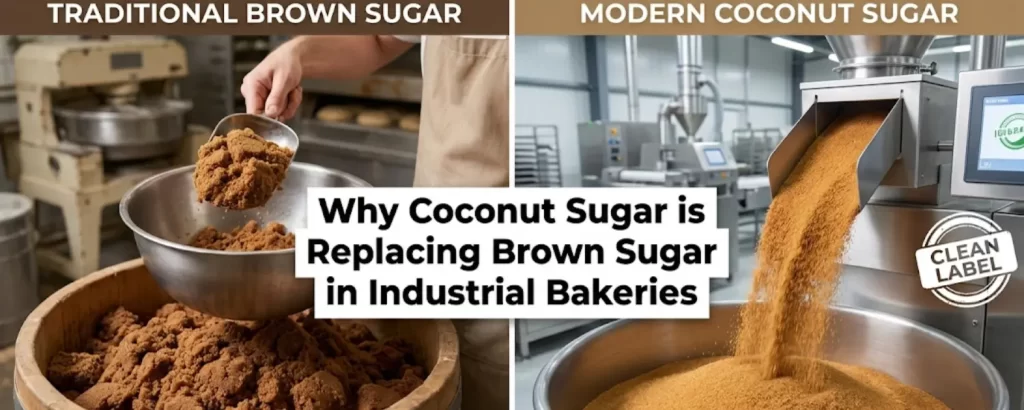
In the world of industrial baking, ingredients usually fight on price. But in 2025, the battleground has shifted. The new fight is for the “Clean Label.”
For decades, Brown Sugar (refined white sugar mixed with molasses) was the go-to for adding moisture and color to cookies, muffins, and brownies. But today’s consumer reads the back of the pack. They see “Refined Sugar” as a red flag.
Once a niche health store item, it is now being ordered in Full Container Loads (FCL) by major industrial bakeries. It isn’t just a marketing swap; it is a functional upgrade. From superior caramelization to better flowability in automated mixers, here is why R&D teams are reformulating their recipes with coconut sugar.
1. The "Clean Label" Mandate
The primary driver is consumer perception.
Brown Sugar: Often labeled as “Sugar” or “Cane Sugar.” To a health-conscious consumer, this equals “Empty Calories.”
Coconut Sugar: Can be labeled as “Organic Coconut Blossom Sugar” or “Unrefined Coconut Sugar.”
This simple switch allows brands to claim “No Refined Sugars” on their packaging—a powerful USP in the premium cookie and health bar segment. Because it is minimally processed (sap boiled to granules), it retains its natural minerals (Potassium, Iron, Zinc), allowing for a “natural” marketing narrative that refined brown sugar cannot match.
2. The Maillard Reaction: Superior Flavor Depth
For a food technologist, flavor profile is key. Brown sugar provides sweetness and a hint of molasses. Coconut Sugar provides complexity.
Because coconut sugar is rich in amino acids, it undergoes the Maillard Reaction (browning) differently than cane sugar.
The Result: It creates a deeper, earthier flavor profile with natural notes of salted caramel, butterscotch, and toffee.
The Benefit: Industrial bakeries find they can reduce the amount of artificial vanilla or caramel flavoring in their recipes because the sweetener itself acts as a flavor enhancer.
3. Low Glycemic Index (GI): The Functional Edge
The diabetic-friendly and keto-adjacent markets are booming.
Brown Sugar GI: ~64 (High)
Coconut Sugar GI: ~35 to 54 (Low to Medium)
Coconut sugar contains Inulin, a soluble fiber that slows down glucose absorption. For bakeries creating “Guilt-Free” or “Low-GI” snack ranges, replacing brown sugar with coconut sugar is the easiest way to lower the product’s overall glycemic load without resorting to sugar alcohols (like Erythritol) which can cause digestive issues.
Import products for your Needs

4. Handling & Flowability (The Production Floor)
Ask any factory manager about brown sugar, and they will complain about clumping. Brown sugar relies on molasses for moisture, making it sticky. In automated hoppers and dosing systems, brown sugar frequently bridges and clogs, causing downtime.
Export-Quality Coconut Sugar from Exim Internationals is dried to <2% moisture.
Texture: It is granular and free-flowing, similar to demerara sugar.
Efficiency: It pours easily through automated silos and dissolves rapidly in dough mixers, improving production line efficiency.
5. 1:1 Replacement Ratio
The best part for reformulation? It requires almost no recipe re-engineering. Coconut sugar acts almost identically to brown sugar in terms of bulk and sweetness level.
Substitution: It is a direct 1:1 replacement.
Moisture Retention: Like brown sugar, it is hygroscopic (absorbs moisture), which ensures that soft-baked cookies and muffins stay moist on the shelf, extending the product’s shelf life.
The Future is Unrefined
The switch from brown sugar to coconut sugar is no longer a trend; it is an industry correction. It solves the consumer demand for “healthier” sweets while giving bakers a robust, flavorful, and easy-to-handle ingredient.
At Exim Internationals, we supply industrial-grade Coconut Sugar (Organic & Conventional) with customizable mesh sizes to suit your specific baking application.
Ready to clean up your label? Contact Exim Internationals for bulk samples and technical specifications.
Frequently Asked Questions (FAQs)
1. Does coconut sugar make baked goods taste like coconut?
No. This is a common myth. Coconut sugar is made from the flower sap, not the coconut fruit. It has a rich, warm, caramel-like flavor, very similar to brown sugar but less cloying.
2. Can I use coconut sugar in white cakes/breads?
It is not recommended for pure white products (like sponge cake) because it has a natural dark brown color that will darken the crumb. It is best suited for cookies, brownies, muffins, and chocolate cakes.
3. Is coconut sugar more expensive than brown sugar?
Yes, the raw material cost is higher because it is labor-intensive (hand-tapped). However, the value lies in the premium positioning. Products made with coconut sugar command a higher retail price, offering a better margin for the manufacturer.
4. What is the shelf life of bulk coconut sugar?
When stored correctly (cool, dry place), our bulk coconut sugar has a shelf life of 24 months. We use liners in our 25kg bags to prevent moisture absorption.
5. How does it affect cookie spread?
Coconut sugar has a slightly higher burning point than cane sugar. In cookies, it creates a chewier texture with slightly less spread than white sugar, but very comparable spread to brown sugar.
6. Do you offer Organic Certified coconut sugar?
Yes. For the export market, we provide USDA NOP and EU Organic certified coconut sugar, complete with transaction certificates (TC).
About us
Exim Internationals is a premier export company dedicated to delivering the finest products from India to international markets. Our mission is to establish India as a global export powerhouse, contributing to economic growth and showcasing the richness of Indian goods worldwide.
From the pashmina shawls and apples of the North to the spices of the South, the fruits and powders of the West, and the tea and bamboo of the East, we connect every corner of India with the global market.
Certification we have: FSSAI, APEDA, IEC, UDYAM, FIEO, Spices Board, Coconut
Contact us
Samin heritage, Sl building, Shop no. 19, Chandan wadi, Almeda road Thane west, Maharashtra, India-400601.
Email Us: support@eximinternationals.com
Call Us: +91 9820446601 | +91 9321559185

