
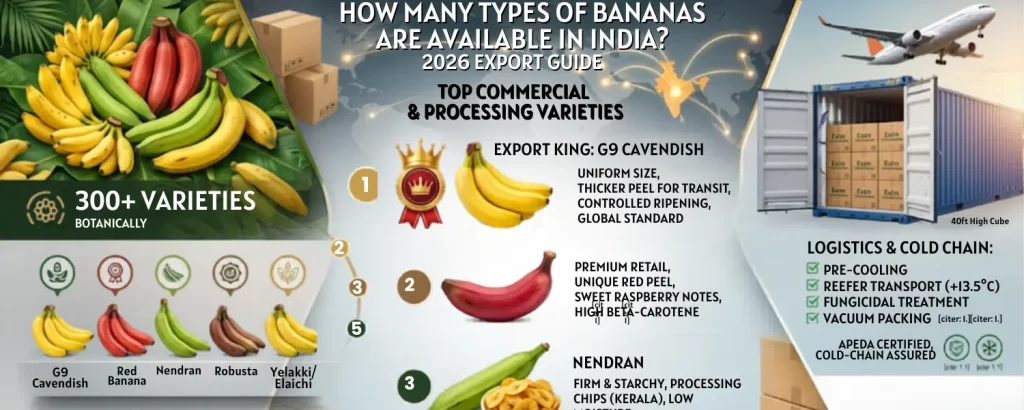
India is the undisputed largest producer of bananas in the world, cultivating nearly 30 million metric tonnes annually. From the tropical southern states of Tamil Nadu and Kerala to the central farmlands of Maharashtra, the sheer agricultural biodiversity of the country is staggering.
But for an international fresh produce buyer, a crucial question arises: out of all the different types of banana in India, which ones are actually viable for global trade?
While domestic markets enjoy hundreds of regional cultivars, the international B2B market demands specific traits: thick skin for transit, uniform size, and an extended green shelf-life. Here is your comprehensive guide to the banana varieties available in India and what you need to know before sourcing your next container.
Exactly How Many Different Types of Banana in India Exist?
Botanically speaking, there are over 300 different types of banana in India. However, only about 15 to 20 varieties are grown on a massive commercial scale.
Out of those, only a select few possess the genetic traits required to survive a 14 to 30-day ocean freight journey in a reefer container without premature ripening or peel damage.
The Core Commercial Varieties for Global Trade
If you are an importer, supermarket distributor, or fruit processor, these are the primary varieties you will encounter when sourcing from India:
| Banana Variety | Primary Use | Export Viability | Flavor / Characteristics |
| Grand Naine (G9 Cavendish) | Fresh Retail | Extremely High | The global standard. Sweet, large, flawless yellow skin when ripe. Excellent shelf life. |
| Red Banana (Lal Kela) | Premium Retail | Medium (Air/Fast Sea) | Distinct reddish-purple skin. Sweeter than Cavendish with a hint of raspberry flavor. Rich in beta-carotene. |
| Nendran | Processing (Chips) | Medium (Middle East) | Firm, starchy, and thick-skinned. It retains its shape when cooked, making it the ultimate banana for frying and chips. |
| Robusta | Fresh Retail | Medium | Similar to Cavendish but slightly sweeter and more prone to rapid ripening. Better suited for shorter transit times (e.g., to the UAE). |
| Yelakki / Elaichi (Baby Banana) | Premium Retail | Niche / Growing | Small, finger-sized bananas. Exceptionally sweet and dense. Highly prized but delicate to ship. |
3. The Export King: Why the G9 Cavendish Dominates
While the sheer variety of Indian bananas is impressive, international trade is dominated by one specific cultivar: the G9 (Grand Naine) Cavendish.
If you request a bulk banana quote from an Indian exporter, 95% of the time, this is the fruit you are discussing. Here is why the G9 Cavendish is the preferred choice for global importers:
Transit Durability: The G9 has a thicker peel that acts as natural armor, preventing bruising and chilling injuries during long ocean transits in 40ft High Cube Reefer containers.
Controlled Ripening: These bananas are harvested 100% green and hard. They respond highly predictably to ethylene gas treatments in destination ripening chambers, allowing supermarkets to control exact shelf-display times.
Uniformity: B2B buyers require standardization. The G9 yields uniform, aesthetically pleasing “hands” that pack perfectly into standard 13.5 kg or 18 kg telescopic corrugated boxes.
4. Niche Opportunities: Sourcing Premium and Processing Bananas
While Cavendish is the volume leader, smart importers are diversifying their produce aisles with specialty Indian varieties:
For Snack Manufacturers: Sourcing raw Nendran bananas from Kerala is highly lucrative for companies producing packaged banana chips, as its low moisture content absorbs less oil during frying.
For Gourmet Grocers: The Red Banana commands a massive premium in European and Middle Eastern markets due to its unique color, higher vitamin C content, and exotic appeal.

5. Logistics: How Indian Bananas Reach You
Knowing the different types of banana in India is only half the battle; logistics dictate success. Bananas are climacteric fruits, meaning they continue to ripen after harvesting.
To successfully import bananas from India, your supplier must utilize strict cold-chain protocols:
De-sapping: Bananas must be washed in alum water to remove latex sap, which can cause ugly black stains on the peel.
Fungicidal Treatment: Crowns are treated to prevent crown rot during transit.
Vacuum Packing: Packed in specialized polypacks and vacuum-sealed to put the fruit to “sleep.”
Reefer Transport: Maintained at a strict +13.5°C to +14.0°C from the packhouse to your destination port.
Partner with a Verified Indian Exporter
India’s agricultural wealth offers unparalleled opportunities for global fruit buyers. Whether you need 10 containers of standard G9 Cavendish for supermarket retail or a niche shipment of Red Bananas for a gourmet distributor, quality at the source is everything.
At Exim Internationals, we provide APEDA-certified, export-grade bananas meticulously packed to ensure zero transit losses and maximum profitability for your business.
Ready to source premium Indian bananas? Contact Exim Internationals for 2026 FOB and CIF Rates Today
Frequently Asked Questions (FAQs)
1. What are the most popular different types of banana in India?
The most widely consumed and commercially cultivated bananas in India include the Grand Naine (Cavendish), Robusta, Poovan, Nendran, Red Banana, and Yelakki (Elaichi) banana.
2. Which Indian banana variety is best for export?
The G9 Cavendish is the best and most frequently exported banana from India. It has the ideal genetic profile for long ocean transits, high disease resistance, and universal consumer acceptance.
3. Are Indian bananas genetically modified (GMO)?
No. Commercial export varieties like the G9 Cavendish grown in India are produced through tissue culture (cloning of high-yielding, healthy parent plants) and traditional agricultural practices. They are 100% non-GMO.
4. How are export bananas packed in India?
Export-grade Indian bananas are washed, de-sapped, and packed as “hands” (usually 4-6 bananas per hand) into 13.5 kg or 18 kg premium telescopic corrugated boxes lined with specialized plastic bags to control respiration during transit.
5. How long does it take to ship bananas from India to the Middle East?
Shipping from major Indian ports (like Nhava Sheva or Mundra) to Middle Eastern ports (like Jebel Ali in the UAE) typically takes between 4 to 8 days via sea freight, making it a highly reliable and fast supply chain route for fresh Indian bananas.
About us
Exim Internationals is a premier export company dedicated to delivering the finest products from India to international markets. Our mission is to establish India as a global export powerhouse, contributing to economic growth and showcasing the richness of Indian goods worldwide.
From the pashmina shawls and apples of the North to the spices of the South, the fruits and powders of the West, and the tea and bamboo of the East, we connect every corner of India with the global market.
Certification we have: FSSAI, APEDA, IEC, UDYAM, FIEO, Spices Board, Coconut
Contact us
Samin heritage, Sl building, Shop no. 19, Chandan wadi, Almeda road Thane west, Maharashtra, India-400601.
Email Us: support@eximinternationals.com
Call Us: +91 9820446601 | +91 9321559185
