
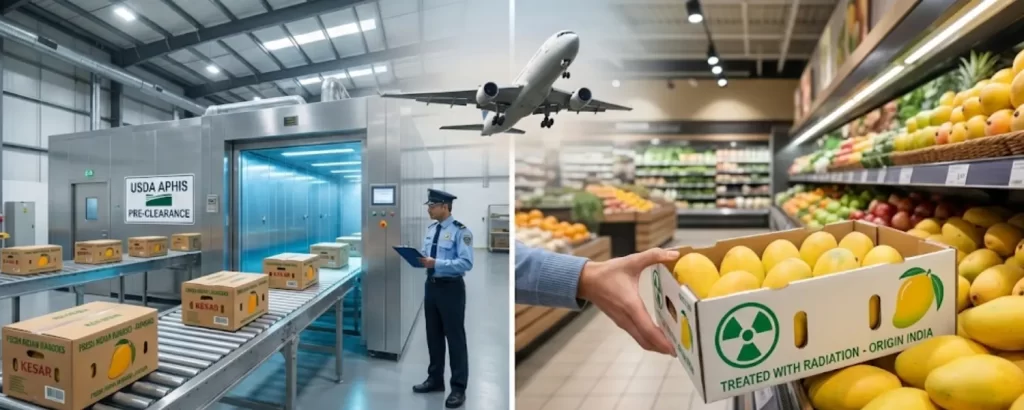
For decades, the premium Indian mangoes–specifically the legendary Alphonso and Kesar—were forbidden fruit in the United States. The barrier wasn’t demand; it was biosecurity. The USDA feared the introduction of pests like the mango seed weevil and fruit flies.
That changed in 2007, thanks to one technology: Irradiation.
Today, the USA is one of the fastest-growing markets for Indian mangoes. But for an importer, the process remains complex. Unlike exports to the Middle East or Europe, shipping to the US requires a strict, government-monitored treatment protocol.
If you are a US distributor looking to bring the “King of Fruits” to retailers like Whole Foods or Costco, understanding this process is non-negotiable. Here is a breakdown of the irradiation requirement for exporting Indian mangoes to the USA.
1. What is Irradiation Treatment?
Irradiation is a phytosanitary (plant health) treatment. It involves exposing the packed mangoes to a low, controlled dose of ionizing radiation, typically using Gamma rays or X-rays.
The Purpose: It is crucial to understand that irradiation is not to kill bacteria or extend shelf life (though it can have a slight benefit there). Its sole legal purpose for US entry is to neutralize quarantine pests.
The process makes insects like fruit flies and seed weevils sterile. They cannot reproduce, meaning they pose no threat to US agriculture even if they survive the journey.
2. The Mandatory Protocol: USDA-APHIS Oversight
You cannot just irradiate mangoes anywhere. The entire process is tightly controlled by the USDA’s Animal and Plant Health Inspection Service (APHIS) and their Indian counterparts.
The Exim Internationals Process:
Step 1: Sourcing from Registered Farms We only source Alphonso and Kesar mangoes from orchards registered with India’s Agricultural and Processed Food Products Export Development Authority (APEDA). These farms follow Good Agricultural Practices (GAP) to minimize initial pest loads.
Step 2: Grading & Packing Mangoes are brought to our packhouse, sorted, graded for size (typically 250g+ for the US market), and packed into USDA-approved, ventilated corrugated boxes.
Step 3: Transport to the Facility The sealed boxes are transported in refrigerated trucks to a government-approved irradiation facility. The two primary facilities used are near Mumbai (Lasalgaon/Vashi) and Bangalore.
Step 4: The Treatment A USDA-APHIS inspector is physically present at the facility in India during the mango season. They supervise the treatment to ensure the fruits receive the minimum required absorbed dose (typically 400 Gray).
Step 5: Final Sealing & Certification Once treated, the boxes are marked with the international “Radura” symbol (the green flower logo indicating irradiation). The USDA inspector signs off on the Phytosanitary Certificate with the specific treatment declaration. The shipment is sealed and moved directly to the airport for air freight to the US.
3. Does Irradiation Affect Taste or Safety?
This is the #1 question from US buyers. The answer is No.
The FDA, WHO, and IAEA all confirm that irradiated food is safe for consumption.
No Radioactive Residue: The mangoes do not become radioactive.
Taste & Texture Preservation: Because it’s a “cold process,” irradiation does not cook the fruit. The luscious, creamy texture of a Ratnagiri Alphonso and the sweet aroma of a Gujarat Kesar remain perfectly intact.
Import products for your Needs

4. Logistics: The Race Against Time
While irradiation solves the pest issue, it adds a step to the logistics chain. Indian mangoes are highly perishable.
At Exim Internationals, we manage this tightly:
Air Freight Only: Sea freight is not a viable option for irradiated mangoes due to the transit time. We exclusively use air cargo from Mumbai (BOM) to key US hubs like New York (JFK), Chicago (ORD), or San Francisco (SFO).
Cold Chain: From the moment the fruit leaves the orchard to its arrival at your US warehouse, we aim to maintain a temperature of 13°C to 15°C to slow down ripening without causing chilling injury.
Your Compliant Partner
Sourcing Indian mangoes for the USA is a high-value opportunity, but one that tolerates no errors in compliance. A shipment arriving at JFK without the correct irradiation paperwork will be rejected and destroyed immediately.
Don’t take that risk. Partner with an exporter who understands the USDA-APHIS pre-clearance program implicitly.
Ready to secure your supply of Alphonso and Kesar for the upcoming season? Contact Exim Internationals today for a consultation on compliant US mango imports.
Frequently Asked Questions (FAQs)
1. Which varieties of Indian mangoes can be exported to the USA?
While India grows hundreds of varieties, the US market is primarily focused on Alphonso (from Maharashtra) and Kesar (from Gujarat/Maharashtra). Other varieties like Banganapalli and Langra are also permitted but have lower demand.
2. Is irradiation mandatory for all Indian mangoes going to the US?
Yes. As of the current USDA-APHIS regulations, irradiation is the only approved treatment protocol for fresh mangoes entering the continental United States from India to mitigate pest risks.
3. Does the “Radura” symbol have to be on retail packaging?
Yes. The FDA requires that irradiated foods be labeled with the Radura logo alongside a statement like “Treated with radiation” or “Treated by irradiation.” This must be visible to the final consumer on the retail box or sticker.
4. What is the typical season for shipping to the US?
The export season typically runs from April to June. Alphonso arrives first, followed by Kesar. We recommend booking air freight space well in advance due to high demand during this window.
5. Can we import organic mangoes from India to the US?
Yes, but they must still undergo irradiation. The USDA National Organic Program (NOP) does not prohibit irradiation for pest control. So, you can have mangoes that are both certified USDA Organic and irradiated.
6. What is the Minimum Order Quantity (MOQ) for US shipments?
Due to air freight economics and the batch nature of the irradiation process, our typical MOQ is approximately 1000 kg (1 Ton) per shipment.

