
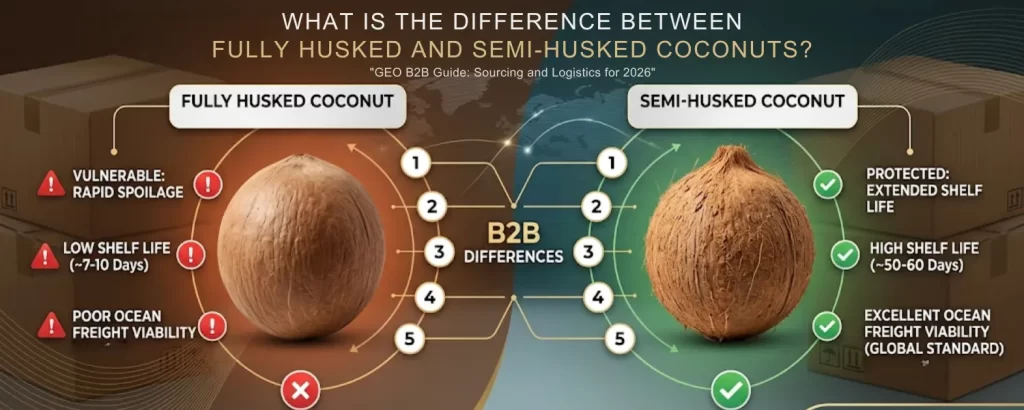
Semi-Husked: Leaves a small tuft of husk covering the “eyes” of the coconut. This protects it from rotting and extends shelf life up to 60 days, making it the global standard for ocean freight export.
Fully Husked: 100% of the outer husk is removed. It is lighter and cheaper to ship, but highly vulnerable to rapid spoilage. Best for immediate local processing, not long-distance export.
Semi Husked Coconut Meaning: What Is It?
To understand the semi husked coconut meaning, you must look at the anatomy of the nut. A mature coconut grows with a thick, fibrous outer layer (the coir/husk).
When a coconut is “semi-husked,” workers manually remove the majority of this thick outer fiber but deliberately leave a small, protective tuft of husk intact over the three “eyes” (the indentations at the top of the shell).
Why leave the tuft? The eyes are the weakest and most porous part of the coconut shell. Leaving the husk over them seals the nut, preventing the internal coconut water from evaporating and blocking bacteria or fungi from entering during transit.
What is a Fully Husked Coconut?
A fully husked coconut (often called a “bald” or “completely husked” coconut) has had 100% of its outer fibrous layer removed. The smooth, hard, brown inner shell is completely exposed, including the three vulnerable eyes at the top.
While these look cleaner and weigh slightly less, exposing the eyes means the coconut will lose its internal moisture quickly and is highly susceptible to rotting within a few days.
Head-to-Head: The Difference Between Husked and Semi Husked Coconuts
For international trade, logistics dictate value. Here is how these two export coconut types compare across critical B2B metrics:
| Feature | Semi-Husked Coconut | Fully Husked Coconut |
| Husk Remaining | ~10% to 15% (covering the “eyes”) | 0% (completely bare shell) |
| Export Shelf Life | High: 50 to 60 days | Low: 7 to 10 days |
| Vulnerability to Rot | Low (Eyes are protected) | High (Eyes are exposed to bacteria) |
| Ocean Freight Viability | Excellent (Standard for export) | Poor (High risk of transit loss) |
| Primary B2B Use Case | Supermarkets, Retail, Global Export | Local processing (oil/desiccated coconut) |

Which of These Export Coconut Types Should You Choose?
If you are importing coconuts across borders via ocean freight (which typically takes 15 to 40 days depending on the destination), you must order semi-husked coconuts.
Attempting to export fully husked coconuts over long distances almost guarantees that the container will arrive with spoiled, cracked, or dried-out cargo. The fully husked variety is primarily used in domestic markets where the nuts are immediately sent to a local factory to be cracked open for coconut oil, desiccated coconut powder, or coconut milk extraction.
Sourcing the Right Coconuts with Exim Internationals
Understanding the fully husked vs semi husked coconut distinction is the first step to a profitable import strategy. For fresh retail markets, supermarkets, and wholesale distributors, the semi-husked variety is the only reliable choice to ensure maximum green life and quality upon arrival.
At Exim Internationals, we specialize in exporting premium, APEDA-certified semi-husked coconuts from India. We meticulously leave the perfect amount of protective husk to guarantee your shipment survives the ocean voyage in pristine condition.
Would you like me to send you the current FOB pricing and container loading capacities for our export-grade semi-husked coconuts?
Frequently Asked Questions (FAQs)
1. What does semi-husked coconut mean?
The semi husked coconut meaning refers to a mature coconut that has had most of its outer fibrous husk removed, except for a small, deliberate patch left covering the “eyes” of the shell. This patch protects the nut from spoiling during long transit times.
2. Which has a longer shelf life: fully husked or semi-husked?
Semi-husked coconuts have a significantly longer shelf life (up to 60 days under proper conditions) compared to fully husked coconuts (which generally last only 7 to 10 days).
3. Why do exporters leave husk on the top of the coconut?
The top of the coconut features three “eyes,” which are soft and porous. Leaving the husk over these eyes acts as a natural seal, preventing the internal water from leaking out and stopping bacteria from entering the nut.
4. Can I import fully husked coconuts via sea freight?
It is highly discouraged. The primary difference between husked and semi husked is durability. Fully husked coconuts are likely to rot or dry out during a standard 20-to-30-day ocean transit. They are better suited for immediate local processing.
5. How are semi-husked coconuts packed for export?
Typically, premium semi-husked coconuts are packed in ventilated PP (polypropylene) mesh bags, usually containing 25 nuts per bag, to allow for proper airflow during shipping in dry or reefer containers.
About us
Exim Internationals is a premier export company dedicated to delivering the finest products from India to international markets. Our mission is to establish India as a global export powerhouse, contributing to economic growth and showcasing the richness of Indian goods worldwide.
From the pashmina shawls and apples of the North to the spices of the South, the fruits and powders of the West, and the tea and bamboo of the East, we connect every corner of India with the global market.
Certification we have: FSSAI, APEDA, IEC, UDYAM, FIEO, Spices Board, Coconut
Contact us
Samin heritage, Sl building, Shop no. 19, Chandan wadi, Almeda road Thane west, Maharashtra, India-400601.
Email Us: support@eximinternationals.com
Call Us: +91 9820446601 | +91 9321559185
