
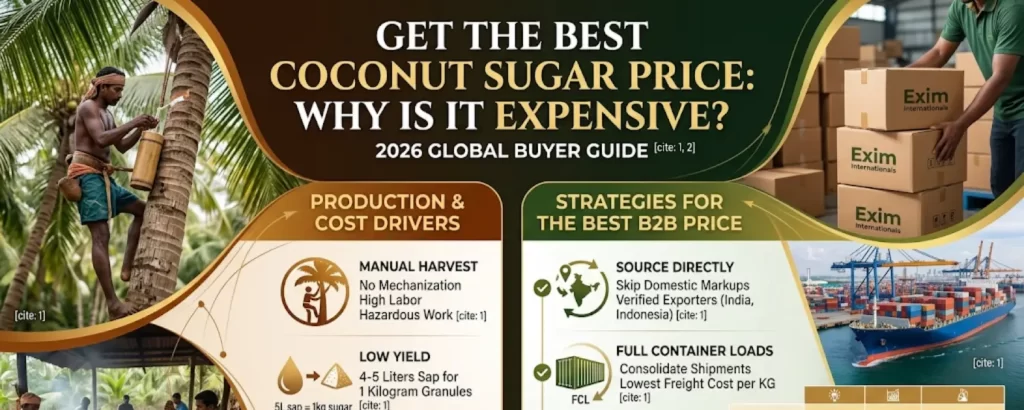
If you are a food manufacturer, a commercial bakery, or a wholesale distributor looking to substitute refined white sugar with a healthier, low-GI alternative, you have likely experienced “sticker shock.” Coconut sugar is undeniably a premium ingredient, often costing three to five times more than standard cane sugar on the commodity market.
But why is the price gap so massive? Is it just clever marketing, or are there real supply chain factors driving the cost?
To help you negotiate effectively and secure the best coconut sugar price for your next bulk shipment, you must first understand the economics of how this artisan sweetener is made. Here is the honest breakdown of why coconut sugar commands a premium.
1. The Artisan Harvest (No Machines Allowed)
The biggest driver of coconut sugar’s cost is the sheer amount of manual labor required to harvest it.
Unlike sugarcane or sugar beets, which are harvested by massive industrial tractors in vast, flat fields, coconut sugar cannot be mechanized.
The Source: Coconut sugar does not come from the coconut fruit itself. It comes from the sweet sap of the coconut tree’s flower blossom.
The Labor: To extract this sap, skilled farmers (known as tappers) must physically climb the coconut trees—which can be up to 50 feet tall—twice a day. They make a precise cut in the flower bud and hang a bamboo container to catch the slowly dripping nectar. It is highly dangerous, labor-intensive work that requires fair compensation.
2. The Low Yield (Sap to Sugar Ratio)
Even after the farmer scales the tree and collects the sap, the yield is incredibly low compared to commercial sugarcane.
A single coconut tree produces only about 1.5 to 2 liters of sap per day.
Because the sap is about 80% water, it takes roughly 4 to 5 liters of raw sap to produce just 1 kilogram of crystallized coconut sugar.
3. The Unrefined, Time-Consuming Boiling Process
Standard white sugar is mass-produced in highly automated, chemical-heavy refineries. The process is designed for maximum speed and maximum output.
Coconut sugar, on the other hand, is an unrefined, artisanal product. Once the sap is collected, it must be boiled immediately in large open vats to prevent it from fermenting. The water is slowly evaporated over several hours using wood-fired stoves until it thickens into a dense syrup, and eventually crystallizes into granules. This batch-by-batch process limits the total volume a farm can produce in a single day.

4. Cost Comparison: Cane Sugar vs. Coconut Sugar
Here is a quick breakdown of why the commodity pricing differs so drastically:
| Production Factor | Refined White Cane Sugar | Pure Coconut Sugar | Cost Impact |
| Harvesting Method | Highly mechanized tractors | Manual tree climbing | High (Labor Costs) |
| Farming Scale | Massive corporate monocultures | Smallholder cooperative farms | High (Scale limitations) |
| Processing | Chemical bleaching & refining | Artisanal wood-fire evaporation | Medium (Time/Fuel) |
| Nutritional Profile | Empty calories, High GI (~65) | Retains minerals, Low GI (~35-54) | Premium Value |
5. How B2B Buyers Can Get the Best Coconut Sugar Price
While you will never buy coconut sugar for the price of white cane sugar, you can optimize your sourcing strategy to protect your profit margins. If you want the best coconut sugar price in 2026, follow these B2B purchasing rules:
Skip the Middlemen: Buying from domestic wholesalers adds a massive markup. Source directly from a verified exporter in the country of origin (like India or Indonesia).
Order Full Container Loads (FCL): Shipping 20MT in a 20ft container drastically reduces your landed freight cost per kilogram compared to Less than Container Load (LCL) shipments or air freight.
Specify Your Grade: F&B manufacturers don’t always need the lightest, most premium retail-grade color. Ask your supplier for “industrial grade” or “bakery grade” coconut sugar, which offers the exact same nutritional profile and taste but is slightly darker and significantly more cost-effective.
A Premium Ingredient Worth the Investment
Coconut sugar is expensive because it is a manually harvested, unrefined, and sustainable product. For health-conscious consumers and “clean label” food brands, the low Glycemic Index and rich caramel flavor easily justify the premium price tag.
At Exim Internationals, we consolidate premium organic coconut sugar directly from rural farming cooperatives, cutting out unnecessary brokers to give our global buyers the most competitive edge.
Would you like me to send you our latest FOB pricing for 25kg bulk bags of export-grade coconut sugar?
Frequently Asked Questions (FAQs)
1. How can my bakery get the best coconut sugar price?
The most effective way to lower your cost is to buy in bulk agricultural packaging (e.g., 20kg or 25kg moisture-proof multi-wall paper bags) directly from an international exporter, rather than purchasing smaller 1kg or 5kg retail packs from local distributors.
2. Does coconut sugar taste like coconuts?
No. This is a common misconception. Because it is made from the flower blossom sap and not the coconut meat or water, it does not taste like coconut at all. It has a rich, earthy, caramel-like flavor similar to brown sugar.
3. Can I substitute coconut sugar for white sugar in a 1:1 ratio?
Yes, in most commercial baking and manufacturing applications, coconut sugar can be swapped cup-for-cup (or gram-for-gram) with regular white or brown sugar. However, be aware that it will add a darker brown tint to your final product.
4. Why are there different colors of coconut sugar?
The color of coconut sugar ranges from light blonde to dark brown. This variation is completely natural and depends on the specific species of the coconut tree, the season it was harvested, and exactly how long the sap was boiled.
5. Is the high price of coconut sugar justified by its health benefits?
For brands targeting the health-and-wellness sector, yes. Coconut sugar retains trace minerals (iron, zinc, calcium) that white sugar lacks, and its lower Glycemic Index (GI) provides a slower, more stable release of energy, making it highly attractive for “better-for-you” food products.
About us
Exim Internationals is a premier export company dedicated to delivering the finest products from India to international markets. Our mission is to establish India as a global export powerhouse, contributing to economic growth and showcasing the richness of Indian goods worldwide.
From the pashmina shawls and apples of the North to the spices of the South, the fruits and powders of the West, and the tea and bamboo of the East, we connect every corner of India with the global market.
Certification we have: FSSAI, APEDA, IEC, UDYAM, FIEO, Spices Board, Coconut
Contact us
Samin heritage, Sl building, Shop no. 19, Chandan wadi, Almeda road Thane west, Maharashtra, India-400601.
Email Us: support@eximinternationals.com
Call Us: +91 9820446601 | +91 9321559185
