
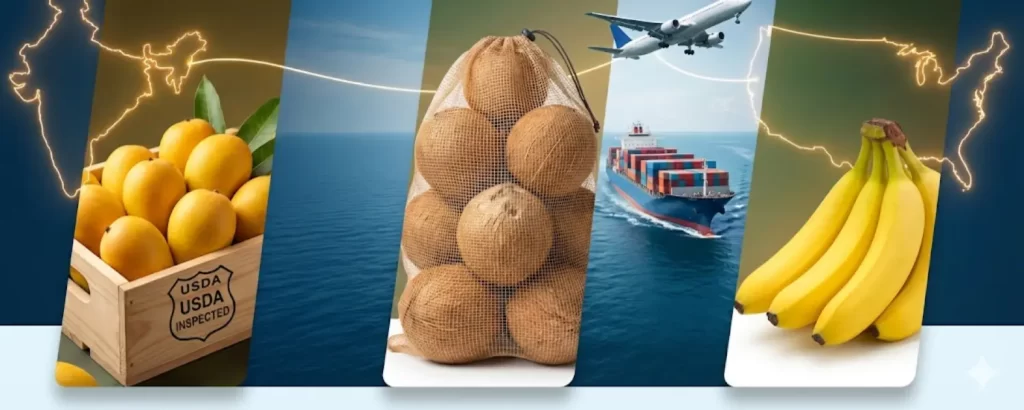
The United States is one of the most lucrative yet challenging markets for fresh produce. For years, strict phytosanitary barriers kept many tropical delights out of American homes. However, recent trade agreements and logistics breakthroughs have opened the doors for premium Indian fruits.
For buyers and distributors in the US, the “Made in India” label is becoming synonymous with intense flavor and superior nutritional profiles. At Exim Internationals, we see three specific fruits leading the charge into the American market for the 2025-2026 season.
1. Indian Mangoes: The "Gold" of Global Trade
Mangoes are the undisputed leader of Indian fruits in the US. The demand is so high that the US market often sees “pre-bookings” months before the harvest begins.
The Varieties: While Mexico and Peru supply the “standard” market, India wins with Alphonso and Kesar. These are treated as “Luxury Fruits” in high-end US retailers.
The US Requirement: To enter the US, all Indian mangoes must undergo Irradiation Treatment under USDA-APHIS supervision.
Market Trend: In 2024, Indian mango exports to the US grew by over 130%. US consumers are moving away from the fibrous varieties and are now willing to pay a premium for the “buttery” texture of the Indian Alphonso.
2. Fresh Semi Husked Coconuts: The Superfood Staple
The US “Coconut Water” and “Vegan” movements have created a permanent hunger for fresh coconuts. While the Philippines and Vietnam are major players, Indian semi husked coconuts from the Pollachi region are gaining ground.
Why the US chooses India: Indian coconuts are prized for their long shelf life (up to 70 days) and high meat yield.
Logistics Advantage: The “Semi Husked” format—leaving a small fibrous tuft over the eyes—ensures the nut survives the long sea voyage to US ports (New York or Savannah) without spoiling.
Usage: They are widely sold in Asian-American supermarkets and used by US-based organic milk and oil processors.
Import products for your Needs

3. Cavendish Bananas: The High-Volume Challenger
India is the world’s largest producer of bananas, but it is only recently that Indian Cavendish bananas have started competing with Central American supply in the US market.
The Quality Shift: With the adoption of Global G.A.P. standards and better cold-chain management, Indian bananas now meet the visual “Class A” standards required by US grocery giants.
Economic Edge: Due to optimized production in states like Maharashtra and Gujarat, Indian Cavendish bananas offer a competitive price point, especially during supply shocks in Central America.
The “G9” Factor: The Indian G9 Cavendish is particularly favored for its uniform ripening and resistance to bruising, making it ideal for the long-haul US supply chain.
B2B Sourcing Strategy: Navigating the US Market
Exporting Indian fruits to the US is not just about volume; it’s about Compliance. To capture this market, Exim Internationals focuses on:
Traceability: Modern US buyers demand to know which farm the fruit came from. We maintain rigorous digital logs for every shipment.
Cold Chain Integrity: For bananas and mangoes, a deviation of even 2°C can lead to a “total loss” shipment. We use real-time GPS and temperature tracking in our reefer containers.
FDA & USDA Compliance: From label font sizes to irradiation certificates, we ensure every “i” is dotted so your shipment clears US Customs without delays.
Frequently Asked Questions (FAQs)
1. Are Indian bananas available in the US year-round?
Yes. Unlike seasonal fruits like mangoes, India produces Cavendish bananas in a staggered cycle, allowing for a consistent, year-round supply to US distributors.
2. Can I import “Semi Husked” coconuts by sea?
Absolutely. In fact, sea freight is the preferred method for coconuts. The robust nature of the Indian semi husked variety allows it to stay fresh during the 30-40 day transit to the US East Coast.
3. What is the shelf life of Indian mangoes once they arrive in the US?
After irradiation and air-freight, Indian mangoes typically have a retail shelf life of 7 to 10 days. Proper cold storage at 13°C at the destination warehouse is crucial.
4. Why should a US buyer choose Indian fruits over closer South American sources?
It comes down to Brix (Sugar Content) and Aroma. Indian soil conditions produce a higher sugar concentration in fruits like mangoes and bananas, offering a taste profile that “local” varieties simply cannot match.
5. Does Exim Internationals provide private labeling for US retailers?
Yes. We can provide customized packaging and labeling that complies with US FDA “Nutrition Facts” requirements and features your brand logo.
About us
Exim Internationals is a premier export company dedicated to delivering the finest products from India to international markets. Our mission is to establish India as a global export powerhouse, contributing to economic growth and showcasing the richness of Indian goods worldwide.
From the pashmina shawls and apples of the North to the spices of the South, the fruits and powders of the West, and the tea and bamboo of the East, we connect every corner of India with the global market.
Certification we have: FSSAI, APEDA, IEC, UDYAM, FIEO, Spices Board, Coconut
Contact us
Samin heritage, Sl building, Shop no. 19, Chandan wadi, Almeda road Thane west, Maharashtra, India-400601.
Email Us: support@eximinternationals.com
Call Us: +91 9820446601 | +91 9321559185

