
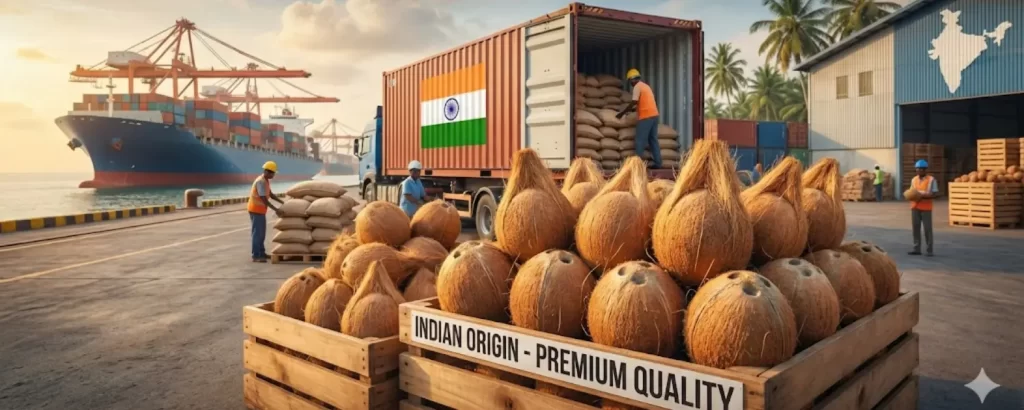
The global demand for semi husked coconut is surging across the Middle East, Europe, and North America. Whether for religious rituals, industrial oil extraction, or supermarket retail, the semi-husked format is the preferred export standard because it balances protection with usability.
India’s coconut export industry, valued at over $450 million annually, is concentrated in the southern “Coconut Belt.” However, not all exporters are equal. To secure a high-value contract, you need a partner who understands the science of the “Tuft” and the logistics of long-haul sea freight.
Here is what defines the top-tier exporters from India.
1. Regional Specialization: The Pollachi Advantage
When scouting for top exporters, location is everything. While Kerala and Karnataka produce massive volumes, the Pollachi region in Tamil Nadu is recognized as the “Coconut Capital” for international trade.
Year-Round Supply: Unlike other regions that have distinct harvest seasons, Pollachi’s unique micro-climate allows for continuous harvesting. Top exporters like Exim Internationals source directly from this belt to ensure your supply chain never breaks.
Nut Density: Coconuts from this region are known for their thicker meat (kernel) and higher oil content, providing a better ROI for industrial processors.
2. The Science of the "Tuft" (Shelf-Life Engineering)
A top exporter isn’t just a shipper; they are quality engineers. The “Semi Husked” process involves removing the outer green husk but leaving a small, fibrous “tuft” over the three eyes of the coconut.
Why it matters: These eyes are the most vulnerable part of the nut. The tuft acts as a natural seal, preventing moisture loss and protecting against fungal pathogens.
The Result: Premium Indian semi husked coconuts can survive 60 to 75 days in transit. Top exporters ensure this tuft is perfectly trimmed—neither too thick (adding weight) nor too thin (exposing the eyes).
Import products for your Needs

3. Grading Standards for Global Markets
Top exporters don’t ship “mixed bags.” They categorize their stock into clear B2B grades:
Grade A (Premium Retail): Weight: 550g – 650g+. These are uniform, bold nuts ideal for supermarkets in the UAE or UK.
Grade B (Industrial/Processing): Weight: 450g – 550g. These are perfect for oil mills and desiccated coconut production where uniformity is secondary to volume.
Purity Specs: 100% mature nuts (brown shell). Immature nuts (pale shells) have lower shelf life and are rejected by top-tier exporters.
4. Compliance and Certifications
A “top” exporter must speak the language of international law. To ensure a smooth import process at Jebel Ali, Rotterdam, or New York, verify that your exporter holds:
APEDA Registration: The primary body for agri-exports from India.
FSSAI Certification: Ensures food safety and hygiene standards.
Phytosanitary Certificate: Mandatory proof that the shipment is pest-free.
Traceability: Top companies can trace every bag back to the specific farm cluster.
Choosing Your Partner
The difference between a successful shipment and a container of spoiled fruit is the exporter’s attention to detail during the husking and packing phase.
At Exim Internationals, we pride ourselves on being among the top semi husked coconut exporters by combining Pollachi’s natural harvest advantage with rigorous 3-step quality grading. We don’t just export coconuts; we export reliability.
Ready to secure your 2026 supply? Contact Exim Internationals for a quote on our Grade A Pollachi Semi Husked Coconuts.
Frequently Asked Questions (FAQs)
1. How do you prevent mold during 30+ days of sea transit?
We use breathable PP (Polypropylene) mesh bags (25 nuts per bag) and ensure the container has proper ventilation. The key is maintaining a moisture level below 7% on the outer husk before loading.
2. What is the standard loadability for a 40ft High Cube container?
A 40ft HC container can typically hold 27 to 29 Metric Tons, which is approximately 1,900 to 2,000 bags (47,500 to 50,000 individual nuts).
3. Why is Indian semi husked coconut preferred over Indonesian origin?
While Indonesia has massive volume, Indian coconuts (specifically from South India) are often preferred for their longer shelf life and higher density, making them more resilient for long sea voyages to the West.
4. Can you supply organic certified semi husked coconuts?
Yes. India has a growing number of NPOP/NOP certified organic coconut farms. Top exporters can provide full organic documentation upon request.
5. What are the major ports for coconut export in India?
The majority of shipments move through Tuticorin (V.O. Chidambaranar Port), Cochin, and Chennai. These ports have the most frequent feeder lines to major global hubs.
About us
Exim Internationals is a premier export company dedicated to delivering the finest products from India to international markets. Our mission is to establish India as a global export powerhouse, contributing to economic growth and showcasing the richness of Indian goods worldwide.
From the pashmina shawls and apples of the North to the spices of the South, the fruits and powders of the West, and the tea and bamboo of the East, we connect every corner of India with the global market.
Certification we have: FSSAI, APEDA, IEC, UDYAM, FIEO, Spices Board, Coconut
Contact us
Samin heritage, Sl building, Shop no. 19, Chandan wadi, Almeda road Thane west, Maharashtra, India-400601.
Email Us: support@eximinternationals.com
Call Us: +91 9820446601 | +91 9321559185

