
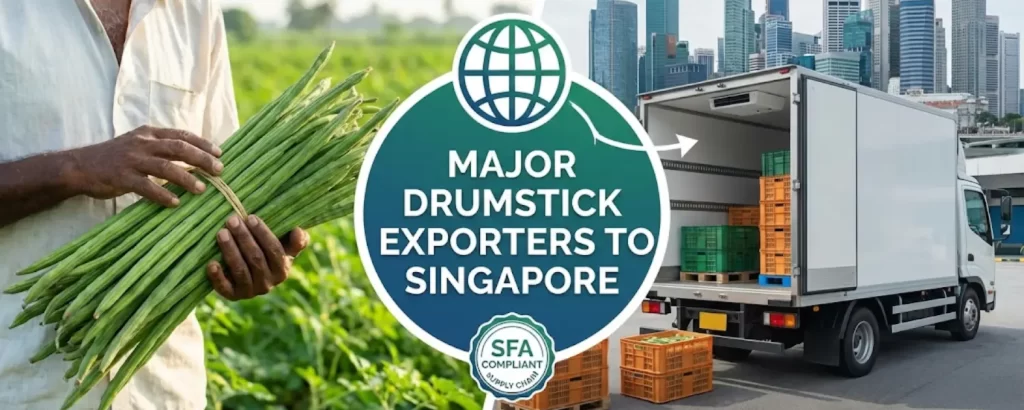
In the bustling wet markets of Geylang Serai and the premium aisles of NTUC FairPrice, the drum stick vegetable is a high-demand staple. Known for its medicinal properties and its essential role in sambar and fish curries, this vegetable is a logistical marvel—travelling from Indian farms to Singaporean tables in less than 24 hours.
If you are a wholesaler or retail buyer in Singapore, understanding who the major players are and how the supply chain works is crucial for your procurement strategy.
1. India: The Undisputed Global Supplier
India accounts for nearly 80% of the world’s drumstick production. For Singapore, India is the most strategic partner due to the short air-transit time from South Indian hubs.
Tamil Nadu (The Production Hub): Over 60% of Singapore’s drumsticks originate here. Regions like Oddanchatram and Theui are famous for high-yield, premium varieties.
Andhra Pradesh & Karnataka: These states serve as the secondary supply belt, ensuring that even during monsoon fluctuations in Tamil Nadu, Singapore’s supply remains uninterrupted.
2. Leading Exporting Varieties for the 2026 Market
Top exporters focus on specific cultivars that withstand the pressure of air travel and maintain their “snap” on the shelf:
PKM-1 & PKM-2: These are the “Gold Standard” for export. They are known for their uniform length (typically 25-35 cm), fleshy pulp, and dark green color.
Coimbatore-1: Prized for its long shelf life and resistance to bruising during packing.
3. Key Industry Players & Exporters
While the market is fragmented, a few names stand out for their consistent “Class A” quality:
Exim Internationals: Specializing in the India-to-Singapore corridor, providing daily air-freight shipments of Sortex-cleaned, pre-cooled Moringa pods.
Yeshraj Agro Exports & White Feather: Large-scale players focusing on bulk volumes for Singapore’s major distribution hubs.
Indimax Global Impex: A leader in sourcing specifically from the Oddanchatram belt in Tamil Nadu.
Import products for your Needs

4. Singapore’s Top Importers (The Reception End)
Once the pods land at Changi Airport, they are quickly absorbed by major local wholesalers who control the distribution:
Chai Ong Vegetable Trading: A major wholesaler in the Pasir Panjang Wholesale Centre.
Superme Vegetables Trading: Known for distributing fresh Indian perishables across the island.
Lip Keong Supplies: A key player in the supply chain for hypermarkets and catering services.
Logistics & Quality Standards for Singapore
To successfully export drum stick vegetables to Singapore, exporters must comply with the Singapore Food Agency (SFA) regulations:
Pesticide Residue Limits: Singapore has some of the world’s strictest limits on pesticide residues. Top exporters conduct batch-testing to ensure compliance with the Ninth Schedule of the Food Regulations.
The Cold Chain (5°C to 8°C): Drumsticks are highly perishable. They must be pre-cooled immediately after harvest to remove field heat and transported in reefer trucks to the airport.
Labelling: Every carton (usually 5kg or 7kg CFB boxes) must be labelled with the producer’s name, address, product description, and date of packing.
Sourcing for the Singapore Market
The Singapore market values tenderness and freshness. For 2026, the trend is moving toward Organic Moringa pods, which fetch a 30% premium in gourmet retailers. Finding an exporter who can navigate the SFA’s “TradeNet” permit system and provide daily fresh arrivals is the key to retail success.
Looking for a consistent supply of fresh PKM-1 Drumsticks for the Singapore market? Contact Exim Internationals today for our daily air-freight rates from Chennai and Trichy.
Frequently Asked Questions (FAQs)
1. How long does it take for drumsticks to reach Singapore from India?
Via air freight, the total time from the packhouse in Tamil Nadu to the Changi Cargo Complex is approximately 12 to 18 hours.
2. What is the typical shelf life of drum stick vegetables in Singapore?
When stored correctly at 5-8°C, fresh drumsticks have a shelf life of 7 to 10 days. At room temperature in a humid environment like Singapore, they should be consumed within 3 days.
3. Do drumsticks require a Phytosanitary Certificate for Singapore?
Yes. A Phytosanitary Certificate is mandatory for all fresh vegetables from India entering Singapore to ensure they are free from pests like fruit flies.
4. Can I import frozen drumsticks to Singapore?
Yes. While the demand for fresh is higher, frozen drumsticks are increasingly popular for the food processing industry and carry a longer shelf life (up to 12 months).
5. What is the MOQ for drumstick exports to Singapore?
Due to the high cost of air freight, most exporters require a Minimum Order Quantity (MOQ) of 500 kg to 1,000 kg per shipment.
About us
Exim Internationals is a premier export company dedicated to delivering the finest products from India to international markets. Our mission is to establish India as a global export powerhouse, contributing to economic growth and showcasing the richness of Indian goods worldwide.
From the pashmina shawls and apples of the North to the spices of the South, the fruits and powders of the West, and the tea and bamboo of the East, we connect every corner of India with the global market.
Certification we have: FSSAI, APEDA, IEC, UDYAM, FIEO, Spices Board, Coconut
Contact us
Samin heritage, Sl building, Shop no. 19, Chandan wadi, Almeda road Thane west, Maharashtra, India-400601.
Email Us: support@eximinternationals.com
Call Us: +91 9820446601 | +91 9321559185

