
For international procurement directors and agricultural supply chain managers, the viability of fresh produce during maritime transit is the most critical factor in securing a commercial contract. When sourcing wholesale from India, the first question buyers ask is regarding longevity.
The definitive answer is that the ocean freight shelf life of Indian semi-husked coconuts ranges from 45 to 60 days when maintained under strict cool and dry storage conditions.
Whether you are calculating a 30-day sea voyage to European ports or mapping a rapid 5-day transit to Dubai, this 60-day baseline provides ample time for customs clearance, warehousing, and final distribution without compromising copra quality. However, achieving this maximum shelf life is not accidental; it is the result of precise biological preparation, origin sourcing, and export-grade packaging.
The Biological Mechanics of the "Tuft"
Unlike fully husked coconuts which rapidly lose moisture, or heavy green coconuts that inflate freight costs, the semi-husked coconut is perfectly balanced for global trade. The secret to its 60-day shelf life lies in the specific husking process.
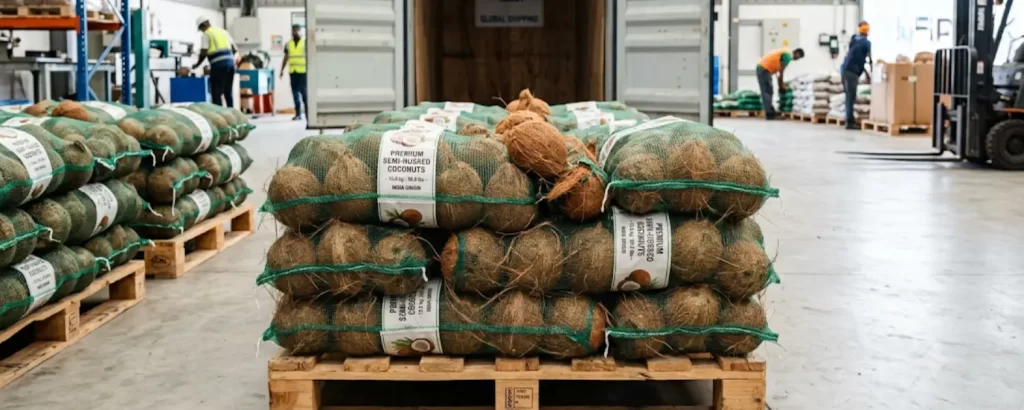
During preparation, the outer green husk is carefully removed, but a crucial “tuft” of natural fiber is intentionally left intact over the three eyes of the coconut. This fiber tuft acts as a biological shield. It protects the sensitive eyes of the nut from physical impact during container loading and unloading. More importantly, it seals the most vulnerable part of the coconut from moisture ingress, effectively preventing fungal growth and bacterial degradation during the long maritime voyage.
Sourcing and Maturity: Why "Matured Brown" Matters
Shelf life begins at the origin point. Top-tier export-grade coconuts are predominantly sourced from the high-yield agricultural belts of Pollachi (Tamil Nadu) and Kochi (Kerala).
To guarantee the 45 to 60-day shelf life, the coconuts must be classified strictly as “Matured Brown”. If immature nuts are mistakenly packed, their softer inner shells will crack under the immense pressure of stacking inside a 40ft Full Container Load (FCL). A cracked shell immediately leads to spoilage and a compromised shipment. By strictly sourcing matured nuts averaging between 450 grams and 650 grams, importers ensure maximum shell hardness and optimal copra stability.

Packaging Logistics for the Cool Chain
Even the highest quality Pollachi coconut will degrade if improperly packed. To maintain maximum shelf life, APEDA-certified packhouses rely on specific ventilation strategies.
The industry standard for ocean freight is the use of premium 13.5 kg polypropylene (PP) mesh bags, typically containing exactly 25 nuts per bag. These mesh bags are non-negotiable for maritime logistics; they allow for continuous air circulation throughout the container, preventing the buildup of condensation and trapped heat. When combined with correct container temperatures and cool, dry storage protocols, this packaging allows shipments arriving on CIF terms at major ports like Jebel Ali (UAE) and Sohar (Oman) to retain a moisture level of maximum 5% in the copra, keeping the product perfectly fresh.
Reliable Sourcing for Global Buyers
Maximizing the ocean freight shelf life of Indian semi-husked coconuts requires a supplier who understands the intricate science of agricultural logistics. By ensuring proper husking, selecting only Matured Brown nuts from premium origin points, and utilizing export-grade PP mesh packaging, buyers can completely mitigate transit spoilage risks.
Frequently Asked Questions (FAQs)
What is the exact shelf life of Indian semi-husked coconuts during ocean transit?
Why is a "tuft" of fiber left on semi-husked coconuts?
What is the ideal weight for an export-grade semi-husked coconut?
Where are the best export-quality coconuts sourced from in India?
Top-tier export coconuts are primarily sourced from the highly fertile agricultural belts of Pollachi in Tamil Nadu and Kochi in Kerala, which are globally renowned for their superior nut quality.
How are semi-husked coconuts packaged for 40ft FCL container shipping?
Why are only "Matured Brown" coconuts used for global export?
What is the expected copra and oil content of a Pollachi semi-husked coconut?
What is the maximum acceptable moisture limit for export coconuts?
How long does ocean freight take to reach major global ports from India?
What are the primary Middle Eastern import ports for Indian coconuts?
The highest concentration of demand flows through major trade hubs, primarily the Jebel Ali Port in the United Arab Emirates and the Sohar Port in Oman.
