
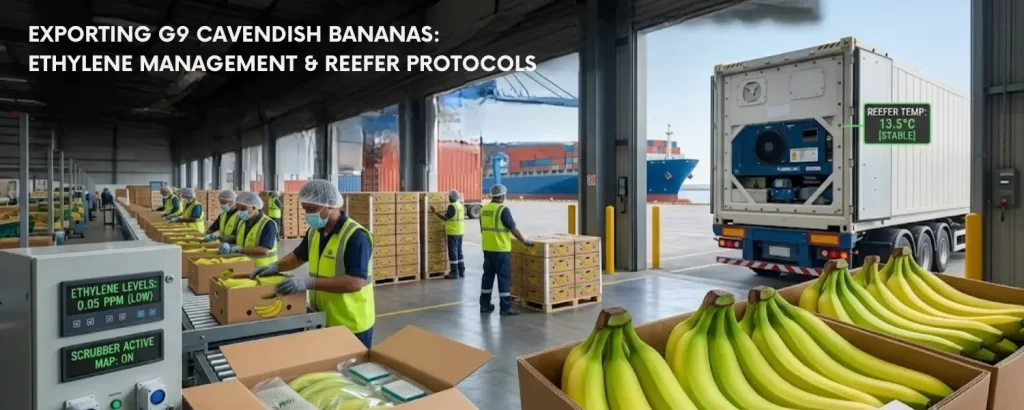
In the global fresh fruit trade, few commodities are as lucrative—or as unforgiving—as bananas. For B2B procurement directors and import managers, the risk is not just a few bruised fruits; a single container of prematurely ripened bananas represents tens of thousands of dollars in unsellable cargo.
India is the world’s largest producer of bananas, but translating that volume into export-grade success requires absolute mastery over the supply chain. When sourcing G9 Cavendish Bananas, your supplier must act less like a farmer and more like a biochemist.
In this guide, we break down the critical pre-shipment protocols, ethylene management strategies, and precise reefer container settings required to ensure your G9 Cavendish Bananas arrive at their destination perfectly green, firm, and ready for your ripening chambers.
The G9 Cavendish Advantage
Why does the international market overwhelmingly demand the Grand Naine (G9) Cavendish variety?
Unlike local varieties that bruise easily and ripen rapidly, the G9 Cavendish is genetically optimized for the rigors of maritime export. It boasts a thick peel that resists mechanical damage, a high yield per bunch, and a remarkably predictable ripening curve when exposed to controlled ethylene gas at the destination port.
However, these genetic advantages mean nothing if post-harvest protocols are mishandled.
1. Pre-Shipment Protocols: Harvesting and Processing
The battle against premature ripening begins the moment the banana hand is cut from the stem. Bananas are climacteric fruits, meaning they continue to ripen after harvest. The goal of the exporter is to hit the “pause button” on this biological process.
Harvesting Maturity
Export-grade G9 Cavendish Bananas must be harvested at exactly 75% to 80% maturity. At this stage, the fruit is physiologically mature (full-sized) but the starches have not yet begun converting into sugars. If harvested at 85% or higher, the fruit will inevitably ripen during a 15-to-30-day ocean transit, regardless of reefer settings.
The Alum-Water Wash Protocol
When banana hands are cut from the main stalk, they bleed a sticky, white latex. If this latex dries on the peel, it causes severe black staining, rendering the fruit cosmetically unacceptable for premium retail markets.
To prevent this, premium packhouses utilize a rigorous washing process:
De-latexing Pools: The hands are immediately submerged in cool, flowing water tanks to wash away the initial latex bleed.
Alum Treatment: The fruit is then passed through a secondary bath containing a precise concentration of alum (aluminum sulfate). Alum acts as a coagulant, stopping the latex flow entirely and sterilizing the crown (the cut area) to prevent fungal crown rot during transit.

2. Reefer Container Protocols and Temperature Management
Once packed, the bananas are loaded into refrigerated (reefer) containers. This is where precision dictates profitability.
The Danger of Chilling Injury
Bananas are highly sensitive to cold. If the temperature inside the container drops below 11.5°C (53°F) even briefly, the bananas will suffer from “chilling injury.” The cell walls break down, causing the peel to turn a dull, smoky grey or black. Worse, chilled bananas lose their ability to ripen properly when they reach your facility; they will remain hard and flavorless even when exposed to ethylene.
The Standard Transit Protocol
To keep the bananas dormant without causing chilling injury, the reefer container must be maintained at a constant, non-negotiable setpoint:
Optimal Temperature: 13.5°C (56.3°F)
Humidity: 85% to 95% (to prevent the peel from dehydrating and shriveling).
3. Ethylene Management: Scrubbing the Air
Temperature control alone is not enough for voyages exceeding 15 days. Bananas naturally produce trace amounts of ethylene gas as they breathe. If this ethylene accumulates inside a sealed container, it acts as a catalyst, triggering a chain reaction that causes the entire load to ripen simultaneously.
To combat this, top-tier B2B exporters employ two critical ethylene management strategies:
Continuous Ventilation
Reefer containers used for bananas are never entirely sealed. The ventilation baffles must be set to allow a steady exchange of fresh air—typically 15 to 25 CBM (Cubic Meters) per hour. This flushes out the naturally accumulating ethylene and carbon dioxide, replacing it with fresh oxygen.
Ethylene Scrubbers and Filters
For long-haul destinations (e.g., India to the Middle East or Europe), exporters deploy ethylene scrubbers inside the packaging or the container. These are typically sachets containing potassium permanganate ($KMnO_4$).
The potassium permanganate chemically reacts with ambient ethylene gas, oxidizing it into harmless water and carbon dioxide. Placing these filters inside the vacuum-sealed polybags acts as a final fail-safe against premature ripening.
4. Export Packaging Standards
The physical packaging must facilitate the reefer’s airflow while protecting the fruit from mechanical damage.
Corrugated Boxes: G9 Cavendish Bananas are packed in heavy-duty, 5-ply corrugated telescopic boxes, usually weighing a net 13.5 kg. These boxes feature specific ventilation holes that align perfectly when palletized, allowing the chilled air from the reefer floor to flow directly through the cargo.
Vacuum Polybags: Inside the box, the bananas are encased in a micro-perforated plastic bag. Once packed, the air is vacuumed out, reducing ambient oxygen and further slowing the fruit’s respiration rate during the voyage.
Why Technical Sourcing Matters
For B2B buyers, sourcing G9 Cavendish Bananas is not about finding the lowest FOB price per box. It is about securing a supply chain that understands the biochemistry of the fruit. A supplier who cuts corners on alum washing, buys cheaper non-ventilated boxes, or fails to deploy ethylene scrubbers will ultimately cost your company massive losses at the destination port.
When you demand strict adherence to maturity indices, temperature protocols, and ethylene management, you guarantee that your ripening chambers receive the flawless green fruit required to dominate the retail market.
Frequently Asked Questions (FAQs)
What is the ideal transit temperature for G9 Cavendish Bananas?
The industry standard setpoint for exporting Cavendish bananas is strictly 13.5°C (56.3°F). Fluctuations below 11.5°C will cause irreversible chilling injury, while temperatures above 14.5°C risk triggering premature ripening.
Why are bananas washed in alum water before packing?
When bananas are cut, they secrete a sticky latex. Alum acts as a coagulant to stop this latex flow, preventing severe black cosmetic staining on the peel. It also sterilizes the cut crown to prevent fungal rot.
How do you prevent bananas from ripening inside a shipping container?
Exporters prevent ripening by harvesting at 75-80% maturity, maintaining a strict 13.5°C reefer temperature, setting container ventilation to 15-25 CBM/hour to flush out naturally produced ethylene gas, and using potassium permanganate ethylene scrubbers inside the packaging.
