Spices

Indian Mangoes
Export Import Fruits Spices Vegetables

Exporting to the USA: Understanding Irradiation Requirements for Indian Mangoes

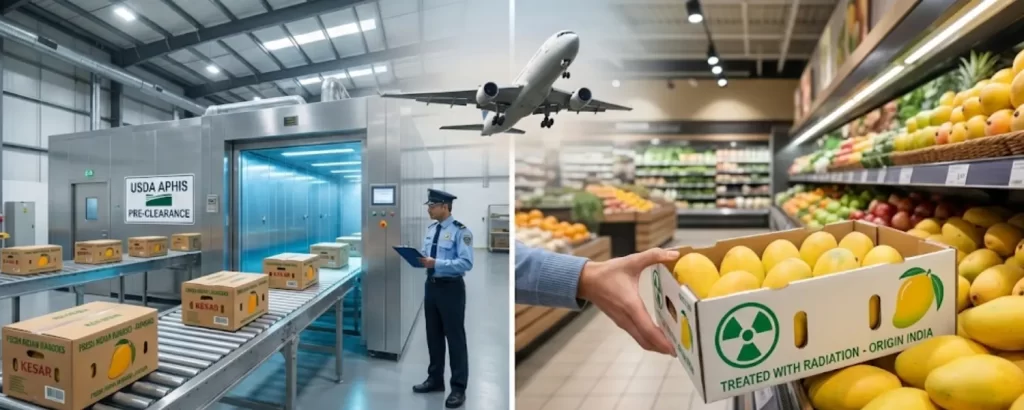
For decades, the premium Indian mangoes–specifically the legendary Alphonso and Kesar—were forbidden fruit in the United States. The barrier wasn’t demand; it was biosecurity. The USDA feared the introduction of pests like the mango seed weevil and fruit flies. That changed in 2007, thanks to one technology: Irradiation.   Today, the USA is one of the fastest-growing markets for Indian mangoes. But for an importer, the process remains complex. Unlike exports to the Middle East or Europe, shipping to the US requires a strict, government-monitored treatment protocol. If you are a US distributor looking to bring the “King of Fruits” to retailers like Whole Foods or Costco, understanding this process is non-negotiable. Here is a breakdown of the irradiation requirement for exporting Indian mangoes to the USA. 1. What is Irradiation Treatment? Irradiation is a phytosanitary (plant health) treatment. It involves exposing the packed mangoes to a low, controlled dose of ionizing radiation, typically using Gamma rays or X-rays. The Purpose: It is crucial to understand that irradiation is not to kill bacteria or extend shelf life (though it can have a slight benefit there). Its sole legal purpose for US entry is to neutralize quarantine pests. The process makes insects like fruit flies and seed weevils sterile. They cannot reproduce, meaning they pose no threat to US agriculture even if they survive the journey. 2. The Mandatory Protocol: USDA-APHIS Oversight You cannot just irradiate mangoes anywhere. The entire process is tightly controlled by the USDA’s Animal and Plant Health Inspection Service (APHIS) and their Indian counterparts. The Exim Internationals Process: Step 1: Sourcing from Registered Farms We only source Alphonso and Kesar mangoes from orchards registered with India’s Agricultural and Processed Food Products Export Development Authority (APEDA). These farms follow Good Agricultural Practices (GAP) to minimize initial pest loads. Step 2: Grading & Packing Mangoes are brought to our packhouse, sorted, graded for size (typically 250g+ for the US market), and packed into USDA-approved, ventilated corrugated boxes. Step 3: Transport to the Facility The sealed boxes are transported in refrigerated trucks to a government-approved irradiation facility. The two primary facilities used are near Mumbai (Lasalgaon/Vashi) and Bangalore. Step 4: The Treatment A USDA-APHIS inspector is physically present at the facility in India during the mango season. They supervise the treatment to ensure the fruits receive the minimum required absorbed dose (typically 400 Gray). Step 5: Final Sealing & Certification Once treated, the boxes are marked with the international “Radura” symbol (the green flower logo indicating irradiation). The USDA inspector signs off on the Phytosanitary Certificate with the specific treatment declaration. The shipment is sealed and moved directly to the airport for air freight to the US. 3. Does Irradiation Affect Taste or Safety? This is the #1 question from US buyers. The answer is No. The FDA, WHO, and IAEA all confirm that irradiated food is safe for consumption. No Radioactive Residue: The mangoes do not become radioactive. Taste & Texture Preservation: Because it’s a “cold process,” irradiation does not cook the fruit. The luscious, creamy texture of a Ratnagiri Alphonso and the sweet aroma of a Gujarat Kesar remain perfectly intact. Import products for your Needs Ready to Import 4. Logistics: The Race Against Time While irradiation solves the pest issue, it adds a step to the logistics chain. Indian mangoes are highly perishable. At Exim Internationals, we manage this tightly: Air Freight Only: Sea freight is not a viable option for irradiated mangoes due to the transit time. We exclusively use air cargo from Mumbai (BOM) to key US hubs like New York (JFK), Chicago (ORD), or San Francisco (SFO). Cold Chain: From the moment the fruit leaves the orchard to its arrival at your US warehouse, we aim to maintain a temperature of 13°C to 15°C to slow down ripening without causing chilling injury. Your Compliant Partner Sourcing Indian mangoes for the USA is a high-value opportunity, but one that tolerates no errors in compliance. A shipment arriving at JFK without the correct irradiation paperwork will be rejected and destroyed immediately. Don’t take that risk. Partner with an exporter who understands the USDA-APHIS pre-clearance program implicitly. Ready to secure your supply of Alphonso and Kesar for the upcoming season? Contact Exim Internationals today for a consultation on compliant US mango imports. Frequently Asked Questions (FAQs) 1. Which varieties of Indian mangoes can be exported to the USA? While India grows hundreds of varieties, the US market is primarily focused on Alphonso (from Maharashtra) and Kesar (from Gujarat/Maharashtra). Other varieties like Banganapalli and Langra are also permitted but have lower demand. 2. Is irradiation mandatory for all Indian mangoes going to the US? Yes. As of the current USDA-APHIS regulations, irradiation is the only approved treatment protocol for fresh mangoes entering the continental United States from India to mitigate pest risks. 3. Does the “Radura” symbol have to be on retail packaging? Yes. The FDA requires that irradiated foods be labeled with the Radura logo alongside a statement like “Treated with radiation” or “Treated by irradiation.” This must be visible to the final consumer on the retail box or sticker. 4. What is the typical season for shipping to the US? The export season typically runs from April to June. Alphonso arrives first, followed by Kesar. We recommend booking air freight space well in advance due to high demand during this window. 5. Can we import organic mangoes from India to the US? Yes, but they must still undergo irradiation. The USDA National Organic Program (NOP) does not prohibit irradiation for pest control. So, you can have mangoes that are both certified USDA Organic and irradiated. 6. What is the Minimum Order Quantity (MOQ) for US shipments? Due to air freight economics and the batch nature of the irradiation process, our typical MOQ is approximately 1000 kg (1 Ton) per shipment.

Exporting to the USA: Understanding Irradiation Requirements for Indian Mangoes Read Post »

turmeric for medicinal uses
Fruits Export Import Spices Vegetables

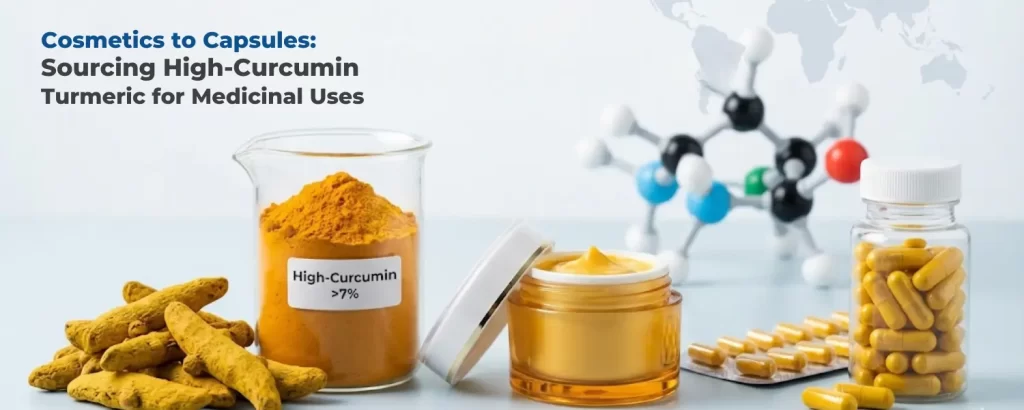
Cosmetics to Capsules: Sourcing High-Curcumin Turmeric for Medicinal Uses

In the global ingredients market, turmeric (Curcuma longa) has transcended the spice rack. Driven by booming demand for natural wellness products, it has become a critical Active Pharmaceutical Ingredient (API) and functional cosmetic additive. For product formulators in the nutraceutical and skincare sectors, generic supermarket-grade turmeric is insufficient. The efficacy of a joint supplement or a brightening serum hinges not on the turmeric itself, but on its primary bioactive compound: Curcumin.   Sourcing turmeric for medicinal uses requires a shift in procurement strategy—moving away from visual appearance (color and polish) and focusing entirely on chemical assay (curcumin percentage and volatile oil content).   At Exim Internationals, we specialize in supplying high-assay turmeric grades tailored for extraction and therapeutic formulations. Here is your guide to sourcing the right raw material for high-value applications. 1. The Curcumin Mandate: Culinary vs. Medicinal Grade The first step in sourcing is understanding the gap between culinary and medicinal requirements. Culinary Grade (The Spice): Typically has a curcumin content of 2% to 3.5%. It is valued for its vibrant yellow color and earthy flavor. Medicinal Grade (The Ingredient): Requires a minimum curcumin content of 5%, often reaching up to 8-9% in premium varieties. For industrial buyers, low-curcumin turmeric is dead weight. If you are extracting Curcuminoids or Turmeric Oleoresin, starting with a 3% raw material doubles your processing costs compared to starting with a 6% material. High-curcumin turmeric is essential for achieving the necessary therapeutic dosage in capsules and maximizing extraction yields. 2. Key Industrial Applications We supply distinct grades of medicinal turmeric optimized for specific industries: A. The Nutraceutical Industry (Capsules & Supplements) The global dietary supplements market heavily relies on turmeric for its potent anti-inflammatory and antioxidant properties. Requirement: High Curcumin (5-9%) dried fingers or coarse powder. End Use: Direct encapsulation (as whole root powder) or solvent extraction to create concentrated 95% Curcuminoid extracts for high-potency joint health formulations. B. The Cosmetic Industry (Skincare & Topicals) Turmeric is surging in skincare for its ability to combat hyperpigmentation, acne, and inflammation. Requirement: Moderate to High Curcumin, but crucially, low microbial count and heavy-metal free. End Use: Used in brightening creams, serums, and Ayurvedic formulations. The raw material must meet strict dermal safety standards, often requiring steam sterilization before processing. Import products for your Needs Ready to Import 3. Sourcing the Right Variety: The “Lakadong” Gold Standard India is the world’s largest producer of turmeric, offering dozens of varieties. For medicinal buyers, geography is destiny. While varieties like Salem and Rajapore are excellent for color, the undisputed king for medicinal use is the Lakadong variety from Northeast India (Meghalaya). Variety Typical Curcumin % Primary Industrial Use Lakadong 7% – 9% (Highest) Premium Nutraceuticals, High-Yield Extraction Pragati 5% – 6% Standard Supplement Grade, Extraction Salem 3% – 4.5% Premium Culinary, Natural Food Coloring (E100) Nizamabad 2% – 3% High-Volume Culinary Grinding 4. Quality & Compliance: The Safety Protocol When sourcing turmeric for medicinal uses, purity is as important as potency. The supply chain is rife with risks that can lead to batch rejection at destination ports. At Exim Internationals, we implement rigorous testing protocols for our medicinal grades: Adulteration Check (Sudan Dye): We test to ensure absolutely no presence of Sudan Red dye or lead chromate, which are illegal carcinogenic adulterants sometimes used to enhance color in low-grade turmeric. Heavy Metals: We provide analysis for lead, arsenic, cadmium, and mercury to meet stringent EU and US FDA pharma standards. Aflatoxins: Stringent moisture control during post-harvest processing ensures our turmeric remains well below internationally acceptable aflatoxin limits. Sourcing for Efficacy Whether you are formulating a new anti-inflammatory capsule or a natural face mask, the quality of your final product depends entirely on the quality of your raw turmeric root. Don’t settle for spice-grade when your product claims medicinal benefits. At Exim Internationals, we bridge the gap between Indian farms and global pharma laboratories. We supply lab-certified, high-curcumin turmeric fingers and powder ready for industrial processing. Need high-assay turmeric for your next formulation? Contact Exim Internationals today for a Certificate of Analysis (COA) and a quote on medicinal-grade turmeric. Frequently Asked Questions (FAQs) 1. What is the minimum curcumin percentage required for medicinal use? While there is no legal minimum, industrial buyers typically demand a minimum of 5% curcumin for therapeutic applications to ensure efficacy and efficient extraction yields. Premium grades should be 7%+. 2. Do you supply Turmeric Oleoresin or 95% Curcumin extract? We primarily supply the raw material—high-curcumin dried turmeric fingers and powder—to extraction houses and manufacturers. However, we can source processed extracts upon request through our partner network. 3. Why is Lakadong turmeric more expensive? Lakadong turmeric has a significantly higher curcumin content (up to 9%) compared to standard varieties (3%). Because it offers double or triple the active ingredient per kilogram, it commands a substantial premium in the medicinal market. 4. Can I use “polished” turmeric for medicinal purposes? Yes, but “unpolished” is often preferred by extractors. Polishing is an aesthetic process to improve appearance for retail spice markets. For industrial grinding or extraction, unpolished fingers are often cheaper and equally effective, as the outer skin does not affect the internal curcumin content significantly. 5. Do you provide a Certificate of Analysis (COA) with specific curcumin levels? Yes. Every medical-grade shipment from Exim Internationals is accompanied by a batch-specific COA from an accredited laboratory, verifying the exact curcumin percentage, moisture levels, and absence of contaminants.

Cosmetics to Capsules: Sourcing High-Curcumin Turmeric for Medicinal Uses Read Post »

coconut sugar
Export Import Fruits Spices Vegetables

Why Coconut Sugar is Replacing Brown Sugar in Industrial Bakeries

In the world of industrial baking, ingredients usually fight on price. But in 2025, the battleground has shifted. The new fight is for the “Clean Label.” For decades, Brown Sugar (refined white sugar mixed with molasses) was the go-to for adding moisture and color to cookies, muffins, and brownies. But today’s consumer reads the back of the pack. They see “Refined Sugar” as a red flag. Once a niche health store item, it is now being ordered in Full Container Loads (FCL) by major industrial bakeries. It isn’t just a marketing swap; it is a functional upgrade. From superior caramelization to better flowability in automated mixers, here is why R&D teams are reformulating their recipes with coconut sugar. 1. The “Clean Label” Mandate The primary driver is consumer perception. Brown Sugar: Often labeled as “Sugar” or “Cane Sugar.” To a health-conscious consumer, this equals “Empty Calories.” Coconut Sugar: Can be labeled as “Organic Coconut Blossom Sugar” or “Unrefined Coconut Sugar.” This simple switch allows brands to claim “No Refined Sugars” on their packaging—a powerful USP in the premium cookie and health bar segment. Because it is minimally processed (sap boiled to granules), it retains its natural minerals (Potassium, Iron, Zinc), allowing for a “natural” marketing narrative that refined brown sugar cannot match. 2. The Maillard Reaction: Superior Flavor Depth For a food technologist, flavor profile is key. Brown sugar provides sweetness and a hint of molasses. Coconut Sugar provides complexity. Because coconut sugar is rich in amino acids, it undergoes the Maillard Reaction (browning) differently than cane sugar. The Result: It creates a deeper, earthier flavor profile with natural notes of salted caramel, butterscotch, and toffee. The Benefit: Industrial bakeries find they can reduce the amount of artificial vanilla or caramel flavoring in their recipes because the sweetener itself acts as a flavor enhancer. 3. Low Glycemic Index (GI): The Functional Edge The diabetic-friendly and keto-adjacent markets are booming. Brown Sugar GI: ~64 (High) Coconut Sugar GI: ~35 to 54 (Low to Medium) Coconut sugar contains Inulin, a soluble fiber that slows down glucose absorption. For bakeries creating “Guilt-Free” or “Low-GI” snack ranges, replacing brown sugar with coconut sugar is the easiest way to lower the product’s overall glycemic load without resorting to sugar alcohols (like Erythritol) which can cause digestive issues. Import products for your Needs Ready to Import 4. Handling & Flowability (The Production Floor) Ask any factory manager about brown sugar, and they will complain about clumping. Brown sugar relies on molasses for moisture, making it sticky. In automated hoppers and dosing systems, brown sugar frequently bridges and clogs, causing downtime. Export-Quality Coconut Sugar from Exim Internationals is dried to <2% moisture. Texture: It is granular and free-flowing, similar to demerara sugar. Efficiency: It pours easily through automated silos and dissolves rapidly in dough mixers, improving production line efficiency. 5. 1:1 Replacement Ratio The best part for reformulation? It requires almost no recipe re-engineering. Coconut sugar acts almost identically to brown sugar in terms of bulk and sweetness level. Substitution: It is a direct 1:1 replacement. Moisture Retention: Like brown sugar, it is hygroscopic (absorbs moisture), which ensures that soft-baked cookies and muffins stay moist on the shelf, extending the product’s shelf life. The Future is Unrefined The switch from brown sugar to coconut sugar is no longer a trend; it is an industry correction. It solves the consumer demand for “healthier” sweets while giving bakers a robust, flavorful, and easy-to-handle ingredient. At Exim Internationals, we supply industrial-grade Coconut Sugar (Organic & Conventional) with customizable mesh sizes to suit your specific baking application. Ready to clean up your label? Contact Exim Internationals for bulk samples and technical specifications. Frequently Asked Questions (FAQs) 1. Does coconut sugar make baked goods taste like coconut? No. This is a common myth. Coconut sugar is made from the flower sap, not the coconut fruit. It has a rich, warm, caramel-like flavor, very similar to brown sugar but less cloying. 2. Can I use coconut sugar in white cakes/breads? It is not recommended for pure white products (like sponge cake) because it has a natural dark brown color that will darken the crumb. It is best suited for cookies, brownies, muffins, and chocolate cakes. 3. Is coconut sugar more expensive than brown sugar? Yes, the raw material cost is higher because it is labor-intensive (hand-tapped). However, the value lies in the premium positioning. Products made with coconut sugar command a higher retail price, offering a better margin for the manufacturer. 4. What is the shelf life of bulk coconut sugar? When stored correctly (cool, dry place), our bulk coconut sugar has a shelf life of 24 months. We use liners in our 25kg bags to prevent moisture absorption. 5. How does it affect cookie spread? Coconut sugar has a slightly higher burning point than cane sugar. In cookies, it creates a chewier texture with slightly less spread than white sugar, but very comparable spread to brown sugar. 6. Do you offer Organic Certified coconut sugar? Yes. For the export market, we provide USDA NOP and EU Organic certified coconut sugar, complete with transaction certificates (TC). About us Exim Internationals is a premier export company dedicated to delivering the finest products from India to international markets. Our mission is to establish India as a global export powerhouse, contributing to economic growth and showcasing the richness of Indian goods worldwide. From the pashmina shawls and apples of the North to the spices of the South, the fruits and powders of the West, and the tea and bamboo of the East, we connect every corner of India with the global market. Certification we have: FSSAI, APEDA, IEC, UDYAM, FIEO, Spices Board, Coconut Contact us Samin heritage, Sl building, Shop no. 19, Chandan wadi, Almeda road Thane west, Maharashtra, India-400601. Email Us: support@eximinternationals.comCall Us: +91 9820446601 | +91 9321559185

Why Coconut Sugar is Replacing Brown Sugar in Industrial Bakeries Read Post »

red chilli for global market
Fruits Export Import Spices Vegetables

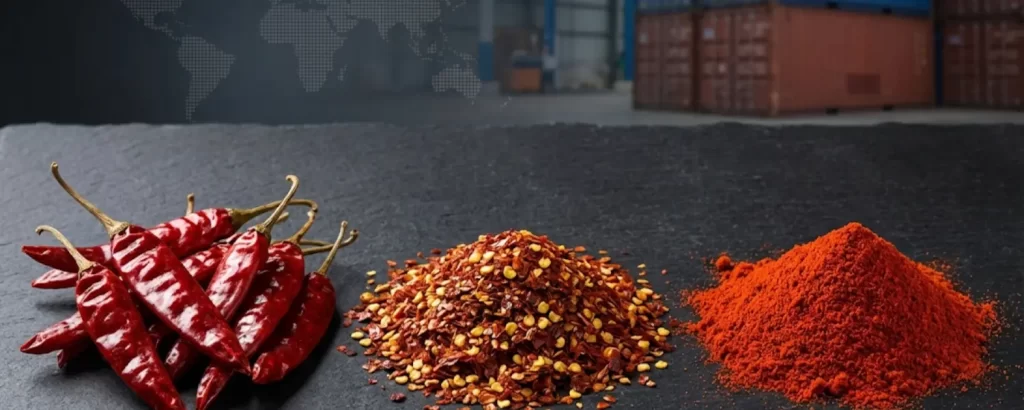
Whole, Flakes, or Powder? Sourcing the Best Form of Red Chilli for Global Market

India is the undisputed “Spice Bowl of the World,” contributing nearly 40% of the global spice trade. Among these, the fiery red chilli is the king. But for an international buyer sourcing Red Chilli for the global market, the decision isn’t just about the variety (Teja vs. Byadgi)—it is about the form.   Should you import raw whole pods? Ready-to-sprinkle flakes? or fine-ground powder? Each form impacts your freight costs, shelf life, and manufacturing process differently. Whether you are a spice blender in London, a sauce manufacturer in Thailand, or a pizza chain supplier in Dubai, making the right choice is critical for your ROI. At Exim Internationals, we supply all three forms tailored to precise SHU (Heat) and ASTA (Color) specifications. Here is your sourcing guide. 1. Whole Dried Chillies: The Raw Standard Best For: Spice Grinding Units, Oleoresin Extraction, Wholesalers Buying whole dried chillies is the most common entry point for the red chilli for global market trade. It offers the buyer maximum control. The Advantage (Quality Control): When you buy whole pods, you can see exactly what you are getting. You can visually inspect the size, skin quality, and ensure there are no impurities. It is the “purest” form of the trade. Stem vs. Stemless: With Stem: Cheaper, but you pay freight for the stems (which are waste). Stemless: Premium priced (approx. 25-30% higher), but offers 100% usable product and lowers contamination risk. Varieties to Watch: Teja (S17): High Heat (75,000+ SHU). The favorite for extraction and heat lovers. Byadgi / Kashmiri: High Color (ASTA 100+), Low Heat. The choice for food coloring and mild blends. Logistics Note: Whole chillies are voluminous. You are essentially shipping air inside the pods. A 40ft container holds approx. 14-15 MT of whole chilli, compared to 25 MT of powder. 2. Chilli Flakes (Crushed Chilli): The Texture King Best For: Seasoning Brands, Pizza/QSR Chains, Ready-to-Eat Meals Often called “Pizza Cut” or crushed chilli, this form is surging in demand across the red chilli for global market. The Spec: Flakes are coarse, usually ranging from 3mm to 6mm. The Balance: The quality of flakes depends on the Seed-to-Skin Ratio. More Seeds: Higher heat (pungency), lower color. More Skin: Better red visual, milder heat. Why Buy Flakes? Convenience. If you are supplying to the HORECA (Hotel/Restaurant) sector, they do not want to grind chilli. They want a ready-to-sprinkle garnish. Sourcing pre-crushed flakes from India saves you the processing cost and dust management at your facility. Import products for your Needs Ready to Import 3. Red Chilli Powder: The Industrial Powerhouse Best For: Sauce Manufacturers, Marinade Brands, Retail Packs For high-volume industrial users, importing powder is the most efficient way to source red chilli for global market needs. Freight Efficiency: Powder is dense. We can pack up to 24-25 Metric Tons in a single container, drastically reducing your shipping cost per kg compared to whole pods. Customization: This is where we act as food technologists. We can blend varieties to hit your exact target. Need 40,000 SHU and 80 ASTA? We blend Teja and Byadgi to create a “Hot & Colorful” mix. Mesh Size: We control the grind size, from coarse powder (20 mesh) to fine dust (60-80 mesh) suitable for smooth sauces. The Risk (Adulteration): Powder is easy to fake. Unethical suppliers may mix fillers or starch. The Exim Solution: We provide Certificate of Analysis (COA) proving the product is 100% pure dried chilli, tested for Sudan Dye and Aflatoxin.   Feature Whole Pods Chilli Flakes Chilli Powder Shelf Life High (12+ Months) Medium (9-12 Months) Medium (6-12 Months) Freight Cost High (Low density) Medium Low (High density) Processing Needed? Yes (Grinding) No (Ready to use) No (Ready to use) Adulteration Risk Very Low Low Medium (Requires Testing) Primary User Grinders / Traders Pizza Chains / Retail Sauce / Masala Factories Sourcing with Strategy The global market for red chilli is evolving. Buyers are moving away from generic commodities and asking for specific solutions—whether it is Stemless S17 for extraction or Sterilized Flakes for European retail. At Exim Internationals, we process all three forms at our facility. Whether you need the raw integrity of whole pods or the freight efficiency of powder, we ensure the heat and color match your spec sheet perfectly. Ready to spice up your product line? Contact Exim Internationals for a quote on Export-Quality Red Chilli (Whole, Flakes, or Powder). Frequently Asked Questions (FAQs) 1. Which form of chilli has the longest shelf life? Whole Dried Chillies have the longest shelf life (18-24 months in cold storage). Once the skin is broken (flakes or powder), the essential oils are exposed to air, slowly reducing potency and color over 6-12 months. 2. What is the standard packaging for Chilli Powder export? For industrial buyers, we use 25kg Multi-wall Paper Bags or HDPE bags with an inner liner to prevent moisture clumping. For retail, we can support private labeling in smaller pouches. 3. How do you ensure your chilli powder is not adulterated? We strictly test every batch for Sudan I-IV dyes and Aflatoxin. We use Steam Sterilization (optional upon request) to ensure the microbial load meets international safety standards. 4. Can you customize the heat level of the powder? Yes. By blending high-heat varieties (like Teja) with low-heat varieties (like Byadgi/Kashmiri), we can manufacture chilli powder to your exact Scoville Heat Unit (SHU) requirement. 5. Why are Stemless Whole Chillies more expensive? Removing the stem reduces the total weight by about 3-5% and requires additional labor (or machine sorting). However, it saves the buyer money on freight (you aren’t shipping waste) and increases the yield during grinding. 6. What is the difference between “Crushed Chilli” and “Chilli Flakes”? In the trade, they are often used interchangeably. However, “Crushed Chilli” typically refers to a mix that includes seeds and skins (hotter), while “Flakes” can sometimes be processed to remove some seeds for a better visual red appearance. About us Exim Internationals is a premier export company dedicated to delivering the

Whole, Flakes, or Powder? Sourcing the Best Form of Red Chilli for Global Market Read Post »

indian lemon from india
Export Import Fruits Spices Vegetables

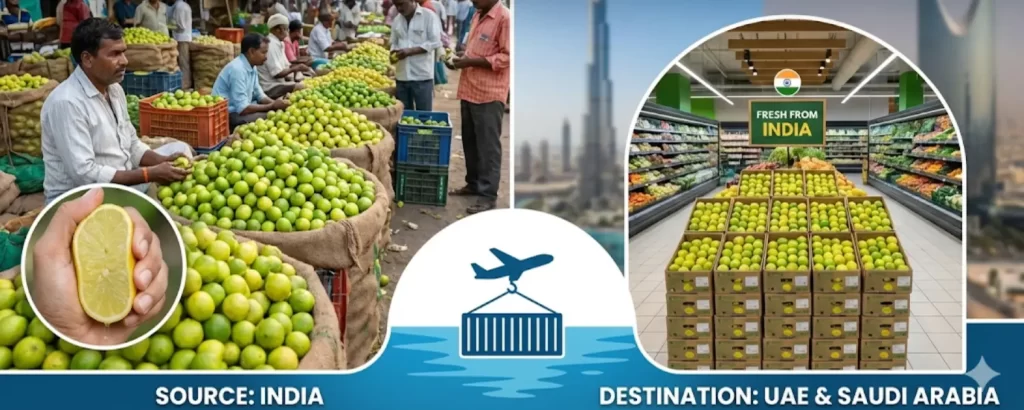
Why the UAE & Saudi Markets Rely on Fresh Indian Lemon from India

In the sweltering heat of the Arabian Peninsula, citrus is not just a fruit; it is a daily necessity. From refreshing mint lemonades in Dubai cafes to the essential squeeze over a plate of Kabsa in Riyadh, the demand is insatiable. While the world grows many types of citrus, the Gulf market has a distinct preference for the Indian lemon from India.   Technically known as the Kagzi Lime (Citrus aurantifolia), this variety dominates the imports into the UAE, Saudi Arabia, and Oman. But why do procurement managers in the Middle East favor this small Indian fruit over the larger, yellow varieties from Turkey or Spain? The answer lies in three key factors: Juice Content, Skin Thickness, and Logistics Speed. At Exim Internationals, we specialize in managing this fast-moving trade lane. Here is why the Indian lemon remains the king of the Gulf market. 1. The “Paper-Thin” Skin Advantage The primary difference between an Indian lemon from India and a European lemon is the rind. European Lemon: Thick skin, lower juice-to-weight ratio. You pay for the peel. Indian Kagzi Lemon: Known for its “paper-thin” skin. For a restaurant or juice factory in Sharjah or Jeddah, this math is simple. One kilogram of Indian lemons yields significantly more juice than one kilogram of thick-skinned varieties. The Indian variety is a powerhouse of acidity and aroma, meaning chefs need fewer lemons to achieve the desired tartness. 2. Perfect Calibration for the Gulf Consumer The UAE and Saudi markets have very specific size requirements (calibration) that Indian exporters are perfectly set up to meet. We grade our lemons by diameter to suit different sectors: 36mm – 40mm (Medium): The “Standard” grade. High demand in supermarkets and retail bags. 42mm – 48mm+ (Jumbo/Bold): The premium grade. Preferred by high-end hotels and restaurants for garnishing and presentation. 30mm – 34mm (Small): Often used by pickle manufacturers and industrial processors. 3. The Color Transition: Green to Yellow One of the unique aspects of exporting Indian lemon from India is managing the color. The local Indian consumer prefers a yellow lemon. However, for export to the UAE and Saudi Arabia, we often ship them Light Green to Greenish-Yellow. Why? Shelf life. A fully yellow lemon is fully ripe and soft. A greenish lemon is firm and has a longer shelf life. The Logistics: During the transit from Mumbai/Nhava Sheva to Jebel Ali, the controlled temperature in the reefer container allows the fruit to slowly ripen. They arrive at the destination firm but turning a beautiful yellow, ready for retail shelves without being over-ripe. Import products for your Needs Ready to Import 4. Unbeatable Logistics: The “Next-Door” Neighbor India’s geographic proximity to the Middle East is a massive strategic advantage. Sea Freight: A reefer container from India to Dubai takes just 4 to 6 days. This short transit time means the lemons arrive incredibly fresh, retaining their natural oils and aroma. Air Freight: For urgent orders or during peak demand (like Ramadan or Summer), we can fly fresh lemons from Indian airports to Dubai or Riyadh in under 24 hours. This speed allows Middle Eastern importers to maintain “Just-In-Time” inventory, reducing their storage costs and spoilage risks. 5. Year-Round Availability Unlike some competitors that have short harvest windows, India produces lemons nearly year-round, with peak seasons in Summer and Monsoon. This reliability makes Indian lemon from India a staple commodity that supermarket chains in Saudi Arabia can list permanently, knowing the supply chain is secure. The Juice Powerhouse For the UAE and Saudi markets, the Indian lemon from India represents the perfect balance of quality and economics. It delivers maximum juice, intense flavor, and arrives fresher than citrus from any other part of the world. At Exim Internationals, we understand the grading nuances of the Gulf market. whether you need a 40ft reefer to Jebel Ali or an air shipment to Riyadh, we ensure your lemons arrive green, firm, and ready for business. Looking for premium Kagzi lemons? Contact Exim Internationals today for our daily rates on fresh Indian Lemon exports. Frequently Asked Questions (FAQs) 1. Is the “Indian Lemon” actually a Lime? Technically, yes. The variety grown in India is the Acid Lime or Kagzi Lime. However, in the international trade (and specifically in the Indian export market), it is widely referred to as “Indian Lemon.” It is round, thin-skinned, and highly acidic. 2. What is the standard packing for lemons to UAE/Saudi? The most popular packaging is the 7kg or 8kg Corrugated Box for premium quality. For wholesale markets, we also supply in Mesh Bags (various weights) which allow for excellent airflow and lower packaging costs. 3. What is the shelf life of fresh Indian lemons? If harvested green and stored at the correct temperature (typically 8°C – 10°C), Indian lemons can have a shelf life of 30 to 40 days. Once they turn fully yellow and soft, they should be consumed within a week. 4. Why do you ship them green? Shipping them green extends the shelf life. It allows the fruit to withstand the transit time and handling. If we shipped fully yellow lemons, they would likely be soft and prone to damage by the time they reach the supermarket shelf. 5. What is the minimum order quantity (MOQ)? For Sea Freight, the MOQ is one 20ft or 40ft Reefer Container. For Air Freight to Gulf countries, the MOQ is typically 1000 kg (1 Ton) to secure the best freight rates. 6. Do you wax the lemons? We can provide waxed lemons upon request. Waxing helps retain moisture (preventing shriveling) and gives the fruit a glossy, attractive shine, which is preferred by some retail chains. About us Exim Internationals is a premier export company dedicated to delivering the finest products from India to international markets. Our mission is to establish India as a global export powerhouse, contributing to economic growth and showcasing the richness of Indian goods worldwide. From the pashmina shawls and apples of the North to the spices of the South,

Why the UAE & Saudi Markets Rely on Fresh Indian Lemon from India Read Post »

fresh semi-husked coconut
Export Import Fruits Spices Vegetables

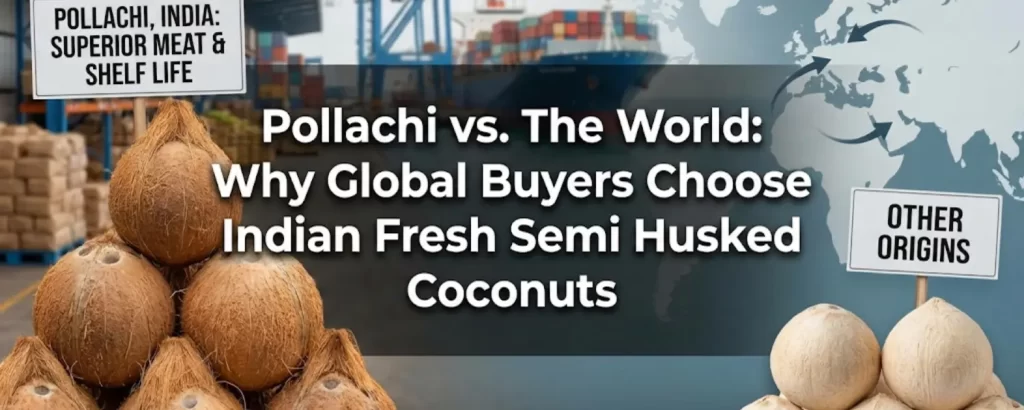
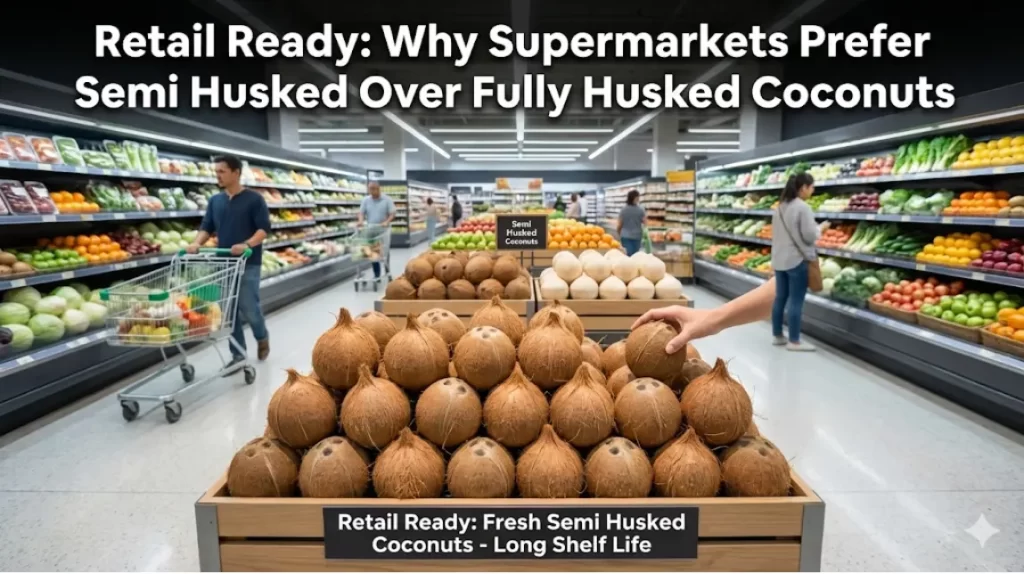
Retail Ready: Why Supermarkets Prefer Semi Husked Over Fully Husked Coconuts

In the fresh produce aisle of a modern supermarket, every inch of shelf space is real estate. For category managers, the coconut presents a unique challenge. Whole Coconuts are too bulky and heavy to stack efficiently. Fully Husked (Bald) Coconuts look clean but spoil notoriously fast. It is the global industry standard for retail—from the hypermarkets of Dubai to the grocery chains of London. But why? It’s not just about aesthetics; it’s about biology and logistics. For importers and retailers, the semi husked coconut offers the perfect balance between consumer convenience and inventory longevity. Here is why it is the “Retail Ready” champion. 1. The “Tuft” Advantage: A Natural Freshness Seal The biggest enemy of a coconut is air. Specifically, air entering through the “eyes.” A coconut has three soft eyes at its base. In a Fully Husked (bald) coconut, these eyes are exposed to the elements. Micro-cracks can develop during handling, allowing mold to enter or coconut water to leak out, leading to spoilage within 15-20 days. The Solution: A Semi Husked Coconut leaves a strategic “cap” or tuft of fiber over the eyes. This fibrous layer acts as a: Natural Seal: It protects the delicate eyes from air exposure and fungal spores. Shock Absorber: It cushions the weak point of the nut during transit. The Result: A massive jump in shelf life. While a fully husked nut lasts 2-3 weeks, a high-quality semi husked coconut can remain fresh for 60 to 70 days at ambient temperature (or longer in controlled storage). For a supermarket, this drastically reduces “shrink” (waste). 2. Shelf Appeal: The “Tropical” Look Consumers buy with their eyes. A fully husked coconut often looks pale and processed. A whole green/brown coconut looks like it just fell off a tree—messy and hairy. The Semi Husked nut hits the sweet spot. Clean yet Natural: The main shell is visible (showing the dark brown color of maturity), but the fiber tuft gives it an authentic, rustic “tropical” look that appeals to consumers looking for natural products. Touch & Feel: Customers can pick it up, shake it to hear the water (the universal freshness test), and feel the weight without getting fiber dust on their hands or clothes. Import products for your Needs Ready to Import 3. Uniformity for Unit Pricing Supermarkets hate variance. They need products that can be sold by the piece (per unit) rather than by weight, as it simplifies checkout. At Exim Internationals, we grade our semi husked coconuts with precision. Size: We typically supply the 12-13 inch circumference grade. Weight: The retail “sweet spot” is 500g to 600g. By removing the excess husk, we standardize the size. This allows retailers to stack them neatly in pyramid displays or crates, creating a uniform, attractive presentation that drives impulse buys. 4. Consumer Convenience Why not just sell the whole raw coconut? Because it is a nightmare to open. The average consumer does not have a machete in their kitchen. The semi husked coconut has already done 80% of the work. The hard outer husk is removed, leaving just the shell. The consumer simply needs to crack the shell to access the water and meat. It offers the “fresh experience” without the “hard labor,” making it accessible to a wider demographic. 5. Sourcing the Best: The Pollachi Standard Not all coconuts are created equal. For the retail market, we exclusively source from Pollachi, India. Meat Thickness: Pollachi coconuts are world-famous for their thick, white meat (malai) and high oil content. Sweet Water: Even in a mature nut, the water remains naturally sweet and potable. When a customer buys a coconut from your store, they expect it to be full. A Pollachi semi husked coconut is heavy for its size, guaranteeing that satisfying “slosh” sound that closes the sale. Import products for your Needs Ready to Import The Smart Stock Keeping Unit (SKU) For retailers, the fresh semi husked coconut is the ultimate low-risk, high-reward SKU. It travels well, stays fresh for months, and stacks perfectly on the shelf. At Exim Internationals, we understand retail specs. From 25-nut polypropylene (PP) bags for easy wholesaling to individual barcode labeling, we prepare our coconuts to move from our container to your checkout counter seamlessly. Stock your shelves with the world’s best coconuts. Contact Exim Internationals today for a quote on retail-grade Fresh Semi Husked Coconuts. Frequently Asked Questions (FAQs) 1. What is the shelf life of a fresh semi husked coconut? Thanks to the protective fiber tuft over the eyes, a semi husked coconut has a shelf life of 60 to 75 days when stored in a cool, dry, and ventilated place. In refrigerated conditions (12°C – 14°C), it can last even longer. 2. Why are semi husked coconuts better for shipping than whole coconuts? Whole coconuts are bulky. By removing the husk (de-husking), we reduce the volume significantly. This allows us to load 20% to 30% more nuts into a container, lowering your freight cost per unit. 3. What is the ideal weight for a supermarket-grade coconut? The most popular weight range for retail sales is 500 grams to 600 grams. This size is manageable for shoppers to carry and offers a good meat-to-shell ratio. 4. How do I know if the coconut inside is fresh? The universal test is the “Shake Test.” You should clearly hear water sloshing inside. If there is no sound, the water has dried up. If the sound is “heavy” or dull, it might be over-mature. Also, check the eyes under the tuft—they should be dry and free from mold. 5. How are these coconuts packed for export? We standardly pack them in PP (Polypropylene) Mesh Bags. The most common size is 25 nuts per bag. This allows for breathability during transit, which is critical to preventing heat buildup and fungus. 6. Can you supply coconuts year-round? Yes. Sourcing from Pollachi, India, gives us a massive advantage—coconut production is continuous year-round, ensuring a stable supply for your supermarket chains regardless of the season. 7.

Retail Ready: Why Supermarkets Prefer Semi Husked Over Fully Husked Coconuts Read Post »

fresh ginger
Fruits Export Import Spices Vegetables

The Drying Factor: How We Control Moisture in Fresh Ginger Shipments

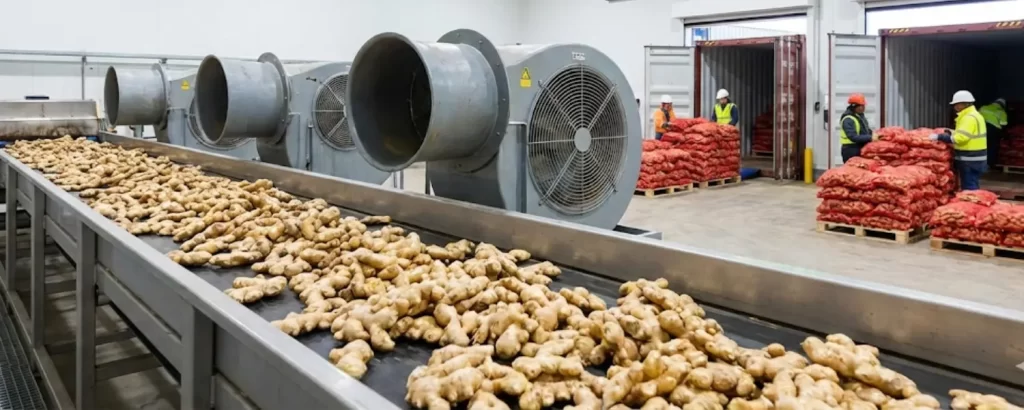
For an importer of fresh produce, fresh ginger is a high-risk, high-reward commodity. It is one of the most difficult rhizomes to transport over long distances. The reason isn’t price or availability; it is biology. Fresh ginger is roughly 80-85% water. This makes it a living, breathing product that is constantly releasing moisture. Too much moisture remaining on the skin? You get Blue Mold (Penicillium) or Soft Rot (Pythium) inside the container within days. Too dry? The rhizomes shrivel, lose weight (shrinkage), and look fibrous and unappealing to the consumer. The art of successful export lies in the “Goldilocks Zone”—maintaining just enough internal moisture for freshness while keeping the surface bone-dry to prevent fungus. At Exim Internationals, we have mastered this balance. Here is the technical breakdown of how we control the “Drying Factor” to protect your investment. 1. The Pre-Export Phase: Curing the Skin Moisture control starts on the farm. We do not pack ginger immediately after harvest. Freshly dug ginger has a very thin, delicate skin that scrapes easily (skinning), which becomes an entry point for bacteria. Our Protocol: We subject the rhizomes to a short curing period. By allowing the ginger to air-dry in the shade for a few days, the skin toughens and heals over minor harvest nicks. This natural barrier is the first line of defense against moisture loss and pathogen entry during the sea voyage. 2. The Washing & Drying Cycle For markets like the UAE and Europe that demand “Washed Ginger,” we use high-pressure water jets to remove soil. However, washing adds surface water-the enemy of long-term storage. The Critical Step: We do not rely on passive drying. After washing, the ginger is passed through Air Blowers and allowed to dry on raised mesh beds in a covered, well-ventilated facility. The Goal: To ensure the surface is dry to the touch, specifically in the “fingers” (the crevices between the nodes) where water tends to get trapped and start fungal colonies. 3. Packaging for Airflow: Mesh vs. Carton If you seal fresh ginger in a plastic bag or a closed box, it will “sweat” its own moisture, creating a greenhouse for mold. Ventilation is non-negotiable. Mesh Bags (25kg / 50kg): This is the preferred packing for the Middle East and Asian markets. The open mesh allows for maximum airflow throughout the pallet stack, ensuring that any respiration moisture escapes rather than settling on the skin. Corrugated Boxes (Cartons): For premium retail markets (like the UK), we use strong 5-ply boxes. Crucially, these boxes are engineered with side ventilation holes aligned to match the pallet stacking pattern, creating a “chimney effect” that pulls cool air through the cargo. Import products for your Needs Ready to Import 4. The Reefer Environment: Controlling Humidity Once the container doors close, the ginger relies on the Reefer (Refrigerated) Unit to manage the atmosphere. Temperature: We typically ship at 12°C to 13°C. Going lower (below 10°C) causes “Chilling Injury,” where the ginger turns grey and watery internally. Humidity Management: We set fresh air exchange vents (typically 15-20 CFM) to flush out the ethylene and excess humidity generated by the ginger, replacing it with fresh, dry cool air. 5. Anti-Fungal Treatment For long transits (20+ days) or specific buyer requests, we can treat the ginger with a food-safe, permissible fungicide dip prior to drying. This provides an chemical shield against surface mold spores that may be present in the air. Note: This is strictly per buyer specifications and import regulations of the destination country. No More “Fuzzy” Surprises Receiving a container of moldy ginger is a financial disaster. It happens when exporters skip the drying phase or use the wrong packaging to save money. At Exim Internationals, we treat moisture control as a science. From curing the skin to ventilating the box, every step is designed to ensure that when you open the container in Dubai or Rotterdam, you see clean, firm, and market-ready fresh ginger. Stop gambling with spoilage. Contact Exim Internationals today for a quote on moisture-controlled, export-quality fresh ginger. Frequently Asked Questions (FAQs) 1. What is the difference between “Washed” and “Unwashed” ginger? Washed Ginger is cleaned of all soil, making it ready for retail shelves but more sensitive to moisture. Unwashed (Muddy) Ginger retains a layer of dried soil, which acts as a natural preservative, extending shelf life. It is often preferred by wholesalers who wash it at the destination. 2. What is the ideal temperature for shipping fresh ginger? The standard protocol is 12°C to 14°C. Temperatures below this range can cause chilling injury, leading to internal rotting and discoloration. 3. How much weight loss (shrinkage) should I expect? Due to moisture evaporation, fresh ginger can lose 3% to 5% of its weight during a typical sea voyage. We account for this by overpacking our bags slightly to ensure you receive the net weight you paid for. 4. Why does my ginger arrive with blue mold? Blue mold usually occurs because the ginger was packed while still damp (surface moisture) or because there was insufficient airflow inside the container, allowing humidity to build up to 100%. 5. Which Indian ginger variety is best for export? Cochin Ginger (from Kerala) and Shimoga/Coorg Ginger (from Karnataka) are famous for export due to their low fiber content, high pungency (oleoresin), and bold size. 6. Can you ship ginger to Europe? Yes. For the EU market, we ensure strict compliance with pesticide residue norms and use premium ventilated carton packaging to meet retail standards. 7. What is the minimum order quantity (MOQ)? Our MOQ is one 20ft or 40ft Reefer Container. A 40ft container typically holds around 24-26 Metric Tons of ginger packed in mesh bags. 8. Is Indian ginger available year-round? The main harvest season (New Crop) starts in December/January. However, we can supply dried or stored fresh ginger year-round, though the “new crop” months offer the best freshness and pricing. About us Exim Internationals is a premier export company dedicated to delivering the finest products from India

The Drying Factor: How We Control Moisture in Fresh Ginger Shipments Read Post »

Drumstick from India to Global
Export Import Fruits Spices Vegetables

Packaging for Perfection: Ensuring Intact Drumstick from India to Global Buyers

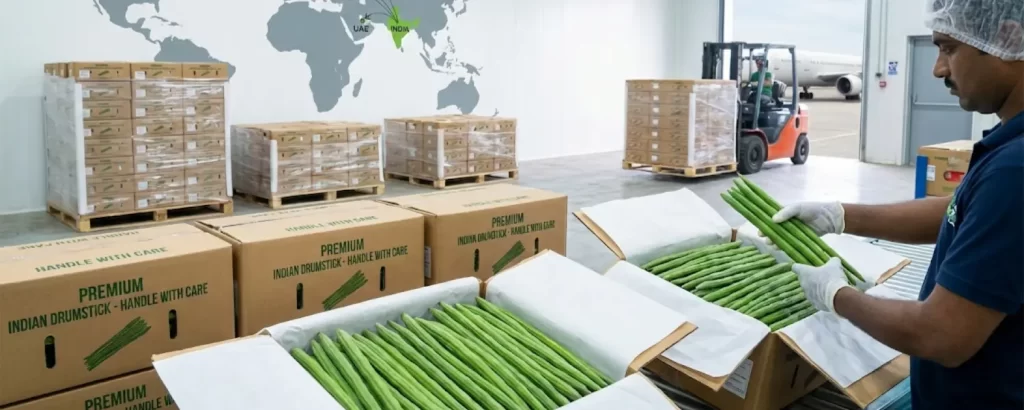
For international importers, sourcing fresh drumstick from India to global markets like the UAE, UK, and USA comes with a specific anxiety: Will it arrive fresh?   Drumstick (Moringa Oleifera) is notoriously fragile. It loses moisture rapidly (shriveling) and snaps easily if mishandled. A shipment that leaves Mumbai green and firm can arrive in Dubai yellow and limp if the cold chain or packaging fails.   At Exim Internationals, we don’t just export vegetables; we export freshness engineering. We understand that for a procurement manager, the value isn’t just in the product—it’s in the condition of arrival. Here is how we ensure every pod arrives shelf-ready. 1. The Variety Advantage: Why ODC is the Exporter’s Choice Before packaging even begins, the choice of variety is critical. While India grows many types, the ODC (Oddanchatram) variety is the gold standard for export. Longer Shelf Life: ODC drumsticks have a naturally thicker skin compared to other local varieties, helping them retain moisture for 2-3 days longer during transit. Flesh-to-Seed Ratio: They are fleshier and tastier, making them the preferred choice for discerning customers in global supermarkets. Uniformity: ODC pods are consistently long and straight, allowing for tighter, safer packing with less breakage. 2. The Pre-Packing Protocol: Pre-Cooling The biggest enemy of freshness is “Field Heat.” If you pack a warm drumstick into a box, it will sweat, leading to fungal growth and rotting within 24 hours. Our Process: Immediately after harvesting, our drumsticks are rushed to a Pre-Cooling Chamber. We rapidly bring the core temperature down to 5°C – 8°C. This puts the vegetable to “sleep,” slowing down its respiration rate and locking in the green color and crunch. 3. The 5-Ply Fortress: Our Packaging Standard We do not use standard local market boxes. For drumstick export, we use specialized 5-Ply Corrugated Fibreboard (CFB) Boxes. Crush Resistance: These boxes are engineered to withstand the weight of stacking in air cargo pallets without crushing the bottom layer. Ventilation: Each box features precision-cut ventilation holes. This allows cold air to circulate freely during the flight, preventing heat buildup while maintaining the necessary humidity. Standard Size: We typically pack in 5kg or 10kg net weight boxes, which are easy for retailers to handle directly. Import products for your Needs Ready to Import 4. Moisture Management: The Secret to “Green” Arrival Air freight is dry. The low humidity at high altitudes can suck the moisture right out of a vegetable. To combat this, we use a dual-layer protection system: Paper Lining: We wrap the bunches in food-grade paper. This absorbs any excess condensation that might form, keeping the skin dry and preventing rot. Moisture Retention: The paper also acts as a humidity buffer, creating a micro-environment inside the box that prevents the pods from drying out and shriveling. 5. Compliance & Documentation Getting the product to the airport is only half the battle. Clearing customs in strict markets like the EU or UAE requires flawless paperwork. Phytosanitary Certificate: Every shipment is inspected and certified pest-free by Indian quarantine authorities. Residue-Free: For our EU and UK clients, we source from GAP-certified farms and provide lab reports proving the product is free from banned pesticide residues. Your Reliable Partner in Freshness When you import drumstick from India to global destinations, you need more than a farmer; you need a logistics partner. By combining the right variety (ODC) with scientific pre-cooling and robust 5-ply packaging, Exim Internationals guarantees that the product you receive is as fresh as the moment it was harvested. Ready to upgrade your fresh vegetable supply chain? Contact Exim Internationals today for a quote on air-freighted, export-quality drumsticks. Frequently Asked Questions (FAQs) 1. What is the shelf life of exported drumsticks? With proper pre-cooling and packaging, our ODC drumsticks have a shelf life of 7 to 10 days from the time of packing, provided they are kept in a cold chain environment (5-8°C). 2. Why do you recommend the ODC variety for export? ODC drumsticks are preferred for export because they are fleshier, tastier, and have a thicker skin that retains moisture better than other varieties, ensuring they stay fresh during air transit. 3. What is the standard box size for drumstick export? We primarily use 5kg Net Weight corrugated boxes. This size is ideal because it minimizes the pressure on the bottom layer of vegetables, preventing breakage and bruising. 4. How do you prevent drumsticks from snapping during transit? We trim the drumsticks to a uniform length (typically 20-24 inches) to fit perfectly inside the box without bending. We also pack them snugly to prevent movement and vibration damage during the flight. 5. Do you ship drumsticks by sea or air? For global markets like Europe and the USA, Air Freight is mandatory due to transit time. For nearby markets like the Maldives or Sri Lanka, sea shipments may be possible, but air is always recommended for premium quality. 6. Is your packaging eco-friendly? Yes, our corrugated boxes are 100% recyclable and biodegradable. We are also moving towards reducing plastic usage by using paper-based liners where regulations permit. 7. Can you supply organic drumsticks? Yes, we have a network of organic certified farms. Please specify your requirement for “Organic” in your inquiry so we can provide the relevant NPOP/USDA certificates. 8. What is the minimum order quantity (MOQ)? For air shipments, our standard MOQ is 500 kg to 1000 kg (1 Ton) to ensure you get the best freight rates. We can mix this with other vegetables like okra or green chili to fill the pallet. About us Exim Internationals is a premier export company dedicated to delivering the finest products from India to international markets. Our mission is to establish India as a global export powerhouse, contributing to economic growth and showcasing the richness of Indian goods worldwide. From the pashmina shawls and apples of the North to the spices of the South, the fruits and powders of the West, and the tea and bamboo of the East, we connect every corner of

Packaging for Perfection: Ensuring Intact Drumstick from India to Global Buyers Read Post »

coconut sugar for food industries
Fruits Export Import Spices Vegetables

Price vs. Purity: How to Detect Adulterated Coconut Sugar in Bulk Shipments

For the global food industry, coconut sugar has graduated from a niche health ingredient to a formulation necessity. From low-GI beverages to paleo-friendly chocolates, manufacturers are scrambling to secure supply. However, this surge in demand has created a dark underbelly in the supply chain: Adulteration.   The math is simple. Coconut sugar is labor-intensive to produce (manual tapping of trees), while cane sugar is industrially farmed and cheap. Unscrupulous suppliers often blend 30-50% cane sugar into bulk coconut sugar to slash costs. For a procurement manager, the risk isn’t just financial—it is legal. If your label claims “Low GI” or “100% Coconut Sugar,” and your product tests positive for cane sucrose, you face recalls and lawsuits.   At Exim Internationals, we believe transparency is the only currency that matters. Here is a technical guide on how to detect adulteration and ensure the integrity of your coconut sugar for food industries. 1. Dark Green Chillies (The “G4” Variety) The most sophisticated (and reliable) way to detect adulteration is looking at the atomic level. The Difference: Coconut trees are C3 plants, meaning they use a specific photosynthetic pathway. Sugarcane and corn are C4 plants. The Test: A Carbon Isotope Ratio Analysis (SIRA) measures the ratio of Carbon-13 to Carbon-12 isotopes. Pure Coconut Sugar: Will show a C3 carbon signature (typically -25‰ to -27‰). Adulterated Sugar: Even a 10% addition of cane sugar shifts the isotopic signature toward the C4 range (-10‰ to -12‰). Procurement Tip: When issuing a Purchase Order (PO), explicitly state: “Must pass C13 Carbon Isotope Analysis for C4 sugar detection.” This clause alone scares off dishonest suppliers. 2. Field Tests: Quick Sensory Checks Before you even send samples to the lab, your Quality Control (QC) team can perform these rapid sensory tests on pre-shipment samples. The “Sweetness” Benchmark Pure Coconut Sugar: Has a complex flavor profile—notes of caramel, butterscotch, and a slight hint of saltiness (minerals). It is less sweet than table sugar. Adulterated Sugar: Tastes aggressively sweet. If the sweetness hits your tongue sharply and immediately (like white sugar), it is likely cut with cane sucrose. The “Solubility” Test Pure: Dissolves slowly in cold water. Because it is unrefined, it often leaves a tiny amount of natural sediment (minerals/fiber) at the bottom of the beaker. Adulterated: If mixed with dyed cane sugar, you might see “color streaks” separating as the dye washes off the white crystals. If it dissolves instantly and perfectly clear, be suspicious. Import products for your Needs Ready to Import 3. Operational Risks: Why Purity Matters for Manufacturing Adulteration isn’t just a label issue; it’s a production nightmare. Melting Point Variances: Pure coconut sugar has a different melting point and hygroscopicity (moisture absorption) compared to cane sugar. In chocolate manufacturing, using an adulterated batch can ruin the tempering process, leading to “blooming” or poor texture. Moisture & Clumping: Export-quality coconut sugar is dried to <2% moisture. Adulterated batches often have higher moisture content or inconsistent granule sizes, leading to massive clumping in industrial hoppers and mixers. 4. The “Color” Myth Do not judge purity by color alone. Natural Variation: Pure coconut sugar varies from light golden to dark brown depending on the harvest season and how long the sap was boiled (caramelization). The Red Flag: Be wary of sugar that is perfectly uniform in color across tons of product. Nature is rarely perfect; industrial blending is. 5. Your Verification Checklist To secure genuine coconut sugar for food industries, implement this 3-step verification protocol: Request the COA (Certificate of Analysis): Ensure it covers SIRA / Carbon Isotope testing, not just basic microbial checks. Check the “Ash” Content: Pure coconut sugar is high in minerals (Potassium, Magnesium, Zinc). It typically has an ash content of 2-3%. Refined cane sugar has <0.5%. A low ash reading is a dead giveaway of dilution. Audit the Supply Chain: Does the exporter have direct farm relationships? Adulteration usually happens at the aggregation level (middlemen), not the farm level. Import products for your Needs Ready to Import Sourcing with Confidence In the high-stakes world of food manufacturing, “cheap” coconut sugar is the most expensive ingredient you can buy. It costs you your reputation. At Exim Internationals, we strictly monitor our supply chain from the tapping of the flower to the sealing of the bulk bag. We provide full transparency, including Isotope Analysis reports, so you can formulate with confidence. Don’t gamble with your ingredients. Contact Exim Internationals today for a quote on 100% pure, lab-verified coconut sugar. Frequently Asked Questions (FAQs) 1. What is the most reliable test for coconut sugar adulteration? The Carbon Isotope Ratio Analysis (SIRA), specifically checking for C4 sugars, is the gold standard. It can detect even small amounts of cane or corn syrup added to the coconut sugar. 2. Why is cane sugar used as an adulterant? It is primarily about cost. Cane sugar is significantly cheaper to produce than coconut sugar. It also mimics the crystalline structure, making it easy to blend visually. 3. Does pure coconut sugar taste like coconut? No. Pure coconut sugar is made from the sap of the flower bud, not the nut. It tastes like a rich, earthy caramel or butterscotch, similar to brown sugar but with more depth. 4. What mesh size should I order for beverage manufacturing? For beverages, we recommend a fine mesh (60-80 mesh). Standard granule sizes may not dissolve quickly enough in cold liquids, leaving residue. We can customize the grind size for your application. 5. Is your coconut sugar FSSAI and FDA compliant? Yes. Our export facilities are compliant with FSSAI (India), FDA (USA), and EU food safety standards. We provide full traceability documents with every container. 6. What is the standard bulk packaging for food industries? We supply 25kg Multi-Wall Paper Bags with an inner HDPE liner to protect against moisture. This is the industry standard for easy handling in factories. 7. Can you supply Organic Certified coconut sugar? Yes. We offer NPOP/NOP Certified Organic coconut sugar for brands that require clean label

Price vs. Purity: How to Detect Adulterated Coconut Sugar in Bulk Shipments Read Post »

green chillies
Export Import Fruits Spices Vegetables

Sourcing Dark Green vs. Light Green Chillies: Which is Right for Your Market?

In the international fresh produce trade, a “green chilli” is never just a green chilli. For an importer in Dubai, London, or Singapore, the difference between a successful shipment and a rejected container often comes down to one specific specification: Variety.   Indian green chillies are broadly categorized into two commercial powerhouses: the Dark Green (G4) and the Light Green (Jwala). While they may look similar to the untrained eye, they are distinct products with different heat levels (pungency), shelf lives, and culinary uses. Choosing the wrong one for your target demographic can be a costly mistake.   As a leading exporter based in Pune, Exim Internationals helps you decode the market demand to ensure you import the right spice for your customers. 1. Dark Green Chillies (The “G4” Variety) If you walk into a supermarket in the UAE or Europe, the chilli you see is most likely the G4 variety. Appearance: Deep, glossy dark green color with a smooth, thick skin. They typically range from 3 to 5 inches in length. Heat Profile (Pungency): High. These are spicy chillies, prized for their ability to add significant heat without needing a large quantity. Shelf Life: Excellent. This is the primary reason importers prefer G4. The thicker skin makes them more resilient to moisture loss and physical handling during transit. They hold up exceptionally well in cold storage (reefer containers). Best Market: Ideal for the Middle East (UAE, Saudi Arabia, Qatar) and markets that demand “hot” chillies for curries and spicy pastes. 2. Light Green Chillies (The “Jwala” Variety) Often called the “finger chilli,” the Jwala (which means “Volcano” in Hindi) is the traditional favorite of the Indian domestic market and the diaspora. Appearance: Pale, light green color. The key visual differentiator is the skin—it is slightly wrinkled and thinner than the G4. They are often longer and slender. Heat Profile (Pungency): Moderate to High, but with a unique aromatic profile. It offers a pungent flavor that is distinct from the sharp bite of the dark green variety. Shelf Life: Moderate. Due to the thinner skin, light green chillies are more sensitive to temperature changes and have a shorter shelf life than G4. They require precise air freight logistics or highly controlled sea shipments. Best Market: High demand in the UK, USA, and Canada, specifically among the South Asian diaspora who prefer the specific aroma of Jwala for traditional cooking, pickles, and consumption as a raw side dish. Import products for your Needs Ready to Import Quick Comparison: G4 vs. Jwala Feature Dark Green (G4) Light Green (Jwala) Color Deep, Glossy Green Pale, Light Green Skin Texture Smooth, Thick Wrinkled, Thin Heat Level Very Hot (High Pungency) Hot + Aromatic Shelf Life Long (10-14 Days) Medium (7-10 Days) Top Logistics Sea & Air Freight Mostly Air Freight 3. The “Dual-Purpose” Strategy Many successful wholesalers do not choose just one. They stock both to cater to different segments: Restaurant/HORECA Clients: Usually prefer Dark Green (G4) because it is easier to store, slice, and provides consistent heat for commercial cooking. Retail/Grocery Clients: Often prefer Light Green (Jwala) for the fresh produce aisle, catering to home cooks who value the specific aroma. 4. Our Cold Chain Guarantee Regardless of the color, the enemy of fresh green chillies is heat. Field heat causes rapid ripening (turning the chilli red) and rotting. At Exim Internationals, we follow a strict protocol for both varieties: Pre-Cooling: Harvested chillies are immediately pre-cooled to 4°C to remove field heat. Sorting: We manually sort to remove any “red tips” or damaged pieces. Ventilated Packing: We use 5-ply ventilated boxes (Net Weight 3.8kg – 4kg) that allow cold air to circulate during the flight or sea voyage, preventing “sweating” inside the box. Know Your Customer Before you place your order, ask yourself: Who is the end consumer? If they want durability and high heat, go Dark Green. If they want traditional aroma and culinary authenticity, go Light Green.   Not sure which variety fits your supply chain? Contact Exim Internationals today for samples and a quote on fresh G4 and Jwala Green Chillies. Frequently Asked Questions (FAQs) 1. Which green chilli variety is best for export to the UAE? The Dark Green (G4) variety is the most popular for the UAE market. Its thick skin allows it to survive sea transit perfectly, and its high heat matches the local palate. 2. What is the shelf life of exported green chillies? With proper pre-cooling and cold chain management (at 4-6°C), Dark Green (G4) chillies can last 12-15 days, making them suitable for sea shipments to nearby ports. Light Green (Jwala) varieties typically last 8-10 days and are often sent via air freight. 3. What is the standard packing size for green chilli exports? The international standard is a Net Weight 3.8kg to 4.5kg corrugated box. We use ventilated boxes to ensure airflow, which is critical to prevent the chillies from rotting. 4. Why do green chillies turn red during shipping? This happens if the “field heat” was not removed before packing, or if the reefer container temperature fluctuated. Chillies continue to ripen (turn red) if kept warm. We solve this by strictly pre-cooling all stock. 5. Can you mix Dark and Light green chillies in one shipment? Yes. For air freight shipments, we frequently send mixed pallets of G4 and Jwala to help importers test the demand for both varieties in their local market. 6. Do you supply pesticide-free green chillies for the EU/UK? Yes. For the European market, we source from specific GAP-certified farms and test for Maximum Residue Limits (MRL) to ensure compliance with strict EU import norms. 7. What is the Scoville unit (SHU) of G4 chillies? G4 Green Chillies typically range from 70,000 to 100,000 SHU, putting them in the “hot” category, similar to Thai Bird’s Eye chillies but with more flesh. About us Exim Internationals is a premier export company dedicated to delivering the finest products from India to international markets. Our mission is to establish India

Sourcing Dark Green vs. Light Green Chillies: Which is Right for Your Market? Read Post »

Scroll to Top
exim international logo

Get Our Products Pricing

Fill out the form to download!