B2B Coconut Sugar Procurement: Why 16-18 Mesh Size is the Industrial Standard
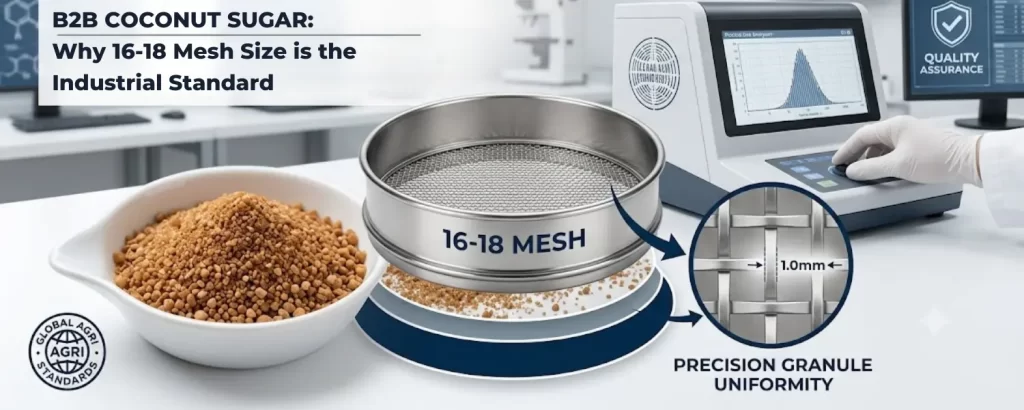
The commercial food and beverage industry is undergoing a massive reformulation. Driven by aggressive consumer demand for functional, low-glycemic, and mineral-rich ingredient alternatives, major brands are rapidly transitioning away from highly refined white cane sugar. At the forefront of this shift is natural coconut sugar. However, retail enthusiasm does not easily translate into industrial application. For Food & Beverage (F&B) formulators, Research & Development (R&D) teams, and global procurement directors, purchasing coconut sugar is not about health trends—it is about exact chemical and physical baselines. In large-scale manufacturing, a sweetener must behave predictably within highly automated mixing systems. In bulk B2B coconut sugar procurement, the primary metric of viability is granulation. Specifically, the global industrial baseline is the 16-18 mesh size. In this guide, we break down why this specific granulation is the non-negotiable standard for commercial formulation and how proper export logistics protect this highly sensitive commodity during ocean freight. Understanding Granulation: What Does “16-18 Mesh” Actually Mean? Before exploring its industrial application, it is critical to define how mesh sizing works in global trade. In industrial powder and granulation metrics, the “mesh size” refers to the number of openings per linear inch of a standardized testing sieve. Therefore, a larger mesh number indicates a finer particle, because there are more (and thus smaller) holes per inch. Conversely, a smaller mesh number indicates a larger, coarser granule. When a B2B Certificate of Analysis (COA) specifies a “16-18 mesh size,” it means the coconut sugar granules have been carefully milled and sifted to pass through a 16-mesh screen (which has openings of approximately 1.19 millimeters) but are retained by an 18-mesh screen (with openings of about 1.00 millimeter). This creates a highly uniform, perfectly consistent particle size that eliminates both ultra-fine powders and overly large, rock-like sugar crystals. Why 16-18 Mesh is the Standard for RTD Beverages The Ready-to-Drink (RTD) beverage market—encompassing everything from cold-brew coffees to functional teas and natural energy drinks—is the largest industrial consumer of bulk coconut sugar. In these commercial applications, the 16-18 mesh size operates as the perfect “Goldilocks” zone for physical chemistry. 1. Optimal Solubility Rates: In automated beverage manufacturing, hundreds of kilograms of sugar are dumped into massive liquid vats. If the sugar granules are too large (e.g., 10-12 mesh), they take too long to dissolve, drastically slowing down the production line and leaving undissolved residue at the bottom of the mixing tanks. The 1.00mm to 1.19mm size of the 16-18 mesh ensures a rapid, uniform dissolution rate, even in cold-liquid formulations. 2. Preventing Equipment Caking: You might assume that an ultra-fine powder (like a 40-mesh confectioner’s sugar) would dissolve fastest. However, in large-scale liquid mixing, ultra-fine powders create “fish-eyes”—clumps where the outside of the powder hydrates and forms a gummy seal, keeping the inside totally dry. Furthermore, fine powders create ambient dust in manufacturing facilities, which can foul automated machinery and create hazardous working conditions. The 16-18 mesh is heavy enough to minimize ambient dust and coarse enough to prevent gummy clumping upon hitting a liquid surface. The Threat of Moisture Ingress: A Hygroscopic Challenge Industrial procurement directors must also consider the physical logistics of moving coconut sugar across the globe. Coconut sugar is inherently hygroscopic, meaning it actively attracts and absorbs moisture from the surrounding air. When exporting a commodity from the tropics across the ocean—often passing through high-humidity maritime zones like the Strait of Malacca or the Suez Canal—this hygroscopic nature becomes a massive supply chain risk. If unrefined coconut sugar absorbs excess moisture during a 30-day sea transit, the 16-18 mesh granules will fuse together. The shipment will arrive at the destination port not as a free-flowing industrial ingredient, but as a solid, unusable brick. To mitigate this, the baseline moisture content of export-grade coconut sugar must be strictly reduced to below 2.0% to 3.0% before packaging. But drying the product is only the first step; keeping it dry during ocean freight requires specialized packaging. Bulk Export Packaging: The 25-Kilogram 3-Ply Kraft Paper Standard You cannot ship industrial coconut sugar in the same standard sacks used for rice or whole coconuts. To maintain the precise 16-18 mesh granulation and block moisture ingress, the global B2B standard requires highly specialized packaging logistics. Export-grade coconut sugar must be packed in 25-kilogram, 3-ply Kraft paper bags. The Outer Structure: The three layers of heavy-duty Kraft paper provide the structural integrity needed to withstand the immense physical pressure of being stacked on pallets inside a 20ft or 40ft shipping container. It prevents punctures and tears during forklift loading. The Inner Poly-Liner: The true protection comes from a food-grade internal polyethylene (PE) liner. This liner is heat-sealed after the 25 kilograms of sugar are filled. The poly-liner acts as an impenetrable barrier against maritime humidity, ensuring that the ambient moisture inside the shipping container cannot reach the hygroscopic sugar. When a B2B buyer specifies this exact packaging on their Request for Quotation (RFQ), it guarantees that the product will remain free-flowing and manufacturing-ready upon arrival. Sourcing Industrial Excellence with Exim Internationals Procuring coconut sugar for commercial manufacturing requires an export partner who understands the intricate chemistry of industrial formulation and the rigorous demands of global maritime logistics. At Exim Internationals, we do not cater to the retail pouch market; we are engineered for bulk B2B procurement. We guarantee a strictly standardized 16-18 mesh size, backed by a comprehensive Certificate of Analysis (COA) confirming microbiological safety, low moisture content, and precise granulation. Packaged in export-standard 25kg 3-ply Kraft bags with sealed inner poly-liners, our coconut sugar arrives at your facility in pristine, free-flowing condition, ready for immediate integration into your production line. Frequently Asked Questions (FAQs) What does a 16-18 mesh size mean in coconut sugar? It refers to the standardized particle size of the sugar granules. A 16-18 mesh means the particles are milled and sifted to be approximately 1.00 millimeter to 1.19 millimeters in size, ensuring perfect uniformity. Why is 16-18 mesh preferred for commercial beverage manufacturing? This specific size
B2B Coconut Sugar Procurement: Why 16-18 Mesh Size is the Industrial Standard Read Post »